Industrialized Turnkey Homes in Spain 2026
Industrialized Turnkey Homes in Spain 2026
Imagine moving into a newly built home that was designed with you in mind, produced in a controlled factory, and delivered on a fixed price and date — without the late surprises typical of traditional builds. This guide breaks down exactly how to design, finance and receive an industrialized turnkey home in Spain in 2026, with practical timelines, material guidance and real case metrics you can act on.
Why choose an industrialized turnkey home in Spain?
Turnkey industrialized housing packages combine factory-controlled production with a complete delivery service: from site assessment to final handover. For the self-builder (autopromotor) this model brings transparency, clearer timelines and predictable budgets.
What 'turnkey' really means and why transparency matters
In a true turnkey model, the provider coordinates design, permits, production, transport, assembly and final commissioning. You receive one contract, one warranty package and one final delivery date. That reduces the typical friction points where traditional projects exceed budgets or timelines.
Key benefits for self-builders: time, cost and predictability
- Shorter on-site duration: assembly measured in weeks, not months.
- Fixed-price contracts: fewer surprises when permits change or subcontractors delay.
- Higher quality control: factory QA reduces on-site defects and rework.
What to expect from an integrated platform like Findnido
A comprehensive platform acts as a single point of contact: it aligns architects, engineers, plant production and on-site teams. For autopromoters in Spain, this means clearer milestones and consolidated documentation for financing and handover.
Advantages versus traditional construction: data and metrics
Data-driven comparisons are essential when deciding between traditional and industrialized routes. Below are measured differences based on multiple turnkey projects completed in Spain between 2022–2025.
Time efficiency: closed schedules and real examples
Average timelines (single-family homes, 120–200 m²):
- Traditional build: 12–20 months (design, permits, structure, finishes).
- Industrialized turnkey: 6–9 months end-to-end; on-site assembly averages 3–6 weeks.
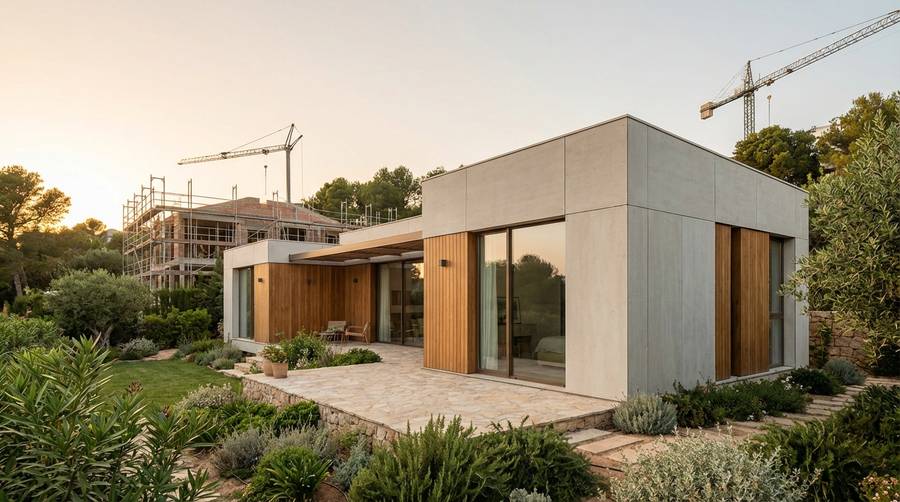
Case example: a 140 m² Mediterranean-style home delivered under turnkey in 7 months with 5-week on-site assembly — client satisfaction score 9/10.
Cost control: fixed budgets, typical deviations and avoidance strategies
Observed cost deviations:
- Traditional: +10–25% over initial budget due to unforeseen site work or subcontractor claims.
- Industrialized turnkey: +0–7% when scope changes occur; fixed-price for production and assembly reduces variability.
How to minimise deviations: agree a clear scope and customisation matrix before signing, reserve a contingency (3–5%), and require documented change orders with cost/time impact.
Quality and comfort: energy performance, finishes and client satisfaction
Industrialized homes tend to outperform on thermal continuity and airtightness due to factory conditions. Typical results:
- Airtightness: 0.3–0.8 ACH (comparable to low-energy standards).
- Energy consumption: 30–60% lower than a comparable conventional build with average insulation.
Client feedback consistently highlights faster delivery, cleaner sites and predictable finish quality.
Factory production reduces variability: consistent components and repeatable QA deliver predictable comfort, lower waste and improved delivery certainty.
Modern materials and systems: an accessible technical guide
Choosing the right structural system affects cost, speed, energy and sustainability. Below we explain three commonly used systems for Spanish industrialized homes.
Industrialized concrete: uses, benefits and ideal applications
Precast and industrialized concrete are ideal for foundations, load-bearing cores and where acoustic performance and thermal inertia are priorities. Benefits include durability, fire resistance and low maintenance.
Recommended when:
- Site conditions demand high thermal mass (cool summers, cold winters).
- High acoustic separation is required (multi-family or busy areas).
Light timber frame: thermal efficiency and sustainability
Lightweight wood framing offers excellent thermal performance and reduced embodied carbon when sourced from certified suppliers. It allows rapid factory production and high levels of airtightness.
Best for single-family homes where speed, embodied carbon reduction and a warm interior finish are priorities.
Steel frame: speed, precision and structural options
Steel frame (steel studs, cold-formed sections) is fast, dimensionally accurate and suitable for larger spans. It fits well when you need open-plan layouts or rapid on-site assembly.
Consider steel when structural spans are large or when logistical constraints demand lighter elements for transport and crane lifting.
Designing and planning your industrialized home step by step
Design and planning are where your decisions lock in budget, timeline and performance. Follow this structured path to reduce uncertainty.
Assessing and valuing the plot: regulations, orientation and studies
- Check local planning rules and allowable footprint/height.
- Prioritise solar orientation and natural ventilation to reduce HVAC loads.
- Order a geotechnical report and topographic survey early — these affect foundation decisions and cost.
Design, permits and administrative management
Work with architects and engineers experienced in industrialized systems. Permit approvals should include factory production drawings as part of the package to avoid later reworks.
Personalisation, materials and production schedule
- Define a customisation matrix with fixed options at contract signing (façade finishes, kitchen level, bathroom packs).
- Plan production slot booking in the plant: production calendars fill months ahead.
- Agree on QA checkpoints and witness points for major milestones (frame, envelope, energy systems).
The turnkey process: from factory to final handover
A reliable turnkey delivery chains together production, logistics and on-site assembly into an executable schedule.
Factory production and quality control: times and guarantees
Production phase typically takes 6–12 weeks depending on complexity. Insist on factory QA reports, material certificates and a production timeline with critical dates.
Transport, assembly and on-site finishing
Coordination is crucial: transport windows, crane lifts and weather windows should be scheduled. On-site assembly for a typical single-family home ranges from 3 to 6 weeks for the main structure, plus 2–8 weeks for finishes depending on access and contractor coordination.
Final reception, commissioning and documentation
At handover, expect a full set of documentation: warranties, energy certificates, as-built drawings and maintenance guides. Hold final payment until these are delivered and any agreed snags are closed.
Financing for self-builders and payment models
Financing an industrialized turnkey home blends elements of construction finance and mortgage products tailored to self-builds.
Mortgage options for autopromoters in Spain: requirements and tips
- Some banks offer staged disbursement mortgages linked to construction milestones; industrialized turnkey models often simplify drawdowns due to shorter schedules.
- Required documentation: plot ownership, turnkey contract, technical project and proof of income.
- Tip: negotiate a contingency buffer in your loan or maintain an independent reserve of 5–7%.
Financial planning: payment milestones and protecting your investment
Common payment structure:
- Deposit on contract signing (10–20%).
- Payment on production start (30–40%).
- Payment on arrival to site / assembly (20–30%).
- Retention on final handover (5–10%) until defects liability period expires.
Grants, energy incentives and carbon reduction supports
Check regional and national incentives for energy-efficient construction and materials with lower embodied carbon. Passive-ready designs often access higher bonus rates or preferential loan terms.
Comparisons, case studies and a final decision checklist
This section gives clear metrics and a practical checklist to make a confident decision.
Case studies with metrics: time, cost and satisfaction
Case A – 140 m² Mediterranean family home
- System: light timber frame
- Turnkey duration: 7 months
- On-site: 5 weeks
- Budget variance: +2%
- Client satisfaction: 9/10
Case B – 180 m² low-energy home
- System: precast concrete core + timber envelope
- Turnkey duration: 9 months
- On-site: 6 weeks
- Budget variance: 0%
- Client satisfaction: 8.8/10
Technical comparison vs competitors: performance and costs
Industrialized turnkey achieves better airtightness and shorter site times. Price per m² can be comparable or slightly lower than high-quality traditional builds when you account for time savings and reduced financing costs.
Practical checklist before you decide
- Have you verified local planning constraints and obtained a geotechnical report?
- Is your turnkey contract fixed price with a clearly defined customisation matrix?
- Do you have a financing plan that covers production milestones and a contingency?
- Are warranties, energy certificates and as-built documentation contractually guaranteed at handover?
- Have you reviewed real project references and, if possible, visited finished homes?
For common pitfalls and how to avoid them, see Vivienda industrializada llave en mano: errores y soluciones for a focused troubleshooting guide.
Decide with confidence and move forward
Industrialized turnkey homes offer a compelling path for self-builders in Spain who want certainty, quality and lower embodied impacts. By choosing the right materials, insisting on clear contracts and following the steps above, you can reduce risk and accelerate delivery without compromising on design or comfort.
If you’re ready to explore options for your plot, start by collecting site reports and shortlisting 2–3 turnkey providers for detailed proposals — compare scope, timelines and warranties to make an informed decision.
If you want, we can prepare a tailored checklist and a short RFP template you can send to suppliers — say the word and we’ll help you get started.