Industrialized Housing: A Turnkey Success Story
From an empty plot to a home: a real family's industrialized housing journey
When the contract arrived after just 14 weeks of factory work, the family sat on the terrace and cried — relief, excitement and disbelief all mixed into one. That moment sums up why they chose industrialized housing: predictable timelines, price certainty and a high-performance home that feels lasting. This case study follows their path from decision to move-in and gives practical lessons for other autopromoters in Spain.
"We wanted certainty: a fixed price, a fast schedule and a house that would cut our energy bills by half. Industrialized housing delivered all three."
The starting point: why the family chose industrialized housing
Initial context: motivations and the autopromoter profile
The clients were a young family of four in their late 30s. Both parents worked full-time and wanted a low-maintenance, thermally comfortable home outside the city. Their priorities were:
- Fixed total cost to avoid budget overruns.
- Short and reliable construction time so they could plan life and school routines.
- High energy efficiency with a Passivhaus-informed target to reduce bills and future-proof the house.
Project objectives: budget, deadlines and sustainability criteria
The family set clear constraints: a maximum total investment, a target move-in date 14 months from contract signing, and a net-zero-ready performance goal. The team agreed on a turnkey industrialized housing approach to meet these objectives.
Outcome summary: key metrics
- Total elapsed time: 15 months from contract to keys in hand.
- Factory fabrication: 14 weeks.
- On-site assembly: 3 weeks for main envelope, 6 weeks for finishes and connections.
- Total cost: within 3% of the initial fixed price (including agreed contingencies).
- User satisfaction: post-move surveys showed 9/10 comfort and 80% reduction in heating consumption vs their previous home.
The challenge: plot limitations and client expectations
Site conditions and Spanish urban requirements
The plot was a suburban corner lot with a modest slope and strict local setbacks. Key urban constraints included maximum height, roof slope rules and permitted footprint. Early site evaluation by the team reduced surprises later and accelerated permit approvals.
Budget constraints and the need for a fixed price
The family needed a contractual price ceiling to secure financing. A turnkey industrialized housing contract provided a fixed total price with clearly defined deliverables, avoiding open-ended change orders common in traditional builds.
Aesthetics and energy ambitions (Passivhaus target)
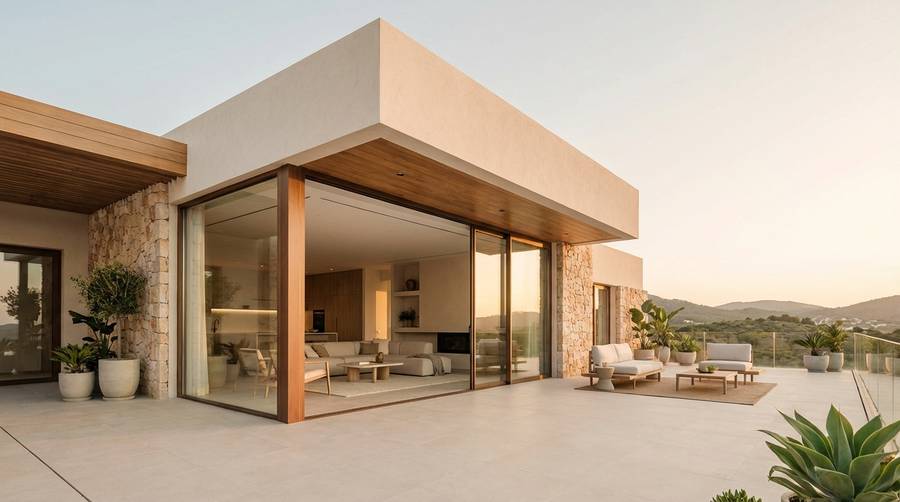
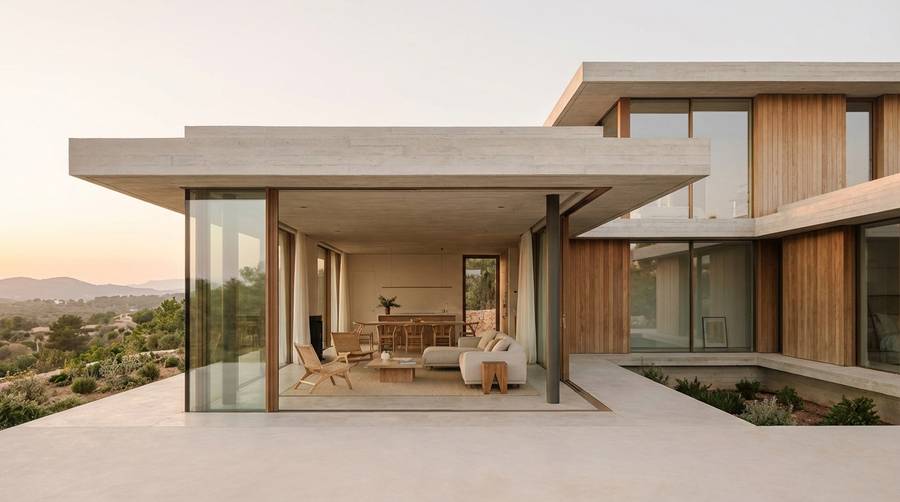
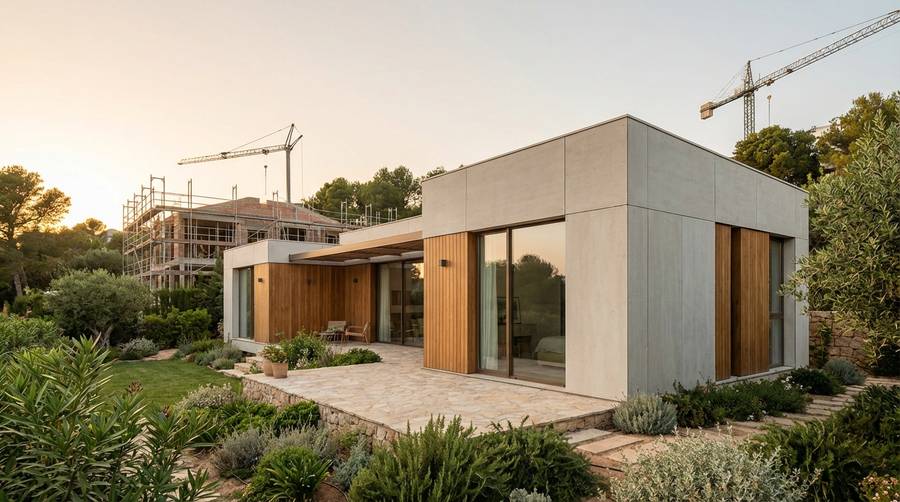
They wanted a Mediterranean, contemporary aesthetic—light façades, wood accents and large windows—while also aiming for a near-Passivhaus level of performance. That required balancing window area and shading, selecting high-performance glazing, and designing a continuous thermal envelope.
Turnkey solution: how the project was designed and executed
Phases of the turnkey service
The project followed five clear phases:
- Site selection and feasibility: zoning check, topography survey and utility availability.
- Design and approvals: architectural and energy design, municipal permits.
- Factory industrialization: panel and module fabrication, quality control.
- On-site assembly: foundation work, envelope installation and connections.
- Finishes and delivery: interior fit-out, commissioning and handover.
Coordination between architecture, industrialization and supply chains
Weekly coordination meetings kept the team aligned. A single digital model (BIM-lite) connected design, factory orders and on-site logistics. This reduced errors and avoided duplicate work. The industrialized approach turned design decisions into precise factory instructions, which meant fewer surprises on site.
Adjustments and communication with the family
Two adaptations occurred during the process: a minor shift in window sizes to improve shading, and adding a small utility room. Both changes were costed and signed off quickly thanks to the transparent contract. The project manager provided biweekly updates with photos and a dashboard showing schedule and budget status.
Materials and technology: technical choices that cut time and carbon
Comparing systems: industrialized concrete vs light timber frame vs steel frame
The design team evaluated three systems by these criteria: speed, thermal performance, embodied carbon and cost predictability.
- Industrialized concrete panels: excellent thermal mass and durability; slightly longer curing needs but very robust acoustic performance.
- Light timber frame (entramado ligero): fast, low embodied carbon and adaptable for high insulation thickness; ideal for tight schedules when factory lines are optimized.
- Steel frame (steel frame): precise and fast, but with higher embodied carbon unless paired with recycled steel and careful detailing.
For this project, the team selected a hybrid approach: structural concrete foundations and ground-floor slab for durability, with a light timber frame upper structure for speed and low embodied carbon. This delivered a balance of longevity, thermal comfort and a reduced carbon footprint.
Energy efficiency solutions: insulation, windows and ventilation
Key measures to approach Passivhaus-level performance included:
- Continuous external insulation: 140–200 mm of high-performance mineral wool and breathable membranes.
- Triple-glazed windows: Uw ≤ 0.9 W/m²K with optimized solar gain.
- Mechanical ventilation with heat recovery (MVHR): 85%+ efficiency to ensure indoor air quality and heat recovery.
These choices cut heating demand dramatically and improved summer comfort through shading design and cross-ventilation strategies.
Impact on carbon footprint and durability
The hybrid choice reduced embodied carbon by an estimated 20% compared to a full steel solution and by roughly 10% vs a fully industrialized concrete envelope. Durability measures—robust window details, ventilated façades and high-quality finishes—were prioritized to lengthen service life and lower life-cycle emissions.
Timeline and real costs: the case metrics
Time breakdown: design, factory and assembly with dates and weeks
- Design and permits: 18 weeks.
- Factory fabrication: 14 weeks (panels, modules, windows).
- On-site assembly: 9 weeks (foundations, mount, finishing and connections).
- Total: 41 weeks (9.5 months) active work; 15 months end-to-end including mortgage and municipal timelines).
Final cost vs initial budget: main items and contingencies
The project closed within 3% of the fixed turnkey price. Major cost lines were:
- Land purchase and legal fees
- Foundations and groundworks
- Factory fabrication and modular components
- On-site assembly and technical connections
- Interior finishes and landscaping
A 5% contingency in the original contract covered two client-requested changes without breaking the budget.
Satisfaction indicators and return on investment
After six months of occupancy, measured outcomes included:
- Heating consumption: reduced by ~80% compared to their previous brick home thanks to high insulation and MVHR.
- Acoustic comfort: positive feedback from the family in an urban-adjacent context.
- Market value: preliminary local appraisals suggest a premium of 5–8% over conventional nearby houses of similar size due to energy performance and shorter construction age.
Financing and paperwork: how the self-build mortgage was handled
Financing options for modular projects in Spain (2026)
By 2026, Spanish banks offer mortgages adapted to autopromotion and modular builds, including staged disbursements aligned with turnkey milestones. The project used a construction-autopromoter mortgage with scheduled draws for design, factory, and final delivery.
Practical process: documentation, valuation and disbursements
Required documents included the turnkey contract, technical project, schedule, and builder guarantees. The bank performed a progressive valuation and released funds in agreed tranches tied to verified milestones. Using a fixed-price turnkey contract simplified the bank's risk assessment.
Tips for autopromoters: strengthen solvency and negotiate better terms
- Prepare a clear turnkey contract with defined milestones and acceptance tests.
- Keep a healthy down payment to improve loan-to-value ratios.
- Negotiate fixed-interest or caps for construction-stage draws to avoid rate volatility.
Lessons learned and recommendations for future autopromoters
What to repeat: choices that saved time and ensured quality
- Choose a turnkey industrialized housing provider with proven factory workflows.
- Use early site surveys to uncover urban constraints before design locks.
- Prioritize a clear communication plan with scheduled updates and photo evidence.
What to avoid: common errors and mitigation
- Avoid vague scope documents—insist on defined deliverables and acceptance criteria.
- Do not under-budget landscaping and connection works; these often create overruns.
- Beware of over-glazing without shading design; it increases summer overheating risk.
Practical first steps: a checklist to start today
Ready to begin? Follow this starter checklist:
- Confirm your plot is buildable: request a certificate of urban planning.
- Define a clear budget ceiling and preferred move-in date.
- Choose a turnkey provider experienced in industrialized housing and request real-case metrics.
- Prepare basic financing documents and speak early to a bank about staged disbursements.
- Read a practical guide: Vivienda industrializada: guía llave en mano 2026.
Final thought: Industrialized housing gave this family predictability, low operational costs and a modern Mediterranean home that blends comfort with sustainability. If you are considering autopromotion, the combination of a turnkey contract, tested materials and clear communication is the most reliable path to success.
If you'd like a practical roadmap tailored to your plot and budget, start by gathering your site documents and contact a specialist to request a feasibility review — small steps now save months later.
Artículos relacionados