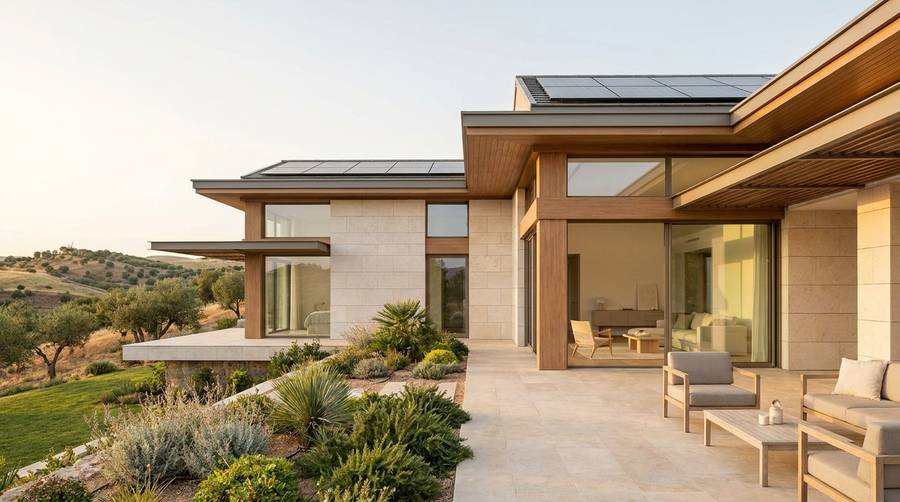
Passivhaus Industrialized Housing in Spain: The Next Decade
Imagine reducing your home's heating needs by 80% while cutting construction time in half — and doing it with a fixed budget. That combination is no longer theoretical: it's the core promise of Passivhaus industrialized housing emerging across Spain. This article maps the evidence, the step-by-step process for autopromoters in 2026, real project metrics and pragmatic financing options that make this future actionable today.
Why Passivhaus projects are shaping the future of industrialized housing in Spain
Sector evidence: recent data on energy savings and rising demand
Measured savings matter. Recent pilot studies in Spain and neighboring EU markets show typical primary energy reductions of 60–90% compared to conventional builds when industrialized methods are paired with Passivhaus standards. National registries and third-party monitoring indicate average space heating demands between 10–15 kWh/m2/year for certified projects built with industrialized envelope components.
Key trends driving demand:
- Rising energy prices that shift buyer preference toward low-operational-cost homes.
- Regulatory pressure: near-zero energy targets push developers to seek reliable compliance routes.
- Market differentiation for builders offering fixed-price, rapid-delivery high-performance homes.
Comparative advantages vs traditional and standard prefabrication
Passivhaus industrialized housing combines three advantages:
- Predictable performance: Off-site manufacturing and factory QA reduce on-site variability that often undermines insulation continuity and airtightness.
- Faster delivery: Controlled production sequences compress timelines — envelope assembly, MEP integration and finishes overlap between factory and on-site works.
- Cost transparency: Industrialized supply chains enable fixed-price contracts with fewer variation risks than traditional builds.
Compared with low-end prefabrication, Passivhaus industrialized solutions invest more in thermal bridging control, continuous insulation and certified ventilation systems — the components that deliver measurable comfort and energy savings.
Implications for developers, builders and autopromoters
For developers: adopting industrialized Passivhaus components reduces long-term energy liabilities and increases asset value through demonstrable energy labels. For builders: the shift requires new QA routines, factory partnerships and skills in airtightness testing. For autopromoters (self-builders): the model offers a way to retain design control while offloading execution risk with a turnkey supplier.
Practical guide: How to design a Passivhaus industrialized home step by step (Spain 2026)
From plot search to handover: milestones in a turnkey workflow
Define feasibility early. A rapid site appraisal should evaluate solar orientation, shading, access and local regulations. Early-stage site decisions drive envelope geometry and mechanical strategies — vital for Passivhaus compliance.
- Feasibility & financing approval: plot purchase options, zoning checks, preliminary budget and lender alignment.
- Concept design & energy target: set the Passive House component targets (heating demand, airtightness, ventilation efficiency).
- Factory design & systems integration: finalize modular panels/frames, window specifications, and MVHR (mechanical ventilation with heat recovery).
- Production & site preparation: simultaneous factory manufacturing and groundwork (foundations, utilities).
- Assembly & commissioning: envelope erection, airtightness testing (Blower Door), commissioning of MVHR and thermal performance verification.
- Handover & monitoring: performance handover package, user manual and optional performance monitoring period.
Material selection: industrialized concrete, timber frame and steel frame under Passivhaus criteria
Material choice should prioritize thermal continuity, durability and embodied carbon reduction. Considerations:
- Industrialized concrete panels: use for thermal mass and airtight core when detailing eliminates thermal bridges. Best where high inertia benefits passive cooling.
- Lightweight timber frame: excels in thermal continuity and low embodied carbon; requires factory-calibrated sealing systems and composite external cladding for durability.
- Steel frame (steel frame systems): ideal for longer spans and open-plan layouts; demands thermal break strategies and high-quality insulation to control bridging.
Hybrid approaches (e.g., concrete plinth + timber upper floors) are often optimal in Spanish climates, balancing comfort, cost and carbon.
Schedule and cost control: planning for fixed-price delivery and tight timelines
To achieve fixed-price delivery and predictable timelines, implement these controls:
- Factory lead-time alignment: lock production slots early with suppliers and include clear penalties/incentives.
- Design-for-manufacturing (DfM): limit bespoke details that extend production time; standardize module footprints and connection details.
- Milestone-based payments: link payments to verifiable milestones (design freeze, production start, airtightness pass).
- Contingency & value engineering: keep a 5–8% contingency and run cost-down exercises before production starts, not after.
Real case studies: three Passivhaus industrialized projects with metrics
Project A: schedule, cost per m2 and measured energy performance
Summary: 140 m2 single-family home in Valencia region, completed 2025 using timber-frame panels manufactured off-site.
- Construction time: 18 weeks from foundation to handover (factory production overlapped with site work).
- Cost: €1,650/m2 delivered turnkey (includes MVHR and high-performance windows).
- Performance: Heating demand measured at 12 kWh/m2/year; airtightness 0.45 ACH@50Pa.
Key lesson: early thermal-bridge detailing saved rework and helped meet airtightness targets on first test.
Project B: carbon footprint, client satisfaction and lessons learned
Summary: 110 m2 family home near Málaga using a hybrid concrete base and timber upper modules.
- Embodied carbon: Life-cycle estimate showed a 22% reduction compared to local conventional masonry builds due to prefabrication efficiencies and timber use.
- Client satisfaction: 9/10 on post-occupancy survey for thermal comfort and acoustic performance.
- Lesson: invest in occupant education for MVHR use — users often underutilized systems, reducing expected energy savings.
Project C: financing pathway, autopromotion process and resale impact
Summary: 160 m2 autopromoted townhouse near Zaragoza financed with a hybrid mortgage and green loan package.
- Financing: 60% traditional mortgage + 20% green credit with favorable rate tied to energy certification.
- Process: turnkey supplier handled design-to-delivery; autopromoter maintained control of external finishes.
- Resale: early market appraisal suggested a 7–12% premium over comparable conventional stock due to low running costs and certified performance.
Measured outcomes, not marketing claims, drive buyer trust. Projects that deliver airtightness and validated energy use outperform on resale and occupant satisfaction.
Technical comparison: Passivhaus industrialized versus market alternatives
Thermal performance, airtightness and real consumption vs commercial promises
Many builders advertise low U-values or ‘high efficiency’ without system-level verification. Passivhaus industrialized projects must deliver:
- Airtightness: typical target ≤0.6 ACH@50Pa; validated by independent Blower Door tests.
- Thermal continuity: detailing to prevent linear thermal bridges at connections and junctions.
- Ventilation efficiency: MVHR systems with 75–90% heat recovery and low specific fan power.
Only when these three are integrated does theoretical performance translate into measured low consumption.
Total costs (construction, maintenance, energy) and payback
Compare lifecycle costs over 30 years, not only upfront price:
- Construction premium: well-executed Passivhaus industrialized homes typically carry a 5–12% upfront premium vs mid-range conventional builds.
- Operational savings: energy savings often repay the premium within 10–18 years depending on energy price trajectories and occupancy patterns.
- Maintenance: fewer thermal-bridge related repairs and predictable factory-installed components reduce unexpected maintenance.
Quality of life and comfort: satisfaction metrics and objective measures
Objective indicators of improved quality of life include more stable indoor temperatures, reduced drafts, and lower humidity fluctuations. Post-occupancy surveys in Spain report higher sleep quality scores and less reliance on active heating, particularly in coastal and transitional climates.
Financing and viability: mortgages for autopromotion and financial models for modular homes
Mortgage options and bank criteria for turnkey industrialized projects
Banks evaluate these projects on predictable delivery, certified performance and borrower experience. Common paths:
- Construction-to-permanent mortgages: disburse in milestones; suitable when supplier provides clear schedule and warranties.
- Green loans and preferential rates: lenders may offer reduced rates for certified low-energy homes; energy labels and third-party verification are required.
- Manufacturer-backed guarantees: factory warranties and performance bonds increase lender confidence.
Return calculation: incentives, energy certifications and operational savings
Include these in your cashflow model:
- Upfront incentives: regional grants for low-energy housing or renewable integration.
- Ongoing savings: modeled energy bills reduced by 60–80% compared with baseline.
- Value uplift: market premiums for certified high-performance homes accelerate payback when resale is likely.
Risk mitigation strategies for autopromoters
Practical measures to reduce risk:
- Fixed-price turnkey contracts with clear scope and penalty clauses.
- Third-party verification for airtightness and energy performance before final payment.
- Insurance and performance bonds covering latent defects and supplier insolvency.
Trends and recommendations: preparing today for industrialized Passivhaus housing of tomorrow
Material and process innovations to watch (2026–2030)
Expect maturation in these areas:
- Low-carbon binders in industrialized concrete to reduce embodied emissions without compromising durability.
- Optimized hybrid assemblies that combine timber, concrete and steel to balance carbon, cost and performance.
- Digital twin commissioning for predictive maintenance and verified post-occupancy performance.
Policy, certifications and customer demand to anticipate
Anticipate stricter energy codes and increased demand for verified performance records. Certification (Passivhaus or equivalent) will increasingly unlock financing advantages and market premiums. For technical guidance on Passivhaus certification and financing, see our detailed resource: Passivhaus en vivienda industrializada: guía completa 2026.
Strategic checklist for developers and autopromoters: critical decisions now
Decisions that materially affect outcomes:
- Select a turnkey supplier with documented airtightness & MVHR test results.
- Prioritize site orientation and simple compact geometry to minimize performance risk.
- Secure production slots and align procurement timelines with financial commitments.
- Plan occupant training for MVHR systems to ensure realized energy savings.
Closing reflection: the social and environmental impact of industrialized Passivhaus housing
Contribution to carbon reduction and more resilient cities
Scaling industrialized Passivhaus homes in Spain can cut operational emissions from housing dramatically while enabling faster delivery of quality housing. When deployed at scale, these homes reduce urban heating demand peaks and contribute to climate resilience.
Accessibility, housing quality and social cohesion
Lower running costs increase housing affordability over time. Coupled with rapid construction, the model can expand access to quality housing for diverse households — if policy and financing structures support equitable deployment.
Becoming an informed, responsible autopromoter
Start with measurable commitments: require airtightness targets in contracts, demand third-party verification and choose suppliers who provide transparent lifecycle data. These steps protect your investment and amplify social benefits.
Ready to move from interest to action? If you're evaluating a plot or need a reliable turnkey partner, begin with a site feasibility audit that includes orientation, shading and a production-slot check with a certified supplier. Small early choices determine whether your project becomes a flagship of resilient, low-carbon housing — or a learning case with costly rework. Contact a specialist advisor or request documented performance results from potential suppliers before signing.