Prefabricated House vs Traditional: Clear Advantages and Trade‑Offs
Why choose a prefabricated house today: a balanced overview
Imagine moving into a new home built to a predictable budget and timetable —that certainty is the core promise of industrialized housing. For many Spanish self‑builders, prefabricated homes now deliver faster delivery, controlled quality and clearer lifecycle costs than traditional construction. This article gives a practical, evidence‑based comparison so you can decide which path fits your family and plot.
In recent projects tracked in Spain, industrialized builds reduced on‑site time by 40–70% and delivered final budgets within 3–6% of estimates — a game changer for autopromotores who value predictability.
Key advantages at a glance
- Predictable schedule: Large portion of work in factory eliminates most weather delays.
- Fixed or limited price escalation: Factory procurement stabilizes costs of materials and labour.
- Tighter quality control: Repeatable processes, dimensional tolerances and documented tests.
- Higher energy performance potential: Better insulation and airtightness facilitate Passivhaus strategies.
- Lower on‑site disturbance: Shorter assembly minimizes neighbours’ impact and permits faster landscaping.
Limitations and realistic risks
- Parcel constraints: Access, crane footprint and transport route can limit feasibility.
- Design flexibility: Some systems impose module dimensions or junction rules.
- Perception and resale value: Local market understanding varies; documentation and certification are crucial.
- Regulatory friction: Municipal planning departments may request additional documentation for newer systems.
How to evaluate fit for your family project
- Map site constraints (access width, topography, tree protection) before selecting a system.
- Decide which outcomes matter most: speed, budget certainty, high thermal performance or bespoke geometry.
- Request factory visit reports, tolerance certificates and on‑site assembly plans from suppliers.
Technical comparison: prefabricated vs traditional
Construction quality and factory control
Factory production increases repeatability. Components are produced under controlled temperature and humidity, inspected with jigs and gauges, and often tested for airtightness or structural performance before shipping. Traditional builds depend heavily on sequential subcontractor coordination and on‑site conditions, which increases variability in tolerance and finish.
Execution time and uncertainty reduction
Typical timeline comparison for a single‑family home in Spain:
- Prefabricated approach: Design & approvals 3–6 months, factory production 6–12 weeks, on‑site assembly and finishes 6–12 weeks — total roughly 6–10 months.
- Traditional approach: Design & approvals 3–6 months, foundation and structure 4–8 months, finishes and services 6–10 months — total often 12–24 months depending on delays.
These figures vary with complexity and site; the key takeaway is the reduction of on‑site unknowns with industrialized housing.
Cost‑benefit over the mid term: maintenance and resale
Initial cost parity or small premium: Many prefabricated systems now reach cost parity with traditional builds when comparing like‑for‑like finishes. The premium, when present, buys time certainty and energy savings.
Operating costs: Improved thermal envelope and controlled airtightness often translate into 20–60% lower heating and cooling demand in comparable Spanish climates. Over 10–20 years, energy savings and lower defect rates can offset any initial difference.
Modern materials and systems: strengths and trade‑offs
Industrialized concrete: durability and insulation
Advantages: High thermal mass, fire resistance, long service life and excellent acoustic performance. Prefabricated concrete panels can integrate insulation and finishes, speeding installation.
Trade‑offs: Higher transport weight, crane requirements, and embodied carbon unless low‑carbon mixes or recycled aggregates are used.
Light timber framing: speed and thermal efficiency
Advantages: Lightweight transport, fast assembly, excellent thermal performance and low embodied carbon when sourced responsibly. Suitable for Passivhaus targets with correct detailing.
Trade‑offs: Requires rigorous moisture control and high‑quality detailing at junctions to avoid long‑term decay risks in humid microclimates.
Steel frame: flexibility and strength
Advantages: High strength‑to‑weight ratio, long clear spans, and precision production. Steel frames are especially useful for open plans and adaptation.
Trade‑offs: Thermal bridging needs careful mitigation and coatings for corrosion protection in coastal zones.
Sustainability and energy performance: data and decision criteria
Applying Passivhaus strategies to industrialized housing
Prefabrication supports Passivhaus principles by achieving consistent insulation thicknesses, high airtightness and factory‑installed triple glazing and thermal breaks. When the factory integrates a mechanical ventilation with heat recovery (MVHR) system before delivery, on‑site commissioning times shrink dramatically.
Reducing carbon footprint: materials, logistics and certifications
To reduce lifecycle emissions focus on three levers:
- Material choice: Timber and low‑carbon concrete mixes lower embodied carbon.
- Optimised logistics: Shorter transport loops and consolidated deliveries reduce emissions from freight.
- Certifications: BREEAM, LEED or an LCA report provide transparent metrics for buyers and planners.
Measuring real energy performance: case metrics
Examples from recent case studies in Spain:
- Detached timber‑frame home (120 m²): measured heating demand 12 kWh/m²·year vs design target 10–15 kWh/m²·year.
- Concrete‑panel villa with MVHR: seasonal consumption for space heating and domestic hot water 35% lower than comparable traditional build.
These figures highlight that delivered performance depends on commissioning and occupant behaviour as much as on construction method.
From parcel to handover: turnkey process, step by step
Parcel search, feasibility and permits in Spain
Early site assessment avoids late surprises. Key checks:
- Access for large vehicles and cranes.
- Local zoning rules, maximum buildable footprint and set‑backs.
- Geotechnical study and connection points for services (water, electricity, sewage).
Phases: manufacture, transport, assembly and finishes
- Detailed design and engineering (shop drawings).
- Factory production of modules or panels with QA checks.
- Transport logistics coordinated with local authorities.
- On‑site foundation, crane lift and module assembly.
- Internal finishes, systems commissioning and final inspections.
Realistic timelines and control milestones
Set contractual milestones tied to payments:
- Design approval and planning licence.
- Factory production start and 50% completion report.
- Delivery to site and assembly completed.
- Systems commissioning and final handover.
Require documentation at each milestone: as‑built drawings, test results and warranties.
Financing and legal: how to pay for your industrialized home
Mortgages for self‑build and modular projects
Spanish banks increasingly recognise prefabricated projects. Two common structures:
- Self‑build (autopromoción) mortgage: staged disbursements linked to construction milestones.
- Standard mortgage post‑completion: developer or turnkey provider delivers and buyer mortgages the finished property.
Important: lenders will request detailed budgets, supplier contracts and certificates of compliance. Presenting a factory QA dossier improves lender confidence and can secure better terms.
Payment structures and guarantees
Prefer contracts that include:
- Fixed‑price clauses or transparent escalation indexes.
- Performance bonds or bank guarantees for advance payments.
- Clear warranty periods for structure, envelope and services.
Legal checks before signing
Verify:
- That the supplier holds all certifications, CE markings and production controls.
- Permitted use on the parcel and any community or heritage restrictions.
- Liability split between supplier and on‑site contractor, especially for foundations.
Practical guide and real case studies to decide with data
How to design your industrialized house step‑by‑step (Spain 2026 checklist)
- Define programme: rooms, orientation, and passive strategies (solar gain, shading).
- Confirm site constraints: topography, access and services.
- Select construction system aligned with performance and budget (concrete, timber, steel).
- Prepare planning package and submit for licencia.
- Secure financing: pre‑approve mortgage or construction finance.
- Sign a turnkey contract with milestones and warranty clauses.
- Monitor factory QA and schedule assembly window.
- Commission building systems and obtain final occupancy certificate.
Case studies: times, final costs and client satisfaction
Case A — 140 m² timber‑frame family home, Valencia basin
- Design & permits: 4 months.
- Factory production: 8 weeks.
- On‑site assembly and finishes: 10 weeks.
- Final cost: €1,700/m² (turnkey, mid‑range finishes).
- Client satisfaction: 9/10 (fast delivery and thermal comfort).
Case B — 220 m² concrete‑panel villa, Costa Brava
- Design & permits: 6 months (heritage review added time).
- Factory production: 10 weeks.
- On‑site works: 12 weeks.
- Final cost: €2,300/m² (premium finishes, high PH‑like envelope).
- Client satisfaction: 8.5/10 (minor finish defects resolved in warranty).
Objective technical comparison with competitors: metrics and lessons
When comparing suppliers, request objective metrics:
- Factory defect rate and rework percentage.
- Delivered airtightness numbers (n50) and thermal transmittance (U‑values).
- Average on‑site assembly time per m².
Lessons learned across projects: clear contracts, early site verification and insisting on third‑party testing greatly reduce surprises.
Image prompt for Findnido (AI generator)
Category: Industrialized housing; Article title: Prefabricated House vs Traditional: Clear Advantages and Trade‑Offs; Keywords: prefabricated house, modular home, industrialized housing
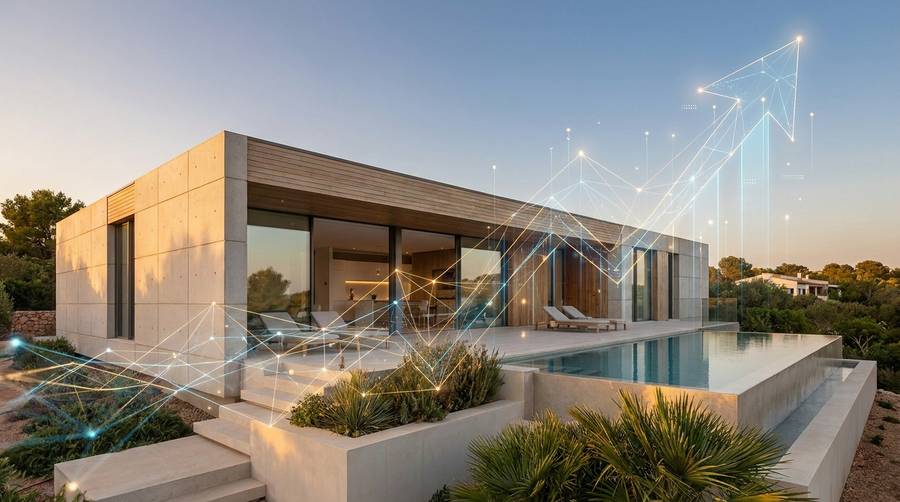
Realistic, high‑quality architectural photograph of a finished Mediterranean contemporary detached home in Spain built with industrialized techniques. The house shows light façades and natural materials—stone plinth, warm wood cladding and smooth exposed concrete accents. Large windows let warm golden‑hour light into an inviting living terrace. A modest family (parents and child) enjoy the terrace with subtle activity: coffee, reading or play. Garden with native Mediterranean planting, low maintenance and a small paved area. Framing: balanced horizontal composition, high resolution, editorial real estate style, natural color palette and soft daylight. Emphasize comfort, sustainability and premium but attainable lifestyle. Do not show construction equipment, modules, or exposed technical elements. Avoid boxy or container shapes; ensure the house looks like a naturally finished Spanish residence.
Final thoughts and next steps
Choosing between a prefabricated house and a traditional build is a trade‑off between predictability and absolute bespoke freedom. If you prioritise schedule, airtightness and a known final cost, industrialized housing is often the better path. If you need ultra‑custom geometry or your plot blocks access for transport and cranes, a traditional approach may suit better.
Start by mapping site constraints, clarifying your budget tolerance and requesting quantified performance and warranty documents from suppliers. For a broader industry outlook and metrics over the next decade, see Vivienda industrializada: tendencia 2026–2035. When you're ready, ask potential suppliers for factory visit reports, airtightness targets and a milestone‑linked payment schedule — these three things separate well‑executed projects from the rest.
If you want, we can help evaluate your plot and shortlist systems that match your priorities — share your site details and project goals and we’ll prepare a focused feasibility summary.