Passivhaus Industrialized Homes: Complete Guide 2026
Start here: why a Passivhaus industrialized home makes sense
Imagine arriving to a house that stays cozy in winter and cool in summer while costs and uncertainty stay under control. This guide explains, with concrete steps and measurable metrics, how to design and deliver a Passivhaus-quality industrialized home in Spain using modern systems, factory-controlled quality and a turnkey approach.
Passivhaus industrialized projects commonly cut operational energy by 75–90% compared to standard builds while reducing on-site time by 40–70%—if planned and executed correctly.
Guía esencial: why choose Passivhaus for industrialized housing
Key benefits: comfort, energy savings and carbon reduction
Comfort. Passivhaus guarantees steady indoor temperatures and high air quality through rigorous insulation, airtightness and mechanical ventilation with heat recovery (MVHR).
Energy savings. Expect primary energy demand and heating demand to drop substantially—real-world industrialized Passivhaus homes in Spain report heating needs well below 15 kWh/m²·year.
Carbon reduction. Lower operational emissions are the main driver. When combined with low-carbon materials and efficient construction logistics, lifecycle emissions fall significantly.
Advantages versus traditional construction: closed timelines, fixed price and quality control
- Factory control: components produced under controlled conditions reduce variability and defects.
- Shorter on-site time: panels and modules allow rapid assembly—reducing weather delays and neighborhood disruption.
- Fixed-price contracts: many manufacturers offer firm prices for defined scopes, lowering financial uncertainty.
How Passivhaus fits an industrialized, turnkey model
Passivhaus requirements—continuous insulation, air-tight details, thermal bridge-free design—are well-suited to off-site fabrication. Factory precision makes it easier to achieve the airtightness (n50) and construction tolerances Passivhaus demands, simplifying certification at delivery.
Materials and systems recommended for Passivhaus projects
Comparing systems: precast concrete, timber frame and steel frame
Precast concrete: excellent thermal mass and durability; best for zones with high thermal inertia needs. Factory-cast insulated sandwich panels speed assembly but need careful detailing at joints to maintain airtightness.
Timber frame (lightweight): high thermal performance per weight and low embodied carbon. Prefabricated panels achieve fast n50 values; wood permits flexible interior finishes.
Steel frame: structurally efficient for longer spans and open plans. Thermal breaks and continuous insulation are essential to avoid cold bridges.
Envelope solutions, airtightness and thermal bridge strategies
- Continuous external insulation through factory-applied cladding systems or insulated panels.
- Airtightness layers integrated into panel assemblies with tested joints—use tapes and factory-bonded membranes to reduce on-site sealing work.
- Thermal bridge mapping in early design—resolve bridge-prone details (balconies, foundations, window heads) in the factory detail package.
Sustainable finishes and low-carbon material selection
Select finishes that balance performance, durability and embodied carbon: sustainably sourced timber, low-carbon concrete mixes, recycled insulation options and water-based finishes. Prioritise materials with EPDs (Environmental Product Declarations) for credible lifecycle comparisons.
Step-by-step process: from plot to turnkey delivery
Phase 0: choose your plot, check urban viability and Passivhaus prerequisites
- Location assessment: orientation, shading, microclimate and access for transportation.
- Regulatory check: local urban plan constraints, buildable area, maximum heights and required setbacks.
- Passivhaus prerequisites: simulate solar gains and ventilation needs early; large south façades help but good design adapts to most plots.
Design and manufacturing: architectural design, factory quality control and logistics
Develop a coordinated package: architectural plans, thermal model, airtightness strategy and a modular panel schedule. Use a manufacturer with proven factory QA processes: dimensional control, joint testing and pre-installed services reduce site risk.
Tip: freeze major decisions before fabrication—late changes are costly and risky.
Assembly, on-site adjustments and Passivhaus certification
- Assembly: typically 2–10 weeks on site for a single-family home depending on size and system.
- Commissioning: MVHR balancing, blower door testing and thermal imaging to confirm performance.
- Certification: arrange a PHPP model and pre-certification checks; final certification follows blower door and verification tests.
Financing options for Spanish self-builders using modular solutions
Self-build mortgages and finance structures for industrialized housing
Banks increasingly recognise factory-built projects. Finance options include staged drawdown mortgages linked to manufacturing milestones, construction loans adapted to prefab schedules, and specialised autopromotor mortgages. Present a clear timeline, contract with manufacturer and supplier guarantees to get better terms.
Fixed budgets, financial risks and how to present your project to lenders
- Provide a fixed-price contract or capped budget from a reputable manufacturer.
- Show logistics and delivery plan to reassure lenders about completion risk.
- Include evidence of past projects or references when possible.
Grants, incentives and eligibility for energy-efficiency funding
Spain and EU programs offer incentives for deep energy renovations and new highly efficient homes. Passivhaus projects often qualify for higher-support bands—compile technical files (PHPP, U-values, airtightness targets) early to secure subsidies.
Passivhaus case studies: measurable examples
House A — timber frame example: manufacturing time, cost/m² and measured savings
Case summary: a 120 m² timber-frame Passivhaus built in 2024 near Valencia. Factory production: 5 weeks of panel fabrication; on-site assembly: 6 weeks. Final airtightness: n50 = 0.35 h-1. Initial build cost: €1,700/m² (turnkey). Measured heating consumption first year: 8 kWh/m²·year. Owner satisfaction: high—minimal maintenance and steady comfort reported.
House B — precast concrete example: thermal performance and client feedback
Case summary: 180 m² precast insulated panels near Málaga. Production took 7 weeks; assembly 4 weeks. Airtightness tested at n50 = 0.45 h-1 after onsite sealing. Measured summer comfort improved thanks to thermal mass; heating demand under 12 kWh/m²·year. Client highlighted short on-site disruption and clear schedule as decisive factors.
Lessons learned: typical issues and proven solutions
- Logistics mismatches: align road permits and crane access in advance to avoid delays.
- Service coordination: pre-fit service routes in panels to reduce on-site plumbing/electrical rework.
- Quality of joints: insist on factory joint testing and onsite blower-door follow-up.
Technical comparison: Passivhaus industrialized vs traditional builds and competitors
Key indicators: energy demand, airtightness (n50) and lifecycle cost
Typical indicators:
- Energy demand: Passivhaus industrialized: heating <15 kWh/m²·year; traditional new build: often 40–80 kWh/m²·year.
- Airtightness: industrialized homes commonly achieve n50 ≤ 0.6 h-1 with correct detailing; traditional builds vary widely.
- Lifecycle cost: slightly higher initial cost can be offset by 50–70% lower energy bills and lower maintenance depending on materials.
Construction and logistical advantages: speed, quality control and waste reduction
Off-site production reduces material waste, improves finishing quality and shortens disruptive on-site periods. This is especially valuable in dense suburban areas or where weather could delay traditional sequential trades.
How to compare proposals from different manufacturers fairly
- Request comparable scopes: finished floor area, envelope U-values, airtightness targets and MVHR performance.
- Ask for references with measured energy results, not just modeled numbers.
- Compare warranty scope, transport and assembly responsibilities, and what is included in turnkey price.
How to start your Passivhaus industrialized project in Spain: next steps
Initial checklist for self-builders: documents, team and indicative budget
- Plot deed, topographic and geotechnical report.
- Basic budget with a manufacturer’s preliminary quotation.
- Engage an architect/PH consultant early to run PHPP preliminaries.
Choosing a technical team and a Passivhaus-capable manufacturer
Select teams with proven Passivhaus projects and factory QA processes. Look for manufacturers that publish airtightness results and have clear logistics plans. Meet the assembly crew and visit a finished project if possible.
Resources, certifications and turnkey services to progress safely
Key resources: PHPP modeling by a certified consultant, blower-door test providers, and MVHR commissioning specialists. Seek turnkey offers that include final certification support and a clear snagging period.
Image prompt for Findnido (featured image)
AI image generator description (Findnido brand style)
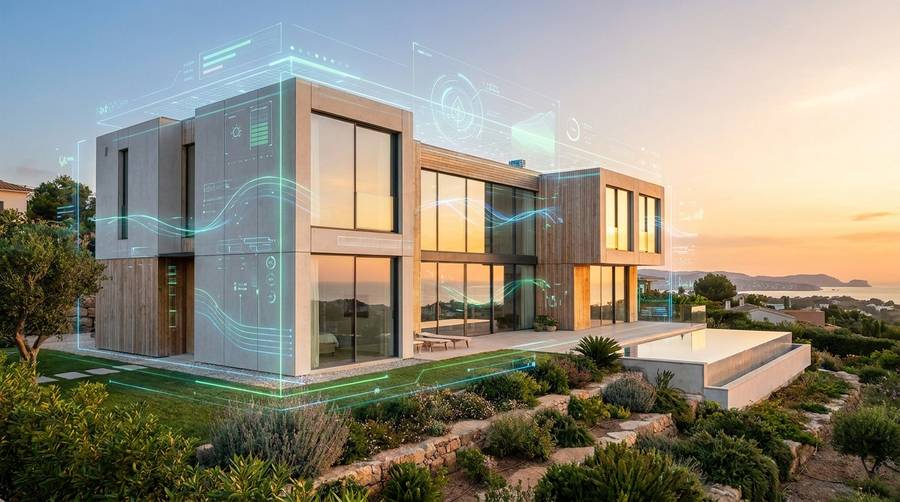
High-quality real-estate style photograph of a finished Mediterranean contemporary single-family home in Spain that embodies industrialized Passivhaus design. The house shows light façades combining fine concrete, natural wood cladding and local stone accents. Large strategically placed windows bathe interiors in warm golden-hour light. Foreground: a landscaped terrace with Mediterranean plants and comfortable outdoor furniture suggesting family living. Background: a residential Spanish landscape with low-rise homes and soft hills. The scene conveys trust, comfort and sustainable modern living—no exposed construction, no modular boxes, no industrial equipment. Realistic textures, balanced framing and warm, natural colors consistent with Findnido’s premium, aspirational brand identity.
Ready to take the next step? Start by compiling your plot documents and requesting a PHPP pre-assessment from a certified consultant—this single step clarifies viability and costs and positions you to secure finance and a reliable manufacturer. If you’d like, I can produce a one-page checklist tailored to your plot and budget to help you talk to banks and builders with confidence.