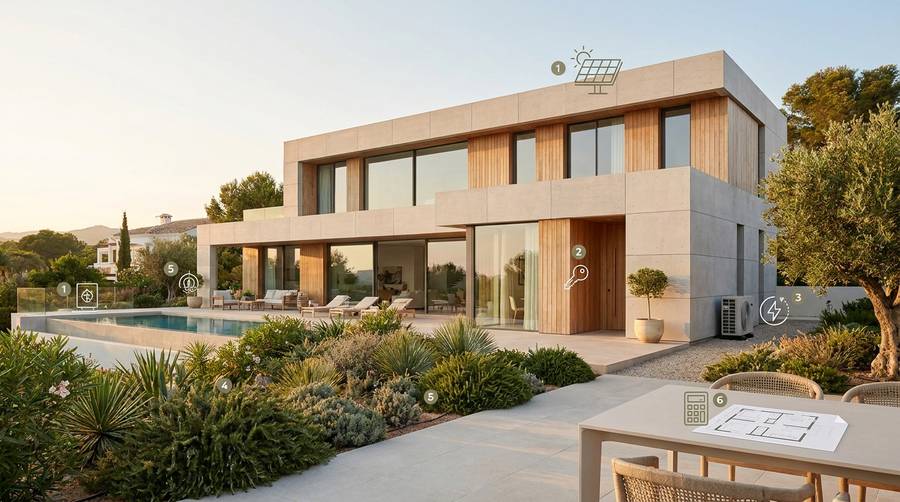
Net-zero homes Spain: Industrialized housing for 2026
Imagine stepping into a new Mediterranean home that consistently uses near-zero energy, was delivered on a fixed price and in months rather than years, and increases its resale value while cutting carbon emissions. That is the practical promise of industrialized net-zero housing in Spain — and this article explains how autopromoters can turn that promise into predictable outcomes in 2026–2030.
Why net-zero homes are the new standard for housing in Spain
Context: energy transition, regulation and autopromoter demand in 2026
Spain's building regulations and climate targets have tightened significantly since 2020. Municipalities increasingly require near-zero energy performance for new builds, and EU directives push life-cycle carbon accounting into project appraisals. At the same time, a growing segment of Spanish autopromoters—families and small developers building for self-use or sale—are choosing industrialized housing because it aligns with these rules while reducing schedule and budget risk.
Benefits for homeowners: energy savings, comfort and asset appreciation
Net-zero homes deliver three measurable benefits:
- Operational savings: Typical well-designed net-zero single-family homes in Mediterranean climates cut annual heating and cooling energy demand by 60–90% compared with baseline new-builds.
- Improved indoor comfort: Continuous ventilation, better envelope performance and thermal inertia reduce temperature swings and improve perceived comfort.
- Resale and asset value: Buyers increasingly pay premiums for verified low-energy homes; early adopters in Spain report faster sales and higher per-m2 values in market tests.
Sector impact: industrialization accelerates climate goals
Industrialized construction standardizes details that most on-site projects struggle to execute consistently. That predictability enables real reductions in operational emissions at scale. With factory QA and repeatable processes, manufacturers can optimize material use and reduce waste — a necessary lever if Spain is to meet decarbonization targets for the built environment.
Industrialized net-zero housing is not an experimental niche: it's a scaling mechanism that makes high-quality, low-carbon homes reproducible and bankable.
Market and technology trends shaping 2026–2030
Industrialization growth: production data, delivery times and market share
Production in Spain's industrialized housing sector is growing at a double-digit annual rate driven by demand from self-builders and small developers. Typical lead times for a turnkey industrialized house: design and permits 3–6 months, factory production 6–10 weeks, on-site assembly 2–6 weeks — meaning occupancy in under a year from permit in many cases. Market share remains modest but rising, especially in peri-urban and rural plots suited to single-family homes.
Digital design and integrated manufacturing: BIM, automation and QA
BIM-based workflows and CNC manufacturing are now standard in advanced factories. That reduces coordination errors, allows precise prefabrication of envelope components, and integrates MEP (mechanical, electrical, plumbing) systems into panels. For autopromoters, the result is fewer surprises at handover and clearer warranties tied to factory-tested assemblies.
Emerging business models: turnkey platforms and standardized packages
New players offer packaged delivery: plot scouting, permit support, turnkey design, factory build and financing facilitation. These platforms reduce friction for autopromoters who want a single point of responsibility. Pricing models vary from fixed-price turnkey to modular packages where clients choose levels of customization.
Materials and systems that define a net-zero house
Technical comparison: industrialized concrete vs light timber frame vs steel frame
Choosing a structural system affects cost, speed, carbon and thermal behavior. Summary comparison:
- Industrialized concrete: Higher embodied carbon but excellent thermal mass and fire performance. Often used for ground floors and urban contexts. Faster with precast panels and slabs.
- Light timber frame: Low embodied carbon, fast factory assembly, excellent thermal performance when combined with high-quality insulation. Ideal for Mediterranean single-family homes where a warm aesthetic is desired.
- Steel frame: High strength-to-weight ratio, precise tolerances and good for larger spans. Embodied carbon depends on recycled steel content and detailing to avoid thermal bridges.
Practical recommendation: For many autopromoters in Spain seeking net-zero performance with Mediterranean aesthetics, a hybrid solution (timber frame envelope with concrete ground elements) balances carbon, cost and comfort.
Insulation and the building envelope: reducing demand with Passivhaus criteria
To reach net-zero in Spain's climate, focus on three envelope priorities:
- Continuous insulation: Avoid thermal bridges with factory-built insulated panels and taped joints.
- High-performance glazing: Use double- or triple-glazed units with warm edge spacers and solar control coatings where appropriate.
- Airtightness and controlled ventilation: Achieve low infiltration rates and pair with mechanical ventilation with heat recovery (MVHR) sized to Passivhaus or equivalent targets.
Life-cycle sustainability: material carbon footprints and offset strategies
Measure embodied carbon early. Use Environmental Product Declarations (EPDs) and favor locally sourced materials to reduce transport emissions. Where embodied carbon remains significant, implement these strategies:
- Design for material efficiency and reuse
- Choose low-carbon alternatives (engineered wood, recycled steel)
- Invest in verified carbon reduction projects or nature-based offsets as a last resort
Design, certifications and metrics that guarantee real performance
From simulation to reality: on-site verification of demand and consumption
Simulations are useful, but verification is essential. Best practice includes:
- Pre-occupancy blower-door and thermal imaging tests
- Commissioning of HVAC and renewables with performance reports
- Post-occupancy monitoring for 12–24 months to compare actual consumption with models
Documenting outcomes builds credibility and supports resale premiums.
Relevant certifications: Passivhaus, PHI Low Energy and Spanish green labels
Passivhaus is a rigorous benchmark for energy demand; PHI Low Energy is useful for flexible designs. Spanish certificates and local seals (energy efficiency class, local sustainability badges) are increasingly influential for permitting and financing. Choosing the right certification depends on budget, goals and market expectations.
Key indicators to measure: primary energy, thermal performance and acoustic comfort
Track these KPIs:
- Annual primary energy demand (kWh/m2/year)
- Envelope U-values and measured airtightness (ACH @50Pa)
- Thermal comfort hours and acoustic ratings for typical living spaces
Practical financing and the turnkey process for autopromoters
How mortgages and financing for modular self-build work in Spain
Spanish banks increasingly offer specific products for self-build and industrialized homes. Typical structures include staged disbursements tied to milestones (land purchase, factory start, assembly, handover) and blended rates that differ from standard mortgages. Important practical points:
- Get pre-approval with a detailed turnkey quote to secure staged financing.
- Use banks experienced with prefabrication to avoid valuation issues at loan appraisal.
- Explore green loan discounts if the project achieves recognized certifications.
Turnkey stages: from plot search to delivery
A replicable turnkey path looks like this:
- Plot selection and feasibility study (3–8 weeks)
- Design and permits (3–6 months; faster if standardized packages are used)
- Factory production (6–10 weeks)
- On-site assembly and commissioning (2–6 weeks)
- Handover, warranties and post-occupancy monitoring
Risks and guarantees: fixed schedules, fixed price and contractual clarity
Key contractual protections autopromoters should demand:
- Fixed-price turnkey contracts with defined scope and change-order rules
- Clear warranty terms for factory components and on-site works
- Penalties or remedies for missed completion dates
Case studies: net-zero industrialized homes with real metrics
Case 1 — Mediterranean single-family house: timelines, cost/m2 and client satisfaction
Project overview: 140 m² single-family home, timber frame envelope, MVHR and 6 kW PV array.
- Design & permits: 4 months
- Factory production: 8 weeks
- Assembly & commissioning: 3 weeks
- Delivered cost: €1,600/m2 turnkey (including plot works)
- Measured primary energy: 22 kWh/m2/year
- Client satisfaction: 9/10 on delivery predictability and comfort
Lessons: early integration of MEP in factory panels reduced on-site surprises and supported the low measured consumption.
Case 2 — Small-scale development: emissions and operational savings vs traditional build
Overview: 8-unit low-rise development using hybrid concrete foundations and light timber frames.
- Embodied carbon reduction vs conventional cast-in-place concrete: ~30%
- Construction time reduction: 40% faster to practical completion
- Operational energy saving: 65% lower heating/cooling demand
Result: faster market absorption and stronger environmental credentials that supported green financing for the promoter.
Lessons learned: common problems and best practices for autopromoters
Common issues and mitigations:
- Permit delays: Start feasibility and permitting early; use standardized packages where possible.
- Site access constraints: Verify logistics for transporting panels and cranes before contract signature.
- Performance gap: Require commissioning and a 12-month monitoring plan in the contract.
Strategic recommendations for autopromoters in 2026
Key decisions: system, certification and industrial partner
Choose the structural system that aligns with climate goals, budget and aesthetics. Prioritize partners with demonstrated QA and traceable EPDs. If resale or financing matters, target a recognized certification such as Passivhaus or a Spanish green seal.
Practical roadmap: priority steps from plot to occupancy
Recommended 12–18 month roadmap:
- Feasibility and financing pre-approval
- Plot surveys, geotechnical study and planning check
- Select turnkey package and sign fixed-price contract
- Factory production while permits are finalized
- Assembly, commissioning and post-occupancy monitoring
Scaling opportunities: how industrialization enables sustainable, profitable projects
Industrialized housing allows promoters to replicate successful designs, reduce per-unit costs through learning curves, and access green financing more easily when performance is documented. For developers targeting small-scale multi-unit projects, standardization of façade and service cores unlocks both time and carbon savings.
For practical guidance on choosing industrialized housing and the main advantages over traditional construction, see Vivienda industrializada: 6 razones para elegirla en España which outlines six reasons autopromoters prefer this route.
Final perspective: Industrialized net-zero homes are now a viable, often preferable path for autopromoters in Spain. They offer predictable schedules, clearer budgets and verifiable performance — all essential to scale low-carbon housing in the next decade. If you're planning a self-build or small development, prioritize early integration of design, certification and financing to convert ambition into delivered performance.
Ready to evaluate a turnkey net-zero option for your plot? Start by gathering your plot details and a simple brief — the right industrial partner will turn that into a fixed-price delivery plan you can trust.