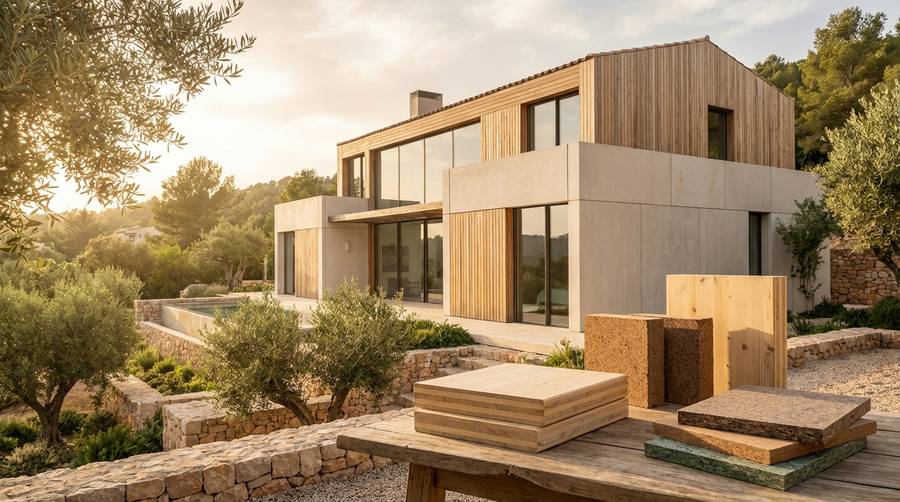
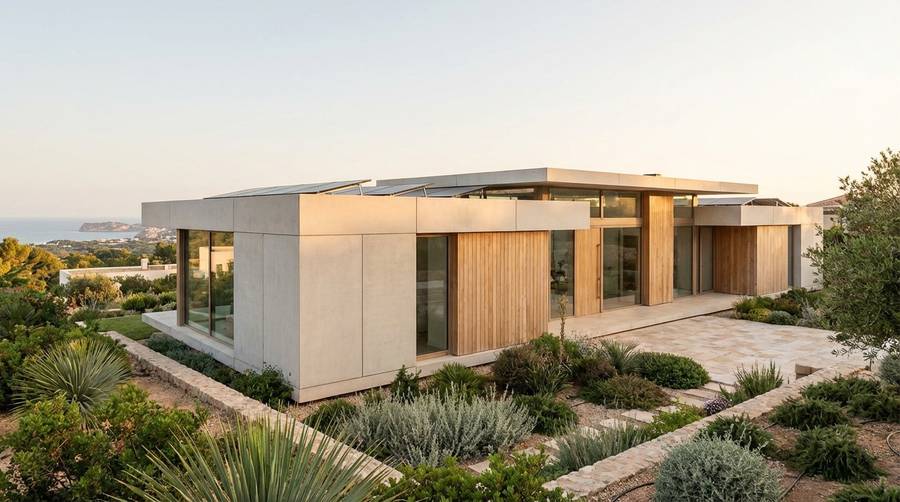
Industrialized Housing: Prefabricated Homes in Spain 2026
Spain stands at a pivot point where industrialized housing moves from niche to mainstream. Developers, banks and families now measure value not only by price per square meter but by predictability, carbon footprint and delivery time. This article dissects the forces shaping prefabricated homes in Spain for 2026–2030 and gives actionable guidance for autopromotores seeking a turnkey modular home.
Why sustainable prefabricated homes will dominate construction in Spain
Current market landscape (data 2023–2025 and 2026–2030 projections)
Between 2023 and 2025, Spain recorded a steady rise in modular permits and factory-built dwellings driven by labor shortages and rising regulatory pressure to reduce embodied carbon. Market studies show modular market share moving from low single digits toward 10–18% of new single-family starts by 2030 in regions with supportive regulation.
Key drivers:
- Shorter site time reducing labor dependency and calendar risk.
- Better cost certainty through fixed-price factory contracts.
- Increasing municipal support for energy-efficient, low-carbon housing.
Advantages versus traditional on-site construction: efficiency, closed schedules and fixed price
Prefabricated homes consistently outperform traditional builds on three measurable dimensions:
- Schedule reliability: Factory workflows decouple weather and site delays. Typical closed-envelope delivery is 4–8 months from contract for medium-size homes.
- Cost predictability: Fixed-price turnkey contracts transfer a large portion of construction risk away from the buyer.
- Efficiency and waste reduction: Industrial processes reduce material waste by 20–40% compared to conventional builds.
Profile of the autopromotor: motivations, expectations and obstacles
Modern autopromotores seek control over design, transparency in costs and a home aligned with sustainability goals. Their main obstacles are parcel acquisition, permitting complexity and accessing mortgage products tailored to modular projects.
Actionable tip: Start with a defined plot strategy and a turnkey contract that itemizes tolerances, completion milestones and failure remedies.
Technological and material trends shaping 2026
Industrialized concrete: performance, durability and waste reduction
Precast and industrialized concrete elements are evolving beyond raw durability. New mix designs and optimized formwork reduce cement content while maintaining structural performance. The result: lower embodied carbon per m² and greater durability for coastal Spanish sites.
Light timber framing and steel frame: hybrid approaches and structural benefits
Hybrid systems combine the thermal advantages and low embodied carbon of timber with the precision and span capacity of steel. For example, timber load-bearing walls paired with steel lateral frames produce lightweight envelopes with higher seismic resilience and simplified MEP integration.
Innovations in insulation and building envelopes to meet Passivhaus standards
Meeting Passivhaus in a prefabricated workflow is increasingly feasible through factory-integrated continuous insulation, triple-glazed windows pre-installed under controlled humidity, and airtightness testing prior to shipment. These steps reduce on-site adjustments and ensure operational energy is minimal.
Technical and economic comparison: prefabricated vs traditional construction
Cost analysis: initial investment, cost per m² and hidden expenses
Direct comparisons must account for:
- Factory manufacturing costs (higher unit precision, lower waste).
- Transport and craning to site (logistics cost proportional to module size).
- On-site civil and foundation works (unchanged by build method).
Numeric frame: For a 150 m² single-family house in Spain, turnkey prefabricated proposals in 2025–2026 typically range between €1,400–€1,900/m² excluding land, while traditional new builds with similar performance often exceed €1,600–€2,200/m² when elevated energy performance is included. Savings appear mainly through shorter financing periods and fewer variations.
Execution times and schedule control: real cases with metrics
Case studies from 2023–2025 provide consistent patterns:
- Design-to-factory: 8–16 weeks for pre-approved modular plans.
- Factory production and finishes: 6–12 weeks.
- Site works and assembly: 2–6 weeks (excluding foundations).
Measured outcome: Total calendar time from contract to handover: 4–8 months for typical single-family turnkey projects—often 30–50% faster than conventional routes.
Quality and warranties: industrial control, tolerances and traceability
Factories implement QA systems usually absent in small-site builds: digital tracking of batches, component-level testing and tighter tolerances on joinery. This translates to clearer warranty scopes and easier remedies if deviations occur.
Industrialized production converts variability into predictability: fewer surprises at handover, and measurable improvements in warranty outcomes.
Measurable sustainability: reducing carbon footprint in industrialized housing
Methodologies and metrics (LCA, embodied and operational emissions) applied to prefabrication
Applying a Life Cycle Assessment (LCA) to a modular home separates embodied emissions (materials, transport, factory energy) from operational emissions (heating, cooling, electricity). Prefabrication reduces on-site waste and can lower embodied carbon through optimized material use and off-site recycling loops.
Passive and active strategies: Passivhaus, energy efficiency and renewables
Combining factory-grade airtightness with high-performance envelopes enables modular homes to meet or approach Passivhaus certification with lower incremental cost than retrofit-heavy approaches. Integration of rooftop photovoltaics and efficient heat pumps makes net-zero operational targets realistic in Spain’s climate.
Case studies in Spain: reductions in emissions and consumption
Representative projects in Spain that used hybrid timber-steel frames and prefabricated envelopes reported:
- Embodied carbon reductions of 12–25% compared with conventional masonry when optimized material mixes were used.
- Operational energy reductions of 60–85% against baseline homes through airtightness and heat recovery ventilation.
Designing and building an industrialized home in Spain: a practical 2026 guide
Turnkey planning: from plot search to final delivery
The turnkey model bundles design, manufacture and assembly. For autopromotores this means:
- Define budget range and lot constraints early—orientation, access and foundation type impact module sizes.
- Choose a turnkey provider with integrated MEP and envelope responsibility.
- Include milestones for interim quality checks and a clear handover protocol.
Link: For a comprehensive primer on materials and process consider Casa prefabricada: guía completa para autopromotores 2026.
Project phases for autopromotores: design, prefabrication, assembly and aftercare
Typical phased workflow:
- Feasibility and parcel due diligence (4–8 weeks).
- Concept and technical design (6–12 weeks).
- Factory production (6–12 weeks).
- Assembly and commissioning (2–6 weeks).
- Aftercare and warranty period (12–24 months tracked by the provider).
Technical and permitting checklist specific to Spain
Essential items autopromotores must track:
- Municipal urban planning rules and allowable built area.
- Energy performance requirements and compulsory certificates.
- Soil study and foundation solution compatible with modular connections.
- Transport permits for oversized modules and crane access approvals.
Practical resource: see recommended materials at Materiales prefabricados sostenibles para tu casa industrializada.
Financing and mortgages for modular self-builds
Financing options: traditional mortgages vs self-build loans
Banks increasingly accept turnkey contracts as collateral for standard mortgage products. Alternatives include staged self-build loans or construction loans that disburse by milestone. The simpler the contract and the more predictable the cash flow, the easier financing becomes.
Bank criteria: closed budgets, turnkey contracts and realistic schedules
Financial institutions typically assess:
- Quality of turnkey contract and the reputation of the manufacturer.
- Fixed-price commitments and penalties for delay.
- Detailed schedule and proof of plot ownership.
Recommendations to strengthen an application
To maximize approval chances:
- Provide a fixed-price turnkey contract with milestone payments.
- Obtain independent cost benchmarking and a complete technical dossier.
- Prepare contingency for logistics and minor site adaptations.
Visionary conclusions: opportunities and risks for 2026–2030
Market opportunities for promoters and families
Opportunities concentrate around delivering high-performance homes faster and with transparent pricing. Developers who standardize proven typologies and integrate sustainability as a baseline will capture growing demand among cost- and climate-conscious buyers.
Risks and barriers to solve: regulation, perception and supply chain
Key barriers:
- Regulatory heterogeneity across municipalities slows roll-out.
- Consumer perception still confuses prefabricated with low-quality mobile units; communication and exemplars are needed.
- Supply chain bottlenecks for specialized components can reintroduce delays.
Recommended roadmap for autopromotores seeking a sustainable turnkey modular home
Practical roadmap:
- Secure a plot with clear access and obtain a preliminary urban report.
- Choose a turnkey partner that demonstrates factory QA and Passivhaus-aligned outcomes.
- Prepare a financing dossier with fixed-price contract and phased payment schedule.
- Plan for lifecycle performance: prioritize envelope, ventilation and renewable energy integration.
Final thought: Industrialized housing in Spain offers a compelling combination of speed, predictability and lower lifecycle emissions. For autopromotores ready to take control, the time to act is now—define the plot, secure a credible turnkey partner and make sustainability a specification, not an afterthought.
If you are planning a modular or prefabricated home, start by mapping your plot constraints and requesting a baseline turnkey proposal; that single step will clarify costs and financing needs and accelerate the path to delivery.
Artículos relacionados