Industrialized Housing in Spain: Top 6 Production Systems
Why choose factory production systems for your industrialized home
Hook: If you want a high-quality home delivered on time, with predictable cost and clear energy performance, factory-built systems are the fastest route from plot to keys.
This article cuts directly to what matters for self-builders in Spain: the real advantages, trade-offs and measurable outcomes of the main production systems used in industrialized housing. Read fast, compare, and use the checklist at the end to move toward a turnkey delivery.
Benefits at a glance: fixed price, speed and quality control
- Price predictability: Factory workflows reduce surprises. Contracts with fixed-price clauses are standard in turnkey offers.
- Reduced program time: Concurrent site preparation and factory manufacturing typically shorten schedules by 30–60% versus in-situ builds.
- Quality and repeatability: Controlled environments mean tighter tolerances, fewer weather-related defects and consistent finishes.
Impact on sustainability and energy efficiency (Passivhaus focus)
Industrialized processes integrate airtightness, precision insulation placement and factory-assembled window units — all core to achieving Passivhaus-level performance. Several documented Euro and Spanish projects reach heating demand under 15 kWh/m²·yr using factory-made panels and rigorous quality control.
How this aligns with self-build (autopromoción) in Spain
Autopromotores gain transparency: fixed-price turnkey packages, packageized structural systems and well-defined interfaces make it practical to manage budgets, secure specialized mortgages for self-build, and reduce the need for continuous on-site oversight.
For a broader comparison of industrialized vs traditional approaches, see Vivienda industrializada vs tradicional: guía 2026.
Factory production converts uncertainty into measurable outcomes: lower site time, repeatable thermal performance and a clearer path to Passivhaus in Spain.
1. Industrialized concrete: robustness with premium finishes
Constructive advantages: durability, insulation and dimensional precision
Precast concrete panels deliver high thermal mass, excellent fire performance and long service life. When paired with external insulation (ETICS) or internal insulating layers, precast systems reach strong U-values and acoustic ratings. Dimensional precision reduces on-site sealing work and improves window and facade alignments.
Assembly time and factory quality control
- Typical on-site assembly: 1–3 weeks for a single-family shell (depending on complexity).
- Factory QC: standardized molds, integrated embeds and traceable mix designs lower reworks.
Case metrics: relative costs, schedules and energy performance
Example project (Spain, 2024): 140 m² two-storey house using precast panels.
- Manufacturing: 6–8 weeks
- On-site assembly: 10 days
- Total turnkey cost (including finishes): €1,650/m²
- Measured heating demand after commissioning: 18 kWh/m²·yr
When to choose concrete: If you prioritise durability, fire resistance and premium external finishes, and your budget can absorb a slightly higher embodied carbon unless mitigated with low-carbon mixes.
2. Steel frame: speed and architectural flexibility
Technical characteristics: structure, large openings and facade compatibility
Steel frame systems provide high strength-to-weight ratios, enabling larger spans and expansive glazing. They suit contemporary Mediterranean designs with big windows and cantilevers.
Efficiency of assembly and reduced site time
- Typical on-site erection: 1–2 weeks for a single-family shell.
- Prefabricated node plates and cold-formed members speed connections and reduce crane time.
Comparison with concrete and timber: cost, carbon and maintenance
Costs: Generally competitive with timber; often lower than precast concrete for light structures. Maintenance is minimal if galvanised systems are specified.
Carbon footprint: Higher than timber in embodied emissions per kg, but thinner elements and reduced transport can close the gap. Use of recycled steel significantly improves metrics.
3. Timber light frame: sustainability and indoor comfort
Environmental advantages: carbon storage and renewable materials
Timber frame locks carbon in the structure and uses renewable resources. When sourced from PEFC/FSC forests, the lifecycle benefits are clear. For self-builders seeking a low-carbon narrative, timber is a strong choice.
Thermal and acoustic performance; fit with Passivhaus
- Factory-cut panels with continuous insulation achieve airtightness targets more easily.
- Combined with triple-glazed windows, timber systems routinely reach below 15 kWh/m²·yr in measured projects.
Limitations and solutions: moisture protection and longevity
Key concerns are moisture management and detailing at foundations. Solutions include elevated sills, ventilated facades, and durable external claddings. Proper design and factory-applied vapour control layers mitigate most risks.
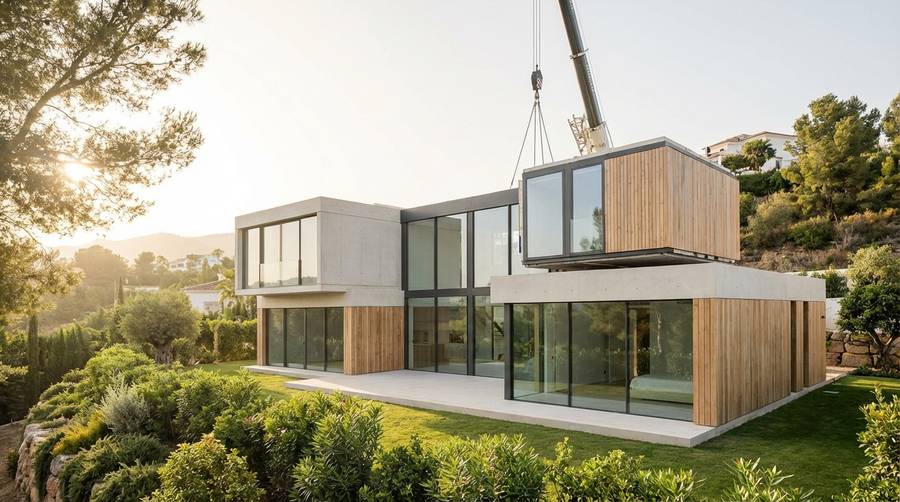
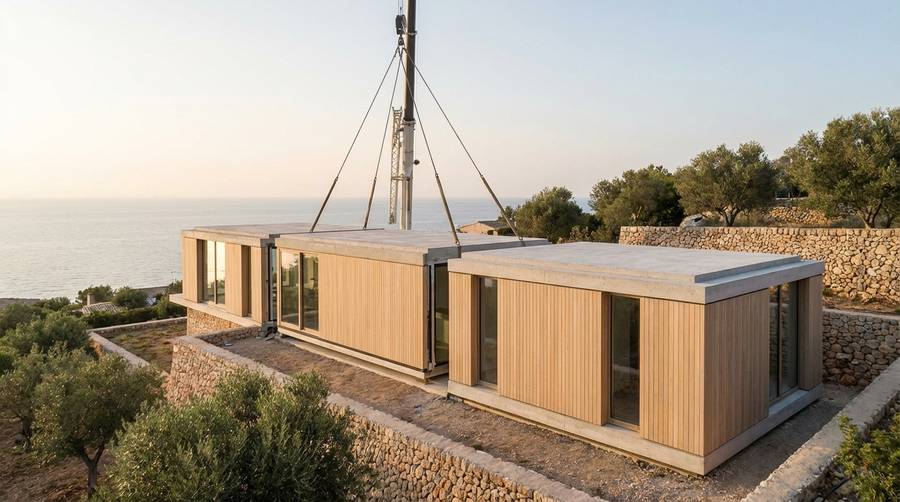
4. Hybrid systems and prefabricated modules: best-of-both-worlds
Common configurations: concrete+timber, steel frame+panels
Hybrids pair a robust base (e.g., concrete plinths or slabs) with lightweight upper structures—timber or steel. This balances thermal mass, seismic performance and speed.
How hybrids optimise time and cost while keeping premium finishes
- Pre-assembled bathroom pods and kitchen modules cut internal fit-out time by 40–60%.
- Hybrid projects often achieve a lower total cost than full concrete models while delivering similar durability.
Practical examples: turnkey project metrics and client satisfaction
Case study (turnkey, Spain, suburban plot): 120 m² hybrid home.
- Manufacturing & fit-out off-site: 7 weeks
- On-site assembly and connections: 12 days
- Total turnkey cost: €1,500/m²
- Client satisfaction (post-occupancy survey): 92% very satisfied with timeline and finish
5. Quick guide to choosing the right production system
Key factors: plot, climate, budget and energy goals
- Plot constraints: narrow lots favour timber or steel frame due to lighter foundations.
- Climate: Mediterranean climates benefit from thermal mass; pair concrete bases with insulated envelopes for stable indoor temperatures.
- Budget and lifecycle costs: Include maintenance, insurance and embodied carbon in decision-making.
- Energy targets: For Passivhaus, favour systems that enable airtightness and continuous insulation — factory-made panels often deliver this most reliably.
Timelines, supply chain and Spanish industrial capacity
Proximity to manufacturing reduces transport time and cost. Spain has growing industrial capacity for timber and hybrid panels; however, precast concrete capacities can be regional — plan procurement early to avoid delays.
Financing and permits: mortgages for self-build and turnkey payment options
Spanish banks offer tailored self-build mortgages (hipotecas para autopromoción) that release funds in stages aligned with manufacturing milestones. For turnkey contracts, negotiate clear payment milestones tied to factory delivery and on-site assembly, and insist on a fixed-price clause with defined tolerances.
6. Next steps: from decision to turnkey delivery
Recommended process: design, permit, manufacture, assemble, handover
- Initial brief and plot study: site orientation, access, connection points and restrictions.
- Feasibility and system selection: choose the production system and obtain preliminary cost and program.
- Design development and energy modelling: confirm U-values, airtightness strategy and Passivhaus feasibility.
- Permitting and procurement: submit license packages early; order factory production slots as soon as technical approvals are in place.
- Manufacture and parallel site prep: foundation work proceeds while panels/modules are produced.
- Assembly, commissioning and handover: include airtightness tests, blower-door and thermal imaging before final occupation.
Checklist for contracts: guarantees, performance metrics and fixed-price clauses
- Define warranty periods for structure, waterproofing and finishes.
- Include performance guarantees: target U-values, airtightness (n50), heating demand.
- Set clear acceptance tests: blower-door thresholds, thermal imaging, and measured energy use at 12 months.
- Price clause: fixed price with indexed exceptions (e.g., VAT changes) and a clear scope of variations.
Resources and example studies: times, costs and client satisfaction
Practical study summaries included above illustrate typical manufacturing windows and measured energy demands. When evaluating suppliers, ask for previous turnkey projects with documented timelines and post-occupancy surveys.
Final considerations and recommended next actions
Choose the system that aligns with your priorities: durability and premium façades → precast concrete; speed and large glazed openings → steel frame; low carbon and comfort → timber; flexibility and speed → hybrids.
If your goal is a turnkey Passivhaus-quality home in Spain with controlled cost and schedule, focus equally on the factory process, the contractual guarantees and the procurement timeline.
Practical rule: a clear contract + factory quality control = predictable outcome. Prioritise measurable guarantees over marketing claims.
Call to action: If you are planning an autopromoción or want a tailored comparison for your plot, contact a specialist who can provide a site-specific feasibility, costed options and a turnkey roadmap — or start with the linked guide to compare industrialized vs traditional systems.
Image brief for Findnido (for AI generator)
Photograph-style image of a finished Mediterranean-contemporary detached home in Spain, two-storey, light-toned façades combining warm natural stone, wood accents and smooth concrete details. Large glazed openings and a furnished terrace/garden in golden-hour light. A family casually enjoying the porch to convey lived warmth. The scene must look like premium real estate photography — natural colors, soft daylight, balanced composition. Avoid any exposed construction, modular joints, container forms or visible factory systems. Emphasize sustainability cues (landscaping, shading devices) while keeping a human, aspirational mood consistent with the Findnido brand.