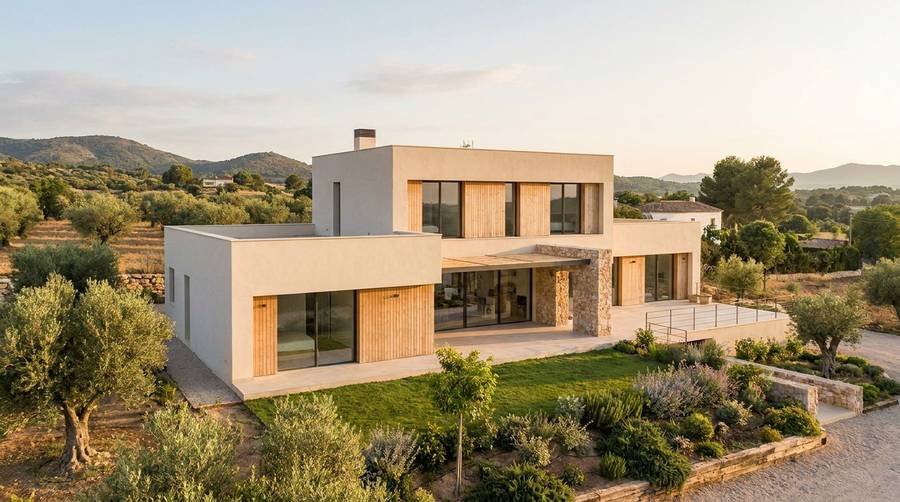
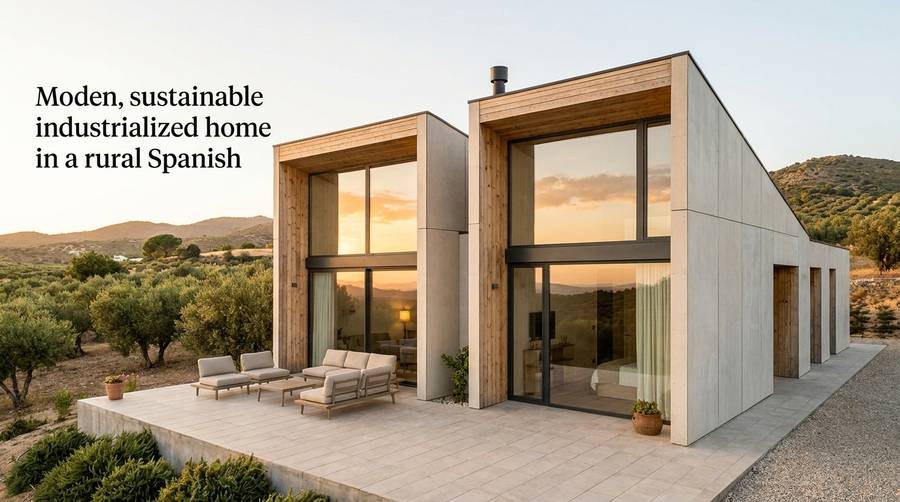
Prefabricated House vs Traditional: Clear Pros and Cons
Why consider an industrialized housing approach in Spain today
Imagine getting the keys to a completed home in months, not years. That speed, combined with predictable costs and higher factory quality control, is why many self-builders in Spain are evaluating an industrialized route.
This section summarizes who benefits most, the strongest advantages over on-site construction, and common misconceptions to dispel early.
Key advantages vs traditional construction: time, cost and quality
- Shorter delivery times: Typical turnkey prefabricated house projects in Spain move from contract to handover in 6–10 months for a standard single-family home, compared with 12–30 months for conventional builds.
- Price certainty: Fixed-price contracts reduce the chance of budget overruns that are common in site-built projects due to weather, subcontractor delays, or material price volatility.
- Factory-controlled quality: Offsite manufacturing means tighter tolerances, reduced moisture exposure and higher reproducibility—translating to better thermal and acoustic performance.
Who benefits: profile of the self-builder and typical cases
Industrialized housing appeals to:
- Families prioritizing a fixed timeline for school or work moves.
- Owners on tight budgets who need cost predictability.
- Clients targeting high energy efficiency (e.g., Passivhaus-level performance) with clear lifecycle cost benefits.
Typical successful cases: first-time developers organizing their own finance, second-home buyers wanting rapid delivery and professionals who value a transparent planning and build schedule.
Myths and realities: debunking preconceived ideas
- Myth: "Prefab equals low quality." Reality: Modern systems use concrete panels, timber frame, and steel frame with finishes indistinguishable from site-built homes.
- Myth: "Limited design freedom." Reality: The most flexible manufacturers allow full customization of layouts and finishes within panel and module rules.
- Myth: "Hard to finance." Reality: There are now specific mortgages and self-build products in Spain that cover modular and prefabricated solutions.
Choosing industrialized housing is less about cutting corners and more about trading on control: time, cost and predictable quality.
Direct comparison: prefabricated house vs traditional house
This comparison focuses on the variables that most influence a self-builder's decision: timelines, total cost and build quality.
Project and construction timelines: predictable, shorter schedules
- Prefabricated house: Parallel workflows—permits and preparation on-site while the home is manufactured offsite—typically reduce on-site time to weeks for assembly and finishing.
- Traditional build: Sequential on-site phases are vulnerable to weather, labor gaps and supply delays; timelines often extend beyond the original plan.
Actionable tip: Request a Gantt-style schedule showing parallel manufacturing and on-site activities. If a supplier cannot provide it, that’s a red flag.
Total cost and financial risk: fixed prices and fewer surprises
- Prefabricated house: Fixed-price turnkey packages reduce contingency needs. Expect clearer allowances for finishes and external works.
- Traditional build: Greater exposure to change orders, latent defects and scope creep, which inflate budgets.
Practical advice: Budget separately for land development (access, foundations, utilities) even if the house contract is turnkey—these are often excluded or underestimated.
Construction quality and durability: factory control vs on-site variability
- Factory-built elements: Higher repeatability, controlled curing for concrete elements, precise junctions for steel frame and timber connections with better sealing.
- On-site work: Dependent on local contractor skill and weather; good results are possible but less consistent.
Evidence-based note: Studies and case data consistently show improved thermal bridging control and lower envelope air leakage for industrialized builds when quality protocols are enforced.
Modern materials and systems: performance and suitable uses
Material choice determines acoustic behavior, thermal inertia and finish quality. Below are three mainstream systems used in Spain.
Industrialized concrete: strength, acoustics and premium finishes
Use cases: Urban plots, homes seeking high thermal mass and excellent acoustic separation.
Pros: Durable, fire-resistant, excellent sound isolation and smooth exterior finishes achievable in factory conditions.
Cons: Heavier foundations, longer lead times for bespoke panels, and transport logistics for large elements.
Light timber frame: efficiency, flexibility and sustainability
Use cases: Suburban and rural homes prioritizing speed, adaptability and embodied carbon reduction.
Pros: Lightweight, fast to assemble, excellent thermal performance when combined with modern insulation, and favorable embodied carbon.
Cons: Requires careful detailing for moisture control and high-quality exterior cladding to ensure long-term durability.
Steel frame: speed, precision and MEP integration
Use cases: Complex geometries, larger spans, or projects that need precise coordination of mechanical, electrical and plumbing systems.
Pros: Highly repeatable, tolerant to tight tolerances and excellent for industrialized production lines.
Cons: Lower thermal mass (requires thermal break strategies) and attention to corrosion protection in coastal areas.
Sustainability and energy efficiency in industrialized homes
Industrialized housing is well suited to deliver high-performance energy targets if integrated from design stage.
Passivhaus design and carbon reduction
Why it fits: Factory precision reduces thermal bridges and ensures airtightness targets are met more reliably than on-site assemblies.
Metric example: A well-executed timber-frame industrialized home can reach specific heating demand under 15 kWh/m²·year with modest glazing strategy and continuous insulation.
Materials and life-cycle impact: realistic assessment
Compare cradle-to-grave values, not just embodied carbon of primary structure. Consider:
- Insulation type and lifespan
- Serviceability and maintenance intervals
- Operational energy savings
Actionable evaluation: Ask suppliers for a simple LCA summary or EPD (Environmental Product Declaration) for major components.
Certifications and measurable energy savings
Practical data: Certified net-zero-ready or Passivhaus modular homes in Spain report 60–90% lower heating demand vs typical 2000s-built homes. Use this to model payback on energy upgrades.
The turnkey process: from plot search to move-in
A successful turnkey industrialized project depends on clear phase definition and responsibilities.
Project phases: plot search, design, manufacturing and assembly
- Pre-purchase feasibility: Verify building envelope, permitted heights, setbacks and soil bearing capacity.
- Design & approvals: Concurrent technical design and permit preparation.
- Factory production: Controlled manufacturing while on-site groundwork proceeds.
- Assembly & commissioning: Rapid erection, installation of services and quality verification.
Link for deeper design guidance: consider reading Cómo diseñar una vivienda industrializada en España 2026 for an expanded step-by-step approach.
Coordinating local permits and Spanish bureaucratic steps
Practical checklist:
- Confirm local urban planning rules before signing any manufacturer contract.
- Secure site access and utility connections as early items on the critical path.
- Plan for the ITE/first occupancy municipal inspections as final project gates.
Quality control and handover: deliverables and guarantees
Demand these from any turnkey supplier:
- Factory QA reports and as-built drawings.
- Thermal tuning and blower-door test results where relevant.
- Clear maintenance and warranty documents for structure, envelope and systems.
Financing and legal matters for self-builders
Financing modular and prefabricated homes is increasingly mainstream, but you must plan carefully.
Mortgages for self-construction and modular-specific products
Options include:
- Developer-style mortgages linked to construction milestones.
- Specialised self-build loans for prefabricated homes covering manufacturing and assembly stages.
Tip: Work with a mortgage broker experienced in self-build deals; they will value fixed-price contracts higher than open-ended traditional estimates.
Hidden costs and how to budget them: urbanisation, permits and connections
Commonly underbudgeted items:
- Access roads, drainage and retaining structures
- Utility connections and off-site works
- Site-specific foundation solutions
Rule of thumb: Set aside 8–12% of total project cost for site and connection works, adjusted to plot complexity.
Contracts and guarantees: what to require in a turnkey agreement
Must-have contract clauses:
- Firm delivery date with liquidated damages for delays.
- Clear scope with finish schedules and specified allowances.
- Warranty periods for structure, envelope and installations and post-handover support terms.
How to decide: practical criteria and next steps
Make an informed decision using objective criteria and real examples.
Checklist to compare proposals: timelines, costs, warranties and finishes
- Ask for a line-item budget, not just a lump sum.
- Compare delivery schedules with milestones and penalties.
- Request samples or factory visits to inspect workmanship.
- Validate warranty scope and responsibility for latent defects.
Real case studies: time, cost and client satisfaction metrics
Example 1 — Coastal timber-frame home (Spain, 2024): Total turnkey delivery 7 months. Final cost €1,650/m² including finishes. Client satisfaction 9/10 for timeline and thermal comfort.
Example 2 — Mediterranean concrete panel house (Spain, 2023): Assembly and commissioning 5 weeks on-site after 4 months factory production. Acoustic performance above initial target; client reported 30% lower estimated heating demand.
These are representative outcomes—results depend on plot complexity and customization level.
Recommended next steps for your 2026 project
- Clarify your budget range and non-negotiable requirements (size, energy targets, finishes).
- Shortlist 2–3 manufacturers and ask for an itemised turnkey proposal and a production schedule.
- Visit a completed project or factory and request blower-door or energy performance tests where applicable.
- Engage a mortgage specialist early to align financing with contract milestones.
Final thought: Industrialized housing is a strategic choice for those who value control, speed and predictable outcomes. It is not one-size-fits-all, but when aligned with a clear brief and competent suppliers it can deliver superior value.
If you want a tailored assessment for a specific plot or budget, reach out to a specialist early—an informed first conversation saves time and money later.