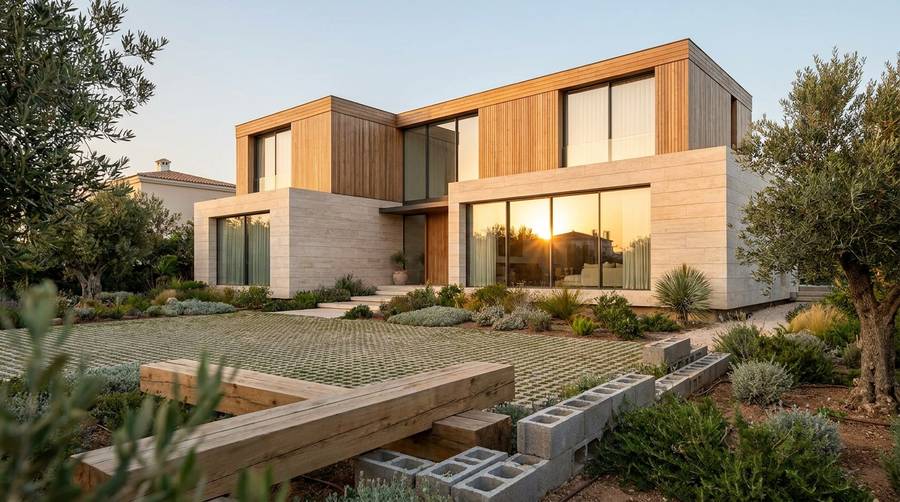
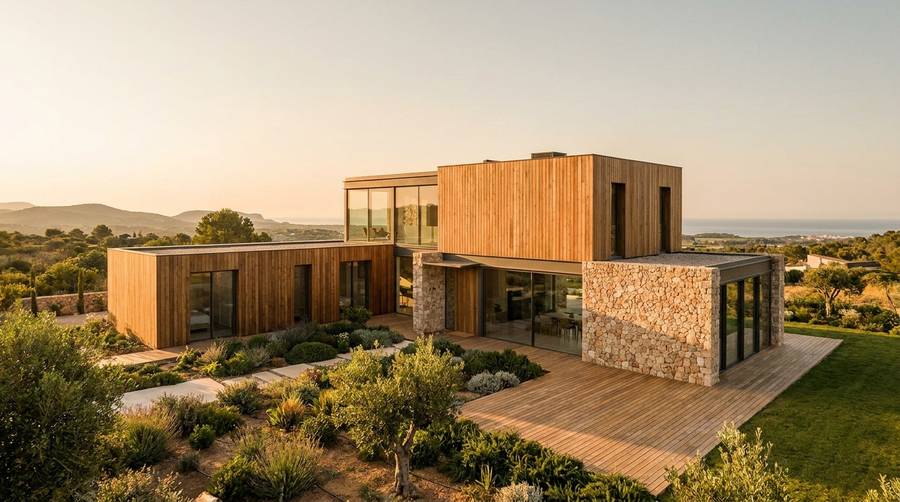
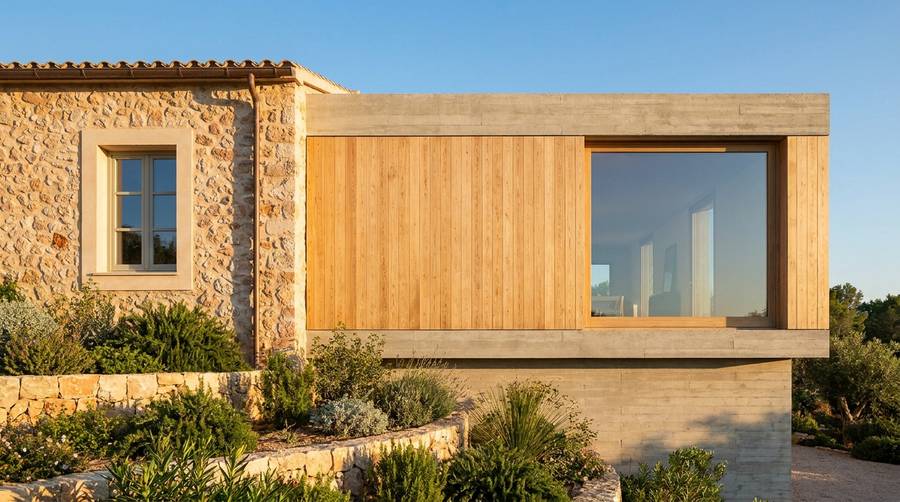
Low-Carbon Industrialized Housing: 5 Materials for Spanish Self-Builders
Why choose low-carbon industrialized housing: key benefits for self-builders
When a family sold their apartment and bought a plot outside Valencia, they expected stress; instead they gained certainty: fixed price, predictable schedule and a home tailored to Mediterranean life. That certainty is the core advantage of industrialized housing done with low-carbon materials.
Industrialized housing shortens on-site time, reduces waste and enables truly measurable reductions in embodied carbon—if you choose the right materials and delivery model. Below you get practical comparisons, real metrics, and a step-by-step view of how to pair material choice with a turnkey (llave en mano) route and autopromotion financing in Spain.
Choosing a low-carbon material early reduces both lifecycle emissions and budget risk: each material shifts cost, assembly time and thermal performance in predictable ways.
Efficiency in time and cost control vs traditional build
What changes with industrialization:
- Manufactured elements cut on-site construction time by 40–70% compared with traditional masonry builds.
- Factory QA reduces rework and variation, making fixed-price contracts realistic.
- Shorter schedules lower holding costs for land and finance interest during construction.
Impact on carbon footprint and energy targets (Passivhaus and beyond)
Key point: Industrialized methods make it easier to apply low-carbon materials consistently, improving embodied carbon numbers and enabling ultra-efficient envelopes required by Passivhaus or similar standards.
How the turnkey model fits financing and autopromotion mortgages
For self-builders, a documented turnkey scope and factory-backed warranties simplify bank underwriting. Lenders in Spain increasingly accept detailed Gantt schedules and supplier guarantees as part of autopromotion mortgage packages.
1) Low-emission prefabricated concrete
Characteristics: prefabrication, optimized batching and CO2-reduction admixtures
Industrialized concrete elements use optimized mixes, lower clinker ratios, SCMs (fly ash, GGBS) and CO2-reducing admixtures. Precasting in controlled conditions also reduces waste and improves dimensional precision.
Thermal performance and durability: implications for energy efficiency
Concrete has thermal mass advantages for Mediterranean climates—stabilizing interior temperatures when combined with high-performance insulation in the envelope. Proper detailing avoids thermal bridges and lets concrete contribute to passive comfort.
Case metrics: assembly time, cost/m² and estimated emissions reduction
- Typical assembly: 1–3 weeks for structural elements on a 120 m² house.
- Cost range: competitive with tradition when factoring lower labor and speed; often €900–1,400/m² for structure+envelope depending on finishes.
- Embodied carbon: optimized mixes can cut ~20–40% vs traditional concrete; full precast systems can reduce site waste by >50%.
2) Timber frame (light-frame) — certified and circular wood
Environmental advantages: carbon sequestration and renewable sourcing
Timber frame stores biogenic carbon and, when sourced from PEFC/FSC forests and managed circular supply chains, delivers one of the lowest embodied carbon profiles per m².
Compatibility with Passivhaus: airtightness and thermal detailing
Timber frame systems integrate continuous insulation layers easily and achieve high airtightness with factory-installed membranes. That makes them particularly efficient to certify to Passivhaus, especially for compact Mediterranean volumes.
Practical considerations: maintenance, costs and Spanish examples
- Maintenance: external claddings (render, timber, stone veneers) determine long-term care—timber frames themselves require little maintenance if protected.
- Costs: typically €950–1,600/m² for high-performance timber frame houses depending on cladding and finishes.
- Examples in Spain show on-site assembly in 2–6 weeks for structure and watertight envelope; satisfied clients report rapid schedule and lower disruption.
3) Steel frame with recycled steel for structural efficiency
Constructive benefits: speed, precision and Mediterranean design flexibility
Steel frame allows long spans and large openings—useful for Mediterranean living rooms and terraces. Factory precision reduces tolerance issues and simplifies installation of windows and façade systems.
Carbon footprint: recycled steel versus new steel; offset strategies
Using high recycled-content steel (EAF route) reduces embodied carbon by roughly 40–60% compared to primary steel. Combine with low-carbon finishes and carbon accounting to present banks and clients clear lifecycle numbers.
Integration with high-quality finishes (light façades, large openings)
Steel frames pair well with ventilated façades, thin stone panels or timber cladding—keeping the premium Mediterranean aesthetic without heavy masonry. Expect structure assembly in 1–3 weeks for typical single-family homes.
4) SIP panels and low-carbon insulation solutions
What are SIPs and sustainable core variants (wood, natural fibers)
SIPs (Structural Insulated Panels) combine a structural skin with a continuous insulating core. Modern SIPs use low-carbon cores—cross-laminated wood, wood-fibre or natural fibre boards—reducing embodied energy and improving hygrothermal performance.
Performance gains: thermal continuity and fewer thermal bridges
SIPs create continuous insulation envelopes that significantly reduce thermal bridging. That lowers heating and cooling loads, useful in Mediterranean climates where passive solar control and night-time cooling are important.
Costs, timelines and comparison with traditional approaches
- Assembly: envelope closed in days for a 120 m² house; reduces on-site trades and coordination needs.
- Costs: premium vs standard cavity walls but competitive when accounting for faster finish and lower energy demand—approximately €1,000–1,700/m² depending on panel specification.
- Compared to traditional humid masonry: faster, less waste, improved airtightness—often a better choice when aiming for Passivhaus with a tight budget.
5) Bio-based composites (hempcrete, natural fibers, eco-OSB)
Properties: hygrothermal regulation, low toxicity and lifecycle gains
Materials like hempcrete and natural-fiber insulation regulate humidity, provide good thermal inertia and are low in embodied energy. They support indoor air quality and reduce VOC concerns.
Limitations and integration into industrial systems
These materials must be integrated into designed systems: hempcrete is usually used with a load-bearing frame; natural-fiber boards need precise detailing for airtightness. Not always suitable as primary structural elements in high seismic areas without hybridization.
Case studies: comfort metrics, costs and client satisfaction
- Comfort: occupants report stable indoor humidity and perceived comfort in summer months.
- Costs: similar to high-spec timber frame when used as complementary systems; typically €1,000–1,800/m² depending on finish level.
- Satisfaction: clients value indoor air quality and sustainability claims when documented by lifecycle assessments.
How to choose the ideal low-carbon material for your industrialized home
Decision criteria: plot, Mediterranean climate, budget and Passivhaus goals
Match material to the plot realities: thermal mass (concrete) helps coastal diurnal swings; lightweight timber or steel supports constrained access or lightweight foundations. Align material choice with your performance targets and budget.
Turnkey planning: from plot searching to delivery and aftercare
A genuine llave en mano plan should include:
- Documented scope, fixed-price milestones and penalties for delays.
- Factory QA reports and third-party testing for airtightness and materials.
- Post-delivery warranty and clear O&M manual for the homeowner.
For guidance on differences with traditional builds and an in-depth comparison of low-carbon materials, see Vivienda industrializada vs tradicional: guía para autopromotores and Vivienda industrializada y materiales bajo carbono.
Financing options and autopromotion mortgage considerations
For autopromotion mortgages, lenders look for a clear budget, turnkey delivery plan and reliable suppliers. Provide:
- Fixed-price contract and Gantt schedule.
- Factory production timeline and delivery windows.
- Independent lifecycle or energy modelling if aiming for Passivhaus to demonstrate long-term savings.
Practical close: recommended steps and resources for Spanish self-builders (2026)
Quick checklist before choosing material and system
- Assess plot constraints: access, foundation needs, orientation and solar potential.
- Define performance targets: Passivhaus, near-ZEB (Zero Energy Building) or baseline NZEB.
- Request factory data: lead times, QA, environmental product declarations (EPDs) and transport logistics.
- Compare total cost of ownership, not only initial € per m².
Useful resources: guides, case studies and technical comparisons
Explore comparative studies and in-depth guides such as Vivienda industrializada de bajo carbono: guía completa 2026 for lifecycle metrics and Passivhaus alignment. Consult supplier EPDs and independent test reports before committing.
Next steps with a professional, transparent approach
Start with a short feasibility package: site survey, high-level budget for 2–3 material systems, and a timeline. Use that package to approach lenders and specialist turnkey providers. A clear decision at this stage saves months and often tens of thousands of euros.
For self-builders, the best investment is clarity: a documented material decision, a certified performance target and a turnkey path that reduces uncertainty.
Ready to take the next step? If you have a plot and a target budget, prepare a brief with orientation, desired performance and preferred materials—and request a compact feasibility pack from a trusted industrialized housing provider to compare real timelines and quotes. This will let you compare costs, embodied carbon and expected delivery dates side by side before committing.
Artículos relacionados