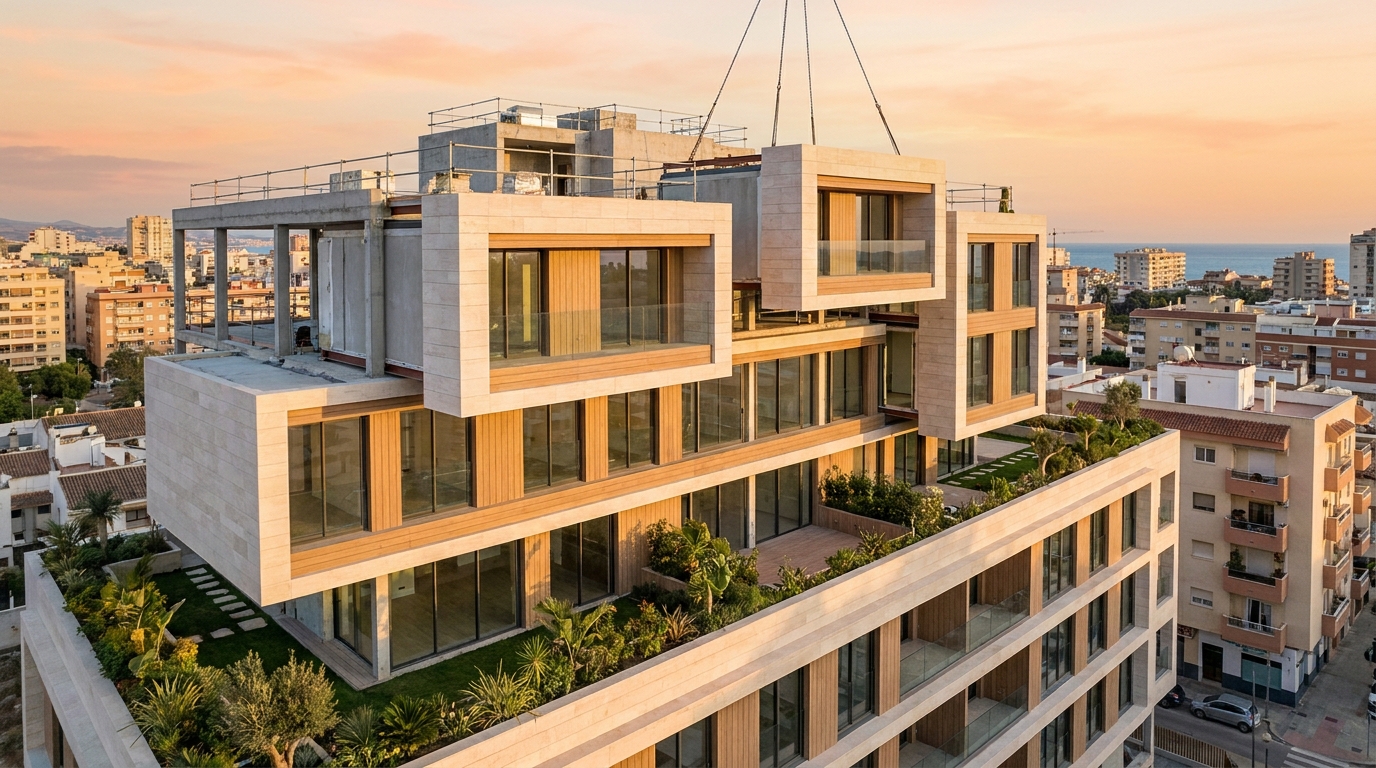
Modular Mid‑Rise Success: A Turnkey Project in Spain
From vacant lot to desirable home: the story of a turnkey mid‑rise project
They arrived with a steep urban lot, a tight budget and a family timeline: one year to move in. That pressure shaped every decision. This case study follows a Spanish autopromoter who chose an industrialized, turnkey solution for a four‑storey residential building and achieved fixed costs, a shortened schedule and high occupier satisfaction.
Initial context: client needs and site constraints
The client was a family cooperative planning six dwellings over four floors on a 420 m² plot in a suburban Spanish town. Constraints included strict urban setbacks, a sloping parcel and limited on‑site storage. The cooperative needed a predictable budget and a delivery date aligned with existing rental contracts.
Primary goals:
- Fixed price contract to avoid scope creep.
- Occupancy within 12 months from contract.
- High thermal comfort and low operating costs (Passivhaus ambition).
- Durable materials requiring low maintenance.
Off‑site planning: why we chose vertical industrialized production
Given the site limits and the delivery target, we prioritized off‑site manufacturing for large portions of the building envelope and systems. The production strategy combined industrialized concrete panels for cores and wet areas with light timber frame modules for apartments.
Expected benefits were:
- Reduced on‑site time and weather risk.
- Higher quality control in factory conditions.
- Predictable procurement and fixed pricing for major packages.
Quantified outcome: times, final cost and satisfaction
Final delivered metrics for the cooperative:
- Total project duration (contract to handover): 11 months.
- On‑site assembly phase: 6 weeks for structural and envelope installation.
- Final project cost variance vs contract: +1.2% (mainly minor finishes).
- Measured first‑year energy consumption (space heating + DHW): 38 kWh/m²·year.
- Resident satisfaction score (survey at 9 months): 9.1/10.
“We moved in on time, our bills are half of what our neighbour pays, and maintenance has been negligible.” — Lead member of the cooperative
Design and materials: combining industrialized concrete and light timber framing
Technical decision: selecting concrete, timber or steel frame
Choice of structural and envelope systems followed three criteria: durability, speed and thermal performance. We selected a hybrid approach:
- Industrialized precast concrete for vertical cores (stairs, lifts) and wet zones to ensure fire resistance, sound insulation and long‑term stability.
- Light timber frame modules for apartment volumes to optimize weight, integrate high‑performance insulation and shorten assembly time.
- Minimal steel framing where cantilevers and balcony connections required higher tensile strength.
This combination maximized the strengths of each material and minimized on‑site complexity.
Construction advantages at height: stability, assembly and sealed schedules
Key construction advantages observed:
- Factory‑assembled wall and floor panels arrived with finished cladding substrates, windows pre‑installed and airtight membranes applied.
- Mechanical and electrical rough‑ins were completed in controlled conditions, reducing rework.
- On‑site assembly followed a predictable cadence: structural concrete cores first, then modular timber volumes placed with a crane over four intense weeks.
Result: the project reached wind‑ and watertight status within two months of mobilization, effectively decoupling interior finish works from weather delays.
Cost and maintenance impact: a comparison with traditional build
Comparative figures (per dwelling average):
- Traditional in‑situ build estimate: 1,600–1,900 €/m² (local market baseline).
- Industrialized turnkey delivered: 1,450 €/m² (fixed price, including finishes).
The cost advantage came from reduced labor hours on site, fewer delays and bulk purchasing in the factory. Maintenance forecasts show lower medium‑term costs because precast concrete cores reduce wet‑zone interventions and factory‑sealed envelopes minimize water infiltration risks.
Efficiency and sustainability: achieving Passivhaus in a modular building
Passive and active strategies applied
To reach near‑Passivhaus performance we combined:
- Airtight factory‑installed membranes and continuous insulation in timber modules.
- High‑performance triple‑glazed windows with thermally broken frames and optimized solar gain per orientation.
- Balanced mechanical ventilation with heat recovery (MVHR) sized per dwelling and commissioned in the factory where possible.
- Thermal bridges minimized by integrating precast concrete cores with timber junction details tested in the factory.
Measured results: energy use and carbon reduction
Actual first‑year monitoring showed:
- Heating demand: 23 kWh/m²·year (well within Passivhaus thresholds for Spanish climate zones with mild winters).
- Total delivered energy (heating + cooling + DHW): 38 kWh/m²·year.
- Estimated operational CO2 reduction vs a conventional build: 55% in first 25 years (accounting for Spanish grid mix projections).
These results combined fabric performance and efficient systems. Crucially, commissioning in factory conditions reduced commissioning defects that often inflate real consumption.
Materials and detailing that improve durability and comfort
Durability choices included weather‑resistant exterior finishes, ventilated façades over insulation in vulnerable exposures and service routes within apartments for future adaptability.
- Concrete cores protect wet rooms and provide acoustic mass.
- Timber modules use certified timber and breathable internal linings to avoid condensation risks.
These details preserve indoor air quality and reduce the need for intrusive maintenance.
Turnkey process explained with real data
Project phases: parcel search, design, off‑site manufacture, assembly and delivery
The turnkey workflow used fixed milestones and clear deliverables:
- Parcel selection and feasibility (6 weeks): zoning, geotechnical quick scan, orientation study.
- Detailed design and permit package (8–12 weeks): coordinated BIM models and factory‑ready drawings.
- Factory production (10–14 weeks): panels and modules, MEP prefabrication.
- Site assembly and commissioning (6–10 weeks): crane operations, connections, finishes.
- Handover and post‑occupancy checks (4 weeks): defects list and performance verification.
Overlap between design approval and early factory work reduced total calendar time. The cooperative signed a fixed‑price turnkey contract that included a performance guarantee for airtightness and MVHR COP.
Real times vs estimates: project schedule and control points
Control points where risks concentrate:
- Permit approval: achieved within the expected 10 weeks due to early engagement with municipal technicians.
- Foundation works: required an unexpected deeper excavation because of a local water table; contingency covered the extra cost and added one week.
- Module delivery windows: strictly managed with daily logistics coordination and two spare crane days reserved.
Monthly stakeholder reviews and a shared online schedule were decisive to keep transparency and react quickly to deviations.
Coordination with authorities and permits for mid‑rise modular projects
Key administrative recommendations from this experience:
- Engage the local planning authority early with mock‑ups and façade precedents to reduce back‑and‑forth.
- Present factory QA documentation (material certifications, fire tests) as part of the permit file.
- Agree on delivery and storage logistics in writing before production starts to avoid on‑site delays.
Financing and viability: mortgages for self‑builders and key figures
Financing models applicable to industrialized housing in Spain 2026
In 2026 Spanish banks and speciality lenders offer three main routes for autopromoters:
- Construction loans with staged disbursement tied to milestones (foundations, envelope, finishes), requiring certified progress reports.
- Self‑build mortgages that treat the project as a single housing loan once completion is certified.
- Green mortgages with preferential terms for verified low‑energy projects (documentation from MVHR suppliers and airtightness tests help secure rates).
Total cost and breakdown: how to present the project to the bank
Typical cost breakdown for this project (per dwelling):
- Land acquisition: 25%.
- Turnkey construction: 55% (including factory modules and finishes).
- Professional fees, permits and contingencies: 12%.
- VAT and tax obligations: 8%.
When presenting to banks, include: fixed‑price contract, factory production schedule, airtightness and MVHR performance guarantees, and projected energy costs with measured comparators.
Risks and guarantees: what lenders value and how to improve approval odds
Lenders prefer:
- Fixed‑price turnkey contracts with clear penalties for delays.
- Performance guarantees for energy and airtightness.
- Experienced contractors with verifiable references and factory visits.
Providing a conservative cashflow plan and showing comparisons with traditional builds improves bank confidence.
Lessons learned and success metrics: the client testimony
Success indicators: time saved, budget deviation and satisfaction
Quantifiable successes included:
- 11‑month total delivery vs an expected 16–20 months for a traditional build.
- Budget overrun of only 1.2% against the fixed turnkey contract.
- Energy bills ~50% lower than adjacent conventional buildings over the first year.
Resident feedback highlighted quiet interiors, stable temperatures and low utility costs as primary benefits.
Challenges and in‑field solutions during assembly
Challenges encountered and responses:
- Unexpected groundwater during foundations — solution: rapid redesign with shallow piling, pre‑approved contingency covered costs.
- Local truck restrictions for module deliveries — solution: micro‑logistics plan and night deliveries for oversized components.
- Minor finish mismatches between factory and on‑site trades — solution: pre‑assembly mock‑ups and a two‑day on‑site finishing window guaranteed in contract.
Practical recommendations for future self‑builders
- Prioritize early factory engagement and request mock‑ups.
- Secure a turnkey contract with clear warranty and performance clauses.
- Build realistic logistics plans for urban deliveries and crane operations.
- Include energy performance guarantees in procurement to protect long‑term costs.
Outlook: how this case reshapes industrialized mid‑rise housing
Technical and economic comparison with similar market projects
Compared to comparable mid‑rise projects carried out traditionally in the same region, this approach delivered:
- Time savings of 30–45%.
- Cost savings of 5–15% depending on finishes and site constraints.
- Operational energy savings exceeding 40% when combined with MVHR and high‑performance envelopes.
These margins make turnkey industrialized approaches competitive for cooperatives, developers targeting sustainable labels and families seeking predictable schedules.
Scalability and typological adaptations
The hybrid model scales well: variations can increase unit counts, adapt floorplans or substitute timber modules with steel frame for higher seismic zones. Standardized junction details and factory QA are repeatable across sites, reducing the learning curve for future projects.
An inspiring close: social and environmental impact
This project demonstrates that industrialized mid‑rise housing can be both aspirational and pragmatic. By delivering quality, predictability and energy performance, the model supports urban densification with lower carbon footprints and real social value for self‑builders and occupants.
If you are considering a turnkey modular project, start with a clear brief, insist on factory QA and demand performance guarantees—those three elements made the difference in this case.
Interested in a feasibility review for your parcel? Contact a specialized industrialized housing advisor to explore options and financing paths tailored to your site and goals.