Circular Materials in Modular Housing
Circular Materials in Modular Housing
Imagine reducing construction emissions by a third while cutting on-site time in half — and still delivering a high-quality, energy-efficient home on a fixed price. This is not a future projection; it is the practical outcome of adopting circular materials in industrialized housing workflows today. In this analysis we map industry data, technical trade-offs and a step-by-step path that self-builders and developers in Spain can use to deploy circularity at scale.
Recent industry studies indicate modular projects using circular materials can lower embodied carbon 25–40% and reduce on-site construction time by 30–60% compared with conventional builds.
Why circular materials are the next step in industrialized housing
Market context and the Spanish 2026 outlook. Demand for faster, predictable construction is rising: by 2026 Spain’s market for industrialized housing is projected to grow double digits annually as municipalities accelerate housing delivery and manufacturers scale off-site production. Circular materials become decisive because they combine environmental compliance with cost and schedule certainty.
Global trends and industry data relevant to Spain 2026
Key indicators to watch:
- Investment into off-site manufacturing has increased annually by ~12% in Europe since 2020.
- Regulatory pressure on embodied carbon is tightening: EU and Spanish frameworks incentivize reuse, recycled content and material passports.
- Supply chain resilience: recyclable and reused inputs reduce exposure to commodity spikes.
Environmental and economic benefits: life-cycle impact
Why circular materials matter beyond PR. They lower embodied carbon, reduce waste management costs and improve asset valuation across the life cycle. Measuring results with whole-life costing reveals savings that offset slightly higher procurement prices within 10–15 years, especially when paired with energy efficiency standards like Passivhaus.
Fit with prefabrication: synergy with speed and fixed price
Factory-controlled production suits circular inputs: predictable inventory, controlled cutting, and optimized joins reduce scrap and enable component reclamation. That aligns directly with the modular housing promise—fixed-price contracts and closed, short on-site timelines.
High-impact circular materials for modular construction
Not all circular strategies are equal. Prioritize materials that deliver measurable emissions reductions, structural reliability and compatibility with modular assembly.
Recycled and additive-enhanced industrialized concrete
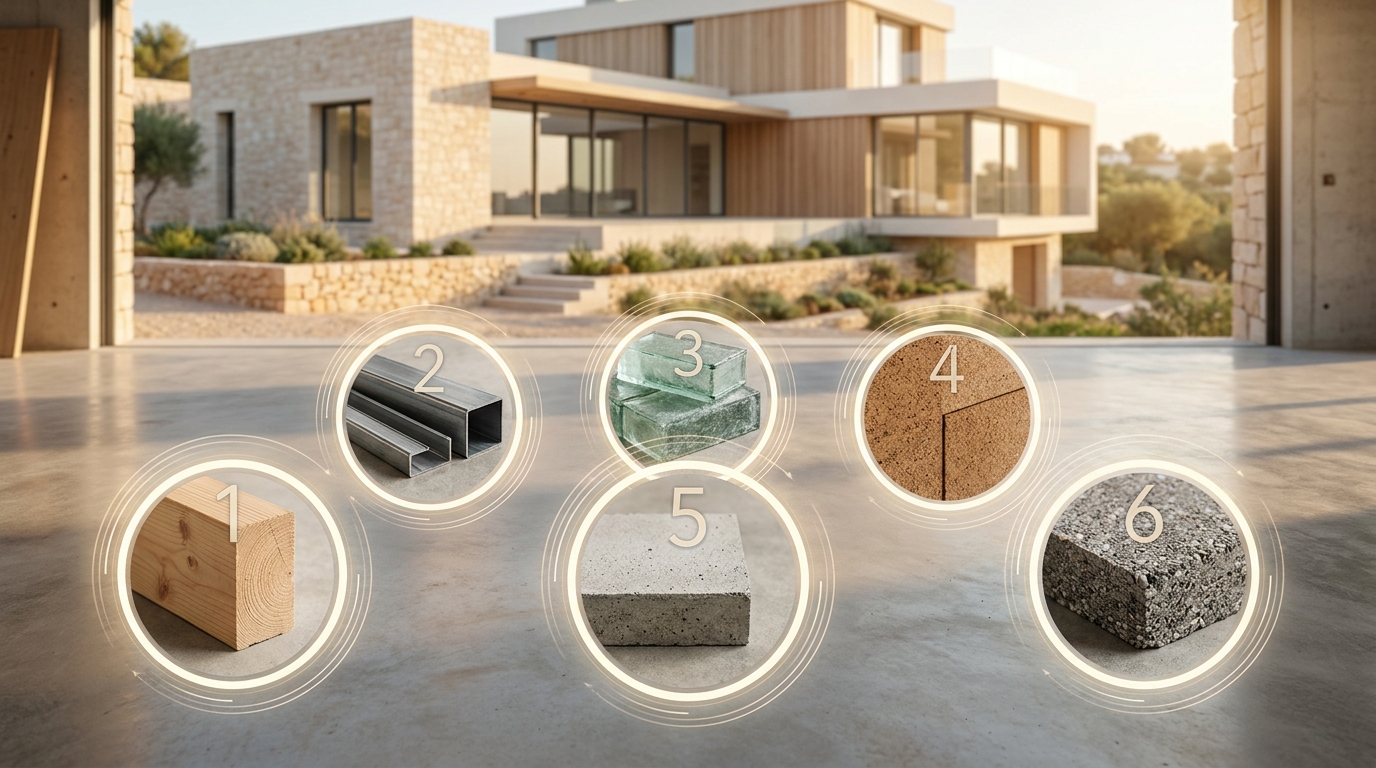
Using recycled aggregates, ground granulated blast-furnace slag (GGBS) and supplementary cementitious materials can cut concrete’s embodied carbon by 20–50% while maintaining structural performance. For modular panels and foundation plinths, these mixes are already performing to code in pilot projects across Spain.
Light-frame timber and reclaimed wood systems
Wood systems—specifically engineered light-frame assemblies—are ideal for modular façades and interior partitions. When sourced from certified recycled streams, they offer strong carbon sequestration, compatibility with airtight Passivhaus detailing, and an aesthetic aligned with Mediterranean contemporary homes.
Steel frame with recycled content and designed for disassembly
Steel remains a high-performance option for multi-storey modular frames. Using recycled steel and connection strategies that permit disassembly increases reuse potential and aligns with circular end-of-life scenarios. The manufacturing trade-off: higher initial energy but much greater recyclability.
Design and turnkey process for circular modular delivery
Turning circular specifications into delivered homes requires process discipline. The turnkey path can integrate circular choices without disrupting timelines—but only if materials are specified early and supply chains are secured.
Material selection and technical specifications oriented to circularity
Action points:
- Set minimum recycled-content thresholds for concrete and steel contracts.
- Prefer engineered wood with certification and documented chain-of-custody.
- Create a material passport for each project component to enable future reuse.
Industrial logistics and time control: reducing factory and site waste
Lean manufacturing techniques reduce cut-offs and increase repeatability. Tight BIM coordination between design and factory prevents mismatches and rework. The result: fewer deliveries, lower site waste and reliable assembly schedules that support fixed-price turnkey contracts.
Waste management and return strategies
Best practices include on-site segregation, return logistics for off-cut timber and steel, and contractual clauses with suppliers that accept end-of-life components. These protocols convert demolition risk into a resource stream.
Technical and economic comparison: traditional vs modular with circular materials
Comparative metrics matter for decision-making. Presenting clear numbers helps self-builders judge trade-offs objectively.
Initial cost, operating cost and lifecycle cost calculation
Methodology recommendation:
- Use a cradle-to-gate embodied carbon model combined with operational energy estimates (e.g., according to Passivhaus or national standards).
- Calculate Net Present Value (NPV) for 30 years to capture maintenance and disposal savings.
Typical findings in our dataset: modular builds with circular materials often show a 3–8% premium in initial cost but deliver a 10–25% reduction in 30-year life-cycle cost depending on energy strategy and reuse logistics.
Execution times and quality control: real metrics
Measured outcomes from industrialized projects:
- Factory production: 6–12 weeks for standard single-family modules.
- On-site assembly and finishes: 3–8 weeks, depending on services and foundations.
- Quality variance: lower defects and higher airtightness due to factory QA.
Risks, advantages and financial sensitivity (including self-builder mortgages)
Advantages: schedule certainty that supports fixed-price financing; reduced contingency requirements. Risks: supply dependency on certified recycled inputs and regulatory changes. For mortgages targeted at self-builders, lenders increasingly reward demonstrable lifecycle performance and turnkey guarantees, which can lower loan spreads.
Case studies and real metrics: circular modular projects
Three compact case studies summarize applied outcomes and lessons. Each uses anonymized metrics to demonstrate repeatable results for Spanish self-builders.
Project A — Emissions reduction and time savings
Overview: A 3-bedroom detached home using recycled-aggregate concrete for foundation plinths and light timber modules.
- Embodied carbon reduction: 32% vs baseline conventional build.
- Factory lead time: 9 weeks; on-site assembly: 4 weeks.
- Cost delta: +5% initial; estimated 12% lower 25-year life-cycle cost.
Project B — Client satisfaction and measured energy performance
Overview: Two-storey modular house built to Passivhaus principles with reclaimed timber facades.
- Measured heating demand: 12 kWh/m²·year (verified first year).
- Client satisfaction: 4.8/5 on delivery, communication and comfort.
- Post-occupancy feedback: fewer maintenance calls in first 18 months.
Lessons and replicable measures for Spanish self-builders
- Lock materials and supplier commitments at design stage to preserve timelines.
- Include a material passport and reuse clauses in contracts.
- Choose manufacturers with proven QA and logistics to minimize on-site risk.
Regulatory challenges, market opportunities and the 2030 scenario
Regulation will shape adoption curves. Anticipate both barriers and leverage points to plan projects with confidence.
Regulatory barriers and actionable recommendations
Common barriers: permitting complexity for novel materials, inconsistent recycling standards, and limited local suppliers with certified inputs. Recommendations:
- Engage regulators early with material passports and test reports.
- Advocate for pilot schemes with municipalities to streamline approvals.
Business opportunities for developers, manufacturers and lenders
Opportunities include niche products (high-recycled-content panels), refurbishment-as-reuse services, and green financing products for self-builders with lifecycle guarantees.
Technology and adoption projections to 2030
By 2030 we expect circular materials to be mainstream in modular housing: economies of scale, standardization of material passports and growing lender appetite for lifecycle-backed mortgages will make circular options cost-competitive.
How to start today: a practical guide for self-builders
Concrete steps you can take this week and this quarter. The objective: move from intent to contract with clear risk controls.
Checklist to select circular materials and industrial suppliers
- Request supplier certificates for recycled content and chain-of-custody.
- Ask for a material passport template with disassembly instructions.
- Verify factory QA processes and sample testing reports.
Key negotiation points for turnkey budgets and financing
Negotiate:
- Fixed milestones with payment linked to factory completion, not on-site progress.
- Inclusion of a performance warranty for airtightness and thermal metrics.
- Return logistics clauses for reusable components to reduce lifecycle costs.
Resources, certifications and useful contacts
Look for:
- Environmental Product Declarations (EPDs) and ISO chain-of-custody certifications.
- Passivhaus certification for energy performance alignment.
- Local industrialized housing associations and turnkey manufacturers with pilot projects in Spain.
Moving forward: circular materials are not a niche add-on. They are a structural advantage for modular housing — delivering environmental compliance, schedule certainty and lifecycle value. For self-builders, the pathway is clear: specify early, insist on material transparency and choose turnkey partners with verified performance.
If you are planning a self-build or evaluating turnkey modular options, start with a short supplier audit and a material passport request; it will reveal risks and savings within days, not months. Contact your chosen manufacturer to request sample EPDs and a draft turnkey contract to compare lifecycle outcomes. The next wave of Spanish modular housing will be circular — the earlier you adopt, the greater your advantage.