Industrialized Housing in Spain: Market Outlook 2026
When a family in Valencia moved into a modular home in just five months, the neighborhood paused to ask: is this the future of Spanish housing? That rapid delivery was not an anomaly—it reflects measurable shifts in supply chains, financing and consumer acceptance that are making industrialized housing a mainstream option for self-builders in Spain.
Current market landscape and trade fairs for industrialized housing in Spain (2026)
Key sector figures: volumes, annual growth and regional segmentation
In 2026 the Spanish industrialized housing sector shows clear signs of maturation. Recent industry tallies indicate annual growth rates in the range of 10–18% year-on-year in units delivered, with significant concentration in Catalonia, Valencia and Madrid regions where land supply and local manufacturing hubs align.
- Volume drivers: urban exodus trends, affordability pressures and local production capacity.
- Regional split: coastal Mediterranean provinces lead in demand for contemporary single-family modular homes; inland areas favor efficient multi-unit systems.
Role of trade fairs and events: networking, demos and lead generation
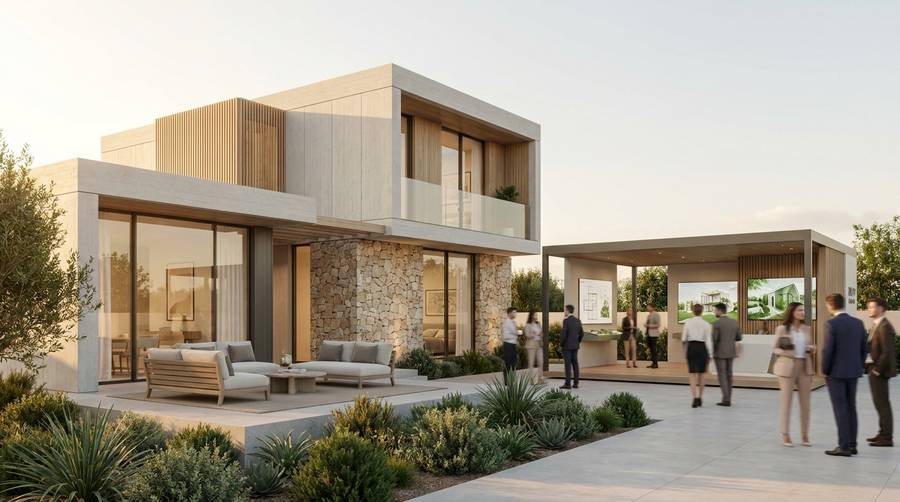
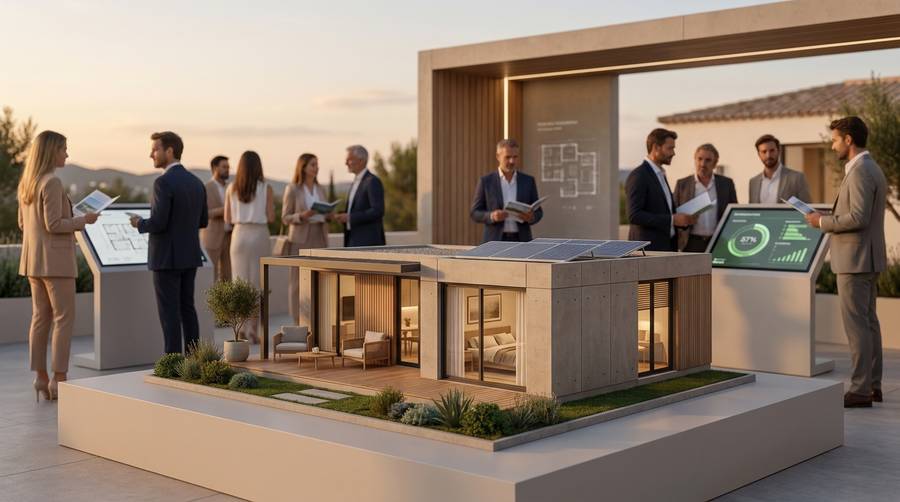
Trade fairs remain pivotal in Spain for converting interest into contracts. Well-run events accelerate trust-building by combining live demonstrations, panel data and access to financing partners. Exhibitors that showcase a working model, clear timelines and sample budgets convert at a higher rate.
- Top-performing stands present: sample finishes, production timelines and finance options.
- Measure success by leads-to-contract conversion rather than visitor counts.
Public perception and adoption: survey insights from self-builders
Recent surveys among autopromotores show rising confidence: around 65% now view industrialized housing as equal or superior to traditional construction on predictability and energy performance. Main concerns remain regulatory complexity and plot-specific risks.
65% of self-builders now consider industrialized housing at least as reliable as traditional construction—a tipping point for mainstream adoption.
Technological trends and materials shaping the future
Technical comparison: industrialized concrete vs light wood frame vs steel frame
Each structural system has strengths depending on performance targets and site constraints:
- Industrialized concrete: excellent thermal mass and acoustic performance; suited for multi-storey and urban infill; higher embodied carbon unless paired with low-carbon mixes.
- Light timber frame: low embodied carbon, rapid factory assembly, excellent for single-family homes and Passivhaus targets; requires robust moisture control detailing.
- Steel frame: high precision and long spans, ideal for modular volumetric systems; steel recycling mitigates embodied carbon but requires energy during production.
Decision matrix: choose timber for low-carbon, concrete for acoustics/thermal mass, steel for complex geometries and multi-storey modularity.
Manufacturing and assembly innovations that cut time and cost
Three innovations are driving efficiency:
- Line production in factories: component standardization and batch workflows reduce unit cost 8–15%.
- Pre-installation of systems: delivering façades and MEP (mechanical, electrical, plumbing) pre-fitted saves on-site labour and shortens wet trades.
- Lean logistics: synchronized parcel-to-factory schedules lower on-site assembly windows and risk of weather delays.
Standardization and digitization: BIM, assembly-line prefabrication and QA
Adoption of BIM and digital twins allows manufacturers to push quality control upstream. The result: fewer on-site variations, less rework and predictable OEE (overall equipment effectiveness). Standard components paired with digital procurement reduce lead times and improve cost transparency for autopromotores.
Sustainability and energy efficiency: moving toward Passivhaus and lower carbon footprints
Emission and consumption metrics: recent case studies
Case studies of recent turnkey projects show:
- Operational energy reductions of 60–85% versus baseline new-builds when certified to Passivhaus principles.
- Embodied carbon: timber-frame homes can lower upfront emissions by 20–40% compared to traditional masonry, depending on material sourcing.
- Lifecycle outlook: a 30-year comparison often favors industrialized solutions because performance degradation is lower and maintenance is predictable.
Constructive strategies to achieve energy certifications in industrialized builds
Practical steps to reach high performance without exploding budgets:
- Start with a compact form factor and high-quality envelope detailing.
- Combine mechanical ventilation with heat recovery (MVHR) and optimized glazing ratios.
- Use pre-certified assemblies to simplify on-site verification and speed certification.
Passive and active materials/solutions balancing cost and performance
Balance is critical. Recommended mix:
- High-performance insulation panels manufactured under factory QA.
- Triple-glazed units with thermally broken frames where solar gains are limited.
- Photovoltaics sized to cover base loads and heat pumps for space heating.
Business models, financing and options for self-builders
Mortgages for self-building and modular housing finance
Spanish financial institutions increasingly offer targeted products for autopromoción and modular housing. Common features include staged disbursements aligned to factory milestones and dedicated appraisal frameworks for off-site-built properties.
- Look for lenders offering fixed-price release schedules tied to factory acceptance.
- Ask for formal valuation methods that recognise reduced on-site risk and guaranteed timelines.
Commercial models: turnkey, partial packages and assisted self-build
Three prevalent commercial models:
- Turnkey: single point of responsibility from plot search to keys—best for clients who prioritise predictability.
- Partial package: manufacturer supplies structure and envelope; promoter manages finishes or site works.
- Assisted self-build: hybrid with consultancy to manage permits, procurement and contractor coordination.
Economic evaluation: CAPEX and OPEX versus traditional build
Normalized comparisons show industrialized housing often matches or undercuts traditional CAPEX when factoring reduced schedules, lower dispute costs and predictable fixed pricing. OPEX is usually lower due to better airtightness and energy systems—critical for buyers comparing total cost of ownership.
Optimizing the turnkey process: from plot to handover
Critical phases and bottlenecks: real timelines and how to shorten them
Typical turnkey timeline and improvement levers:
- Site procurement and due diligence: 1–4 months; accelerate with standardised soil and connection checklists.
- Design and approvals: 2–6 months; use pre-approved modular typologies to reduce planning friction.
- Factory production: 2–4 months depending on complexity; secure slots in advance to avoid lead-time inflation.
- On-site assembly and commissioning: 1–2 months; optimize logistics and pre-fit systems to cut this window.
Coordinating plot‑factory‑site: logistics, permits and risk management
Best practices:
- Align delivery windows with municipal permit timelines and utility connection schedules.
- Use a single project schedule with shared milestones for manufacturer, site contractor and client.
- Transfer risk via clear contract clauses on delays, defects and force majeure.
Case study: turnkey project metrics (times, costs, satisfaction)
Illustrative example: a 140 m2 timber-frame turnkey home near Valencia.
- Plot acquisition & due diligence: 2 months.
- Design & permits: 3 months using a pre-approved typology.
- Factory production: 10 weeks.
- On-site assembly & commissioning: 5 weeks.
- Total turnkey time: ~8 months from contract to keys; final cost aligned to initial fixed price within a 2% variance.
- Client satisfaction score: 9/10 on delivery and energy performance at six-month review.
Opportunities in fairs and markets: positioning your project to capture self-builders
Communication and exhibition strategies to attract self-builders
Effective exhibitor playbook:
- Show a real case with clear metrics (time, cost, energy performance).
- Offer a financing partner on-stand and staged demonstrator displays.
- Prioritise conversational demos over brochures; capture lead intent and next steps.
KPIs to measure at events: leads, conversion and returns for modular projects
Measure:
- Qualified leads (budget + plot): prime KPI for conversion.
- Conversion rate to contract within 6–12 months.
- Cost per signed contract compared to digital acquisition channels.
Strategic partnerships with manufacturers, promoters and financial institutions
Alliances shorten time-to-market. Forge partnerships that combine manufacturing capacity, local promotor expertise and mortgage solutions to present a unified value proposition to autopromotores. For exhibitor mistakes and how to fix them, see Errores en ferias de vivienda industrializada y cómo solucionarlos.
Vision 2030: scenarios, risks and practical recommendations
Plausible scenarios for mass adoption of industrialized housing
Three scenarios:
- Steady growth: continued regional adoption and 25–30% market share in new single-family builds.
- Accelerated adoption: enabled by favourable regulation and finance, modular reaches parity with traditional in procurement cycles.
- Fragmented niche: growth stalls if permitting complexity remains and financing lags.
Major risks: regulatory, market and supply chain
Key risks to monitor:
- Regulatory ambiguity over off-site built certification and local planning.
- Supply chain concentration for key materials (insulation, glazings).
- Market perception risks if low-quality products are introduced.
Practical recommendations for companies, self-builders and event organisers
Actionable checklist:
- Standardise product families and document performance—this eases permits and valuations.
- Secure finance partners that understand staged modular delivery.
- Invest in customer education at events—show metrics, not just visuals. For a complete guide for autopromotores, consult Vivienda industrializada: guía completa para autopromotores 2026.
Industrialized housing is not a single technology—it's a systems shift. Companies that combine repeatable product families, robust financing pathways and transparent turnkey processes will define the next five years in Spain.
If you're planning a self-build or organising an exhibition, start by aligning project timelines, standard components and finance early. For tailored guidance or to benchmark your project against real turnkey metrics, get in touch and we can review your plot-to-keys plan together.
Artículos relacionados