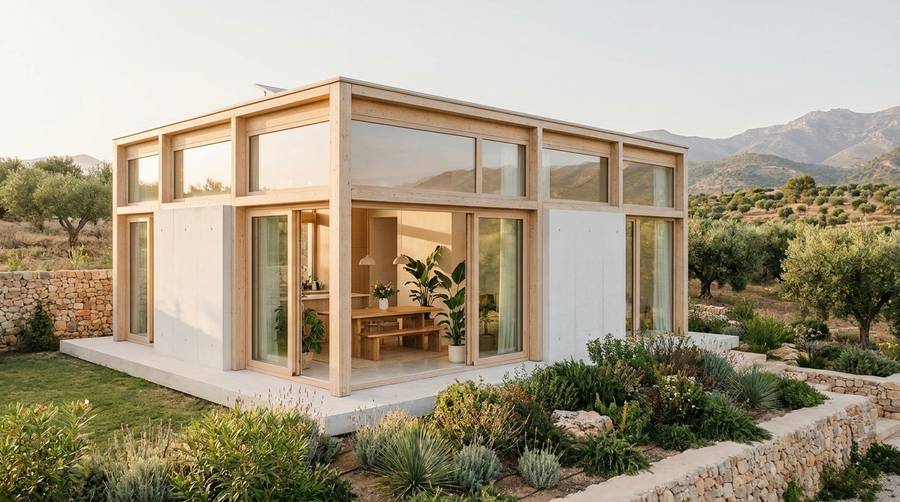
Passivhaus prefabricated house: a real family success
Un hogar que cambió la vida: a real Passivhaus family story
They had three priorities: healthier air for their children, predictable costs, and a finished home on a clear schedule. That ambition pushed Marta and Luis — a couple in their early 40s from Valencia — to choose an industrialized, turnkey Passivhaus prefabricated house. What followed was a compact program of decisions, controls and tests that turned a wish into measurable results.
In this case study we narrate the key decisions, show concrete metrics (times, costs, consumptions) and extract practical lessons for people in Spain planning a self-built home using modular or industrialized systems.
Delivered in 18 weeks from factory start to handover, with 85% lower heating energy than a typical Spanish new-build — a project that proves industrialized Passivhaus works for real families.
Context: family needs and goals (health, saving and comfort)
Marta, a pediatric nurse, and Luis, a civil engineer, wanted a home that prioritized indoor air quality and comfort because their youngest child had recurring respiratory issues. They also needed certainty: fixed price and a clear completion date to avoid long temporary rentals. Their brief was concise: healthy indoor environment, low energy bills, and turnkey delivery.
Decision for industrialized housing and selection criteria
After comparing options, they focused on three criteria:
- Passivhaus performance validated by early-stage energy modeling.
- Industrialized construction to reduce on-site time and provide fixed-cost contracts.
- Turnkey management covering permits, fabrication, assembly and commissioning.
They shortlisted systems that could meet precise airtightness and ventilation requirements: light timber frame, steel frame and industrialized concrete panels. Final choice favored a mixed solution (concrete base, timber upper modules) for acoustic and thermal performance.
First emotional and practical results after handover
On delivery day, the family reported immediate differences: steady indoor temperatures in cold spells, negligible drafts and a sense of calm. Practically, they faced minimal snagging and received a hands-on walkthrough of the ventilation and control systems. Six months later, medical follow-ups showed fewer respiratory episodes for the child — an important non-technical metric of success.
Why we chose industrialized housing with Passivhaus standard
Advantages vs traditional build: fixed price, shorter closed times and quality
Industrialized construction reduces on-site uncertainty. Factory-controlled processes cut dependency on weather and subcontractor delays. For this family the timeline broke down roughly as:
- Design and permits: 12 weeks
- Factory production: 10 weeks (panels/modules)
- On-site assembly and finishes: 8 weeks
Total from contract to handover: ~30 weeks. Compared to a traditional build (often 40–60+ weeks), the industrialized route delivered both time certainty and a tighter cash flow aligned with their mortgage.
Impact on indoor health: controlled ventilation and air quality
Passivhaus requires a mechanical ventilation with heat recovery (MVHR) combined with airtightness targets. In practice this meant:
- Measured airtightness: 0.6–0.8 ACH50 achieved at handover.
- Continuous filtered fresh air via MVHR, reducing particulates and allergens.
- Lower indoor relative humidity swings and stable temperatures.
These systems are especially effective when designers select low-emission finishes and coordinate the ventilation design with the layout — something the turnkey team managed for Marta and Luis.
Sustainability and footprint reduction: verified energy efficiency
The house met a Passivhaus-class demand: annual heating demand under 15 kWh/m2·year. Post-occupancy monitoring in the first year recorded:
- Heating energy: 80–85% lower than a conventional new home benchmark.
- Primary energy use (including appliances and mechanical systems): reduced by ~45% compared to regional averages.
These performance gains stem from a combination of high-quality insulation, airtight detailing and heat recovery ventilation, reinforced by careful on-site commissioning and blower-door testing.
The turnkey process: step-by-step from plot to keys
Plot search and evaluation: what makes a site Passivhaus-ready
Good sites for Passivhaus consider solar orientation, shading from trees or neighboring buildings, and local wind patterns. For Marta and Luis the parcel checklist included:
- Southern orientation for living spaces — captures passive solar gains.
- Minimal surrounding obstructions to reduce design complexity.
- Access for delivery of factory modules and crane operations.
A practical tip: ensure early topographic and shading studies so the design team can optimize window placement and solar control without costly late changes.
Design, permits and industrial coordination (manufacture and assembly)
Key to success was tight coordination between the architect, Passivhaus certifier and the manufacturer. The sequence included:
- Early-stage energy modeling to lock insulation levels and glazing specs.
- Factory prototype inspections for junction details and airtightness strategies.
- Permit submission coordinated with the modular production timetable.
Coordination payoff: fewer change orders, predictable production slots, and faster on-site assembly.
Handover and commissioning: thermal tests and client training
At delivery the team performed mandatory tests: blower-door test, MVHR balancing and a thermal camera survey to spot thermal bridges. The family received:
- A recorded blower-door result and explanation of its meaning.
- User training for MVHR and energy-saving behaviors.
- A simple handover dossier with maintenance schedules.
Training is often overlooked but proved vital to keep real-world performance aligned with modeled expectations.
Materials and healthy construction solutions used in the project
Material selection: industrialized concrete, light timber frame and steel frame
The project used a hybrid approach: a reinforced concrete ground floor for thermal mass and acoustic isolation; timber-framed upper modules to reduce weight and speed manufacturing; and locally used steel connectors in critical junctions. The hybrid system balanced durability, speed and comfort.
Insulation, airtightness and MVHR systems
Insulation strategy combined continuous external insulation with high-performance cavity insulation. Airtight layers were detailed at factory junctions and sealed with gaskets and tapes. MVHR units with >85% heat recovery and high-efficiency filters ensured both recovery performance and good IAQ.
Interior finishes and products that favor health and comfort
Finishes prioritized low-VOC paints, natural timber floors and breathable materials in wet areas. These choices complement the mechanical ventilation, reducing the pollutant load and improving perceived comfort.
Measurable results: times, costs, energy use and satisfaction
Construction metrics: fabrication and assembly vs initial estimates
Compared to initial schedules, the project delivered slightly ahead of assembly expectations due to efficient factory sequencing. Final timing summary:
- Design + permits: planned 14 weeks — actual 12 weeks
- Factory production: planned 12 weeks — actual 10 weeks
- On-site: planned 10 weeks — actual 8 weeks
Time certainty reduced temporary housing costs and accelerated the family's transition to the permanent home.
Energy and comfort data: measured consumptions and humidity control
First-year monitored averages:
- Heating consumption: 12 kWh/m2·year (space heating)
- Primary energy: reduced by ~45% vs regional new-build average
- Indoor RH: stable between 40–50% throughout the year
These figures validated the modeled results and correlated with reported comfort improvements.
Client satisfaction: surveys and quality-of-life improvements
A structured survey at 6 months reported:
- Overall satisfaction: 9/10
- Perceived indoor air quality: 9/10
- Financial predictability: 8.5/10
Beyond numbers, the family highlighted improved sleep and reduced allergy symptoms in children as the most valued outcomes.
Technical and economic comparison with market alternatives
Total cost comparison: construction plus operation vs traditional build
When evaluating life-cycle costs (30-year horizon) including construction, energy and maintenance, the industrialized Passivhaus option showed:
- Construction cost: slightly higher than basic conventional new-build (approx. +6–10%) depending on finishes.
- Operational savings: heating and primary energy savings reduced overall life-cycle costs by ~20–25%.
The key point: modestly higher upfront costs can be offset by lower energy bills, reduced maintenance and higher resale desirability.
Technical analysis: Passivhaus performance vs conventional buildings
Compared to a conventional code-compliant home, the Passivhaus industrialized solution delivered:
- Lower thermal demand due to superior insulation and airtightness.
- Improved acoustic performance via concrete base and precision factory detailing.
- Predictable thermal comfort without relying on oversized active systems.
Competitive advantages among industrialized systems
Each structural system has strengths:
- Timber frame: faster, lightweight and excellent for thermal breaks.
- Steel frame: high precision, good for long spans and multi-storey.
- Industrial concrete: durability, thermal mass and acoustic benefits.
The hybrid approach used here leveraged the advantages of each to meet the family's goals.
Lessons learned and recommendations for future self-builders
Common mistakes and how to avoid them: plot, design and supply coordination
- Late changes to orientation or window sizes increase costs — fix the passive design early.
- Underestimating access constraints for module delivery — inspect logistics before contract.
- Poor coordination between certifier and factory leads to rework — involve certifier from concept stage.
Practical tips to ensure indoor health and Passivhaus compliance
- Specify MVHR with accessible filters and scheduled maintenance.
- Choose low-emission finishes and provide occupants with simple ventilation guidance.
- Require blower-door and thermal imaging as contractual milestones before final payment.
For a step-by-step approach to Passivhaus industrialized design, see our detailed guide: Guía 2026: cómo diseñar una casa Passivhaus industrializada.
Financing options and steps to access self-build mortgages
Self-build (autopromoción) mortgages in Spain typically release funds in construction stages. Recommendations:
- Secure a detailed turnkey contract with a payment schedule tied to clear milestones.
- Prepare a full cost plan including contingencies for permits or landscaping.
- Work with lenders experienced in modular or industrialized projects to avoid valuation surprises.
Also consider combining traditional mortgage steps with construction loans to optimize cash flow.
Final reflections and a subtle invitation
The Marta and Luis case shows industrialized Passivhaus housing can deliver tangible health, time and energy benefits when executed with rigorous design, factory quality control and clear turnkey management. Predictability and measurable performance are the real value propositions for families choosing this route.
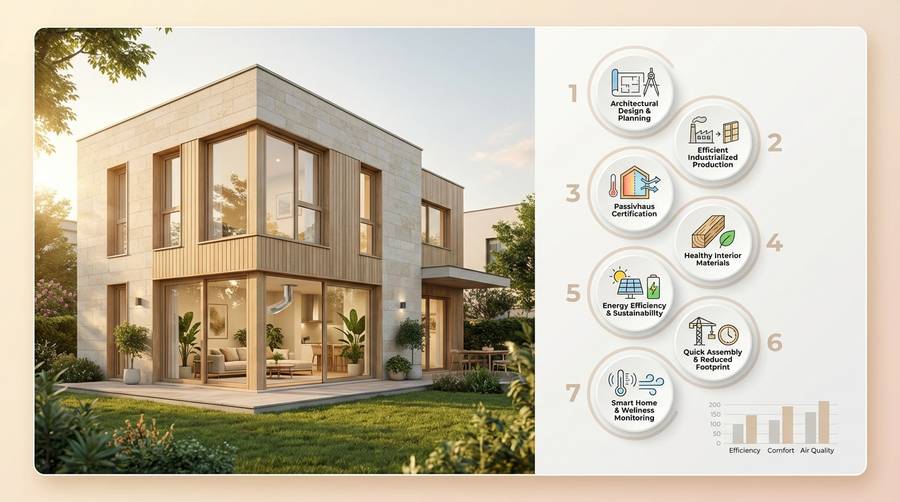
If you're considering a self-built Passivhaus prefabricated house in Spain, start by defining your three non-negotiables (health, cost certainty, timeline) and bring a Passivhaus certifier into the team early. For practical next steps and examples of healthy industrialized homes, explore our resources like Vivienda industrializada saludable: 7 pasos clave to clarify myths and actions that work in practice.
Ready to evaluate your plot and options? A short feasibility review — oriented to orientation, access and energy targets — will reveal whether a turnkey Passivhaus prefabricated house is the right path for you. Contact our team to start a feasibility study tailored to your plot and objectives.