Sustainable Modular Homes: Compare, Decide, Build
Why consider sustainable modular homes today
When a family in Valencia reached a fixed price and moved in just five months after signing, neighbours asked how it was possible. That surprise is the starting point for many who discover sustainable modular homes: an industrialized, predictable approach to building that challenges long-held assumptions about cost, time and quality.
Industry trends in Spain: demand, regulation and support for 2026
Spain's demand for off-site construction has risen due to labour shortages, stricter energy codes and incentives for low-carbon housing. Regional programs and EU recovery funds increasingly favour projects demonstrating energy performance and reduced embodied carbon. Expect faster permit processing for projects aligned with national sustainability targets and certifications such as Passivhaus or nearly zero-energy building regulations.
General benefits: sustainability, speed and cost control
- Predictable price: factory production converts many variables into fixed costs.
- Shorter weather-independent timelines: parallel manufacturing reduces on-site time.
- Better energy outcomes: integrated assemblies allow higher airtightness and insulation continuity.
- Less waste: controlled fabrication means fewer material losses and recycled cut-offs.
What differentiates an eco modular model from other prefabricated options
Not all prefabricated homes are equal. Eco modular models pair optimized production with sustainable materials, whole-building energy design and commissioning processes that verify performance after installation. The difference lies in three commitments: design for energy, low embodied carbon materials, and factory quality control that targets real-life comfort and durability.
“A measured, factory-built envelope plus on-site commissioning typically reduces delivered energy demand by 40–70% compared with standard new builds.”
Comparison: sustainable modular homes vs traditional housing
Execution time and critical phases: factory vs on-site
Modular path: design and permits run concurrently with factory production of components. Typical timeline for a 120–150 m2 single-family home: 8–20 weeks of factory work + 2–8 weeks on-site assembly, subject to foundation readiness and logistics.
Traditional path: sequential site stages—foundation, structure, enclosure, finishes—often 9–18 months for similar homes. Weather, subcontractor availability and change orders are common delays.
- Critical point for modular: early finalization of technical drawings and interfaces—late changes are costly.
- Critical point for traditional: weather and subcontractor coordination—can create queueing effects.
Direct and indirect costs: fixed price, contingencies and long-term value
Upfront cost comparison varies by region and specifications. In Spain in 2026, an eco modular solution with high-performance insulation and Passivhaus-level windows can be similar or slightly higher in base price than a conventional build once comparable finishes and certifications are included. However, the modular route tends to present fewer contingencies.
- Price certainty: modular contracts often include a fixed price for manufacture and assembly, reducing exposure to market inflation.
- Hidden costs in traditional builds: rework, delays and increased labour rates drive contingency spending.
- Life-cycle value: superior energy performance reduces operational costs and often increases market value.
Quality, durability and comfort: energy efficiency (Passivhaus) and real performance
Factory-controlled environments enable repeatable assembly of airtight joints, continuous insulation and precise installation of mechanical ventilation with heat recovery. These details translate into measurable outcomes:
- Lower heating demand (often 60–90% reduction versus poorly insulated traditional houses).
- Stable indoor temperatures and improved acoustic insulation.
- Predictable durability due to standardized quality checks.
Verification through on-site commissioning and post-occupancy monitoring ensures the theoretical gains become lived reality.
Materials and structural systems: sustainable options and implications
Industrialized concrete: performance, carbon footprint and uses
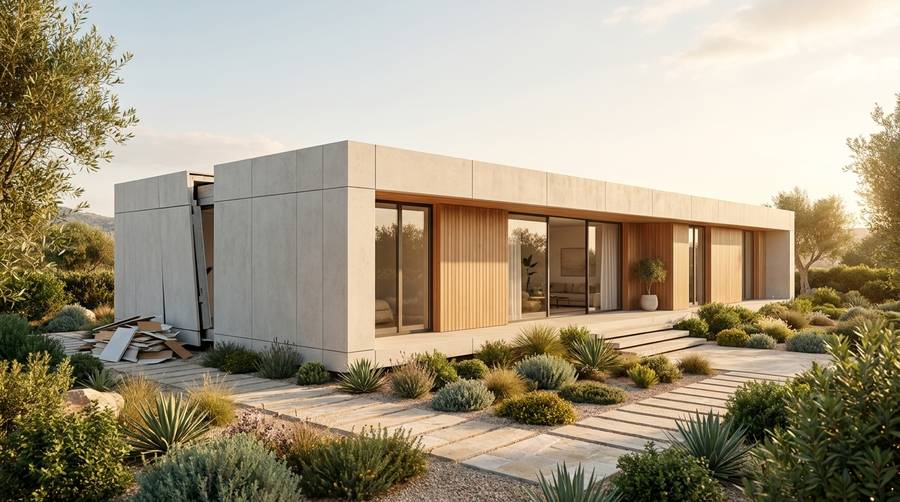
Pros: excellent thermal mass, long service life and architectural flexibility for contemporary Mediterranean façades. Precast or industrialized concrete panels can be optimized with supplementary cementitious materials to lower embodied carbon.
Cons: higher transport emissions when heavy components travel long distances; requires careful detailing to avoid thermal bridges.
Light timber frame: efficiency, insulation and life-cycle
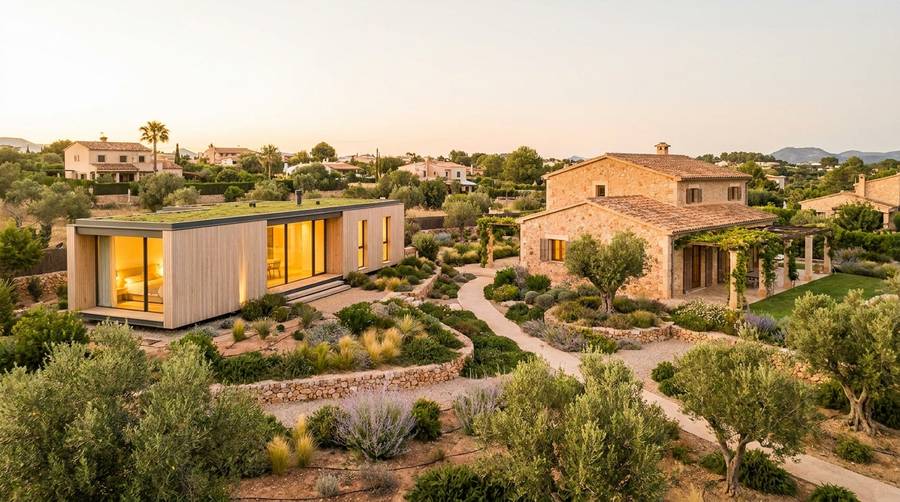
Pros: low embodied carbon, rapid fabrication, excellent hygrothermal behaviour and adaptability for off-site panels. Timber frames integrate well with natural finishes consistent with Mediterranean aesthetics.
Cons: require rigorous moisture management and certified supply chains to ensure sustainability claims.
Steel frame (steel frame): speed, strength and finishing compatibility
Pros: high dimensional stability, suitable for long spans and quick assembly; compatible with a wide range of façades that achieve a Mediterranean look.
Cons: higher embodied carbon per kg than timber; however, selective use and recycled content can reduce impacts. Thermal break details are essential to prevent condensation and heat loss.
Practical pros and cons of eco modular models
Key advantages: schedule control, industrial quality and energy efficiency
- Controlled timeline: overlapping tasks reduce total calendar time.
- Reproducible quality: factory QA/QC minimizes on-site errors.
- Higher performance envelope: enabling Passivhaus or nearly zero-energy buildings more economically.
- Lower site disruption: shorter on-site presence reduces neighbourhood nuisance and temporary site costs.
Limitations and risks: design freedom, transport and site constraints
- Design constraints: transportation dimensions and module interfaces set some limits; complex curves and highly bespoke forms add cost.
- Logistics: narrow roads, steep access or restricted permits can complicate delivery.
- Perception risk: outdated ideas about prefabrication may require client education.
How to mitigate downsides: planning, vendor selection and guarantees
- Start site feasibility early: topography, access and foundation type influence module design.
- Choose vendors with transparent production data, warranties and commissioning processes.
- Include testing and performance guarantees (airtightness, thermal camera inspection).
Turnkey process for self-builders: from land to delivery
Searching for land and viability checks essential for modular builds
Key checks before purchase:
- Zoning and maximum buildable area (occupancy, height limits).
- Access for articulated trucks and crane placement.
- Ground-bearing capacity and drainage—modular foundations can be lighter but still require geotechnical data.
Include these questions when evaluating plots to avoid later modifications.
Design, permits and factory production: coordinating project and workshop
A tight process map helps:
- Finalize schematic design early to freeze module geometry.
- Run permitting and structural checks while the factory prefabricates components.
- Schedule inspections and third-party testing into the timeline.
Logistics, assembly and handover: timelines, inspections and commissioning
Typical onsite sequence: foundation, delivery, craning and assembly (days to weeks), envelope closure, services connection, commissioning and final inspection. Factor in:
- Cranes and traffic permits.
- Planned on-site inspections and airtightness testing.
- Client walkthrough and a snagging period with a clear warranty.
Financing and support for self-building modular homes in Spain
Self-build mortgages and specialised products for industrialized housing
Spanish banks increasingly offer staged drawdown mortgages for self-build projects. For modular homes, lenders often prefer contracts with fixed prices, production milestones and evidence of factory controls. Presenting a full turnkey contract and supplier guarantees improves approval odds.
Payment models: milestones, guarantees and construction insurance
- Milestone payments: tied to factory completion, delivery and final commissioning.
- Retention clauses and guarantees: ensure post-handover fixes are funded.
- Builder's risk insurance: covers transport and on-site assembly risks.
Subsidies and energy certifications that improve financing
Energy-efficiency certifications (e.g., Passivhaus) can unlock regional grants or better mortgage conditions. Investigate local renewable and low-carbon incentives early; they can materially affect net project cost.
Real cases, metrics and a quick guide to decide
Case studies: measured times, costs and client satisfaction
Three anonymised examples illustrate typical outcomes:
- Case A — Coastal Mediterranean home (120 m2): timber-frame modules, completed in 18 weeks total. Fixed contract saved 8% versus initial traditional estimate. Achieved 65% heating demand reduction; client satisfaction score 9/10 for speed and indoor comfort.
- Case B — Suburban Passivhaus (150 m2): hybrid steel and high-performance panels. Factory phase 12 weeks; on-site assembly 3 weeks. Higher upfront cost (+6%) but energy bills reduced by ~70% and resale valuation increased by 5% in local market comparisons.
- Case C — Compact family house (95 m2): precast concrete panels with high thermal mass. Total delivery 20 weeks; lower maintenance expectations and strong acoustic performance. Client rated process clarity 8.5/10.
Practical checklist to compare proposals and choose
- Ask for itemised fixed-price quote and change-order policy.
- Request factory QA reports and third-party test results (airtightness, U-values).
- Check delivery logistics and required on-site equipment.
- Verify warranties, performance guarantees and post-handover support.
- Compare life-cycle costs, not just initial price—include energy and maintenance.
Summary: when to pick sustainable modular and next steps for self-builders
If you value schedule certainty, verifiable energy performance and reduced on-site disruption, sustainable modular homes are often the better route—especially for self-builders aiming for Passivhaus or low-carbon outcomes. If you need extreme bespoke geometry or local artisan finishes that evolve during construction, a traditional approach may suit better.
Next steps: commission a plot viability check, request at least three detailed turnkey proposals and insist on performance verification clauses. For a broader practical guide, see Casa prefabricada vs tradicional: guía práctica 2026 for additional context.
Ready to explore options? Start with a site feasibility report and a transparent turnkey quote to compare real numbers—time, cost and expected performance will make the decision clear.
Artículos relacionados