Prefabricated House vs Traditional: Materials Compared
Why choose circular materials in construction: context and goals
Imagine cutting construction waste by half while delivering a warmer, faster-built home. That bold promise is the driving idea behind adopting circular materials in modern housing — especially when paired with industrialized construction methods. This section explains what circular materials mean for your project and what realistic goals you can expect.
What we mean by circular materials and why they matter
Circular materials are those designed for reuse, recycling or recovery at the end of their life. In practice, this means higher recycled content, ease of disassembly and lower embodied carbon. For a self-builder in Spain, that translates into tangible benefits: reduced material costs over time, simpler deconstruction paths and better alignment with emerging regulations and incentives.
General benefits: lower carbon, resource efficiency and improved performance
- Lower embodied carbon: Choosing low-carbon concrete mixes, reclaimed timber or recycled steel reduces the lifecycle carbon footprint.
- Material efficiency: Factory precision reduces offcuts and waste compared with on-site cutting.
- Predictable supply chains: Standardized components mean fewer surprises during build.
- Performance gains: Many circular products meet strict thermal and acoustic standards out of the box.
How circularity fits with industrialized housing and turnkey delivery
Industrialized housing — prefabricated panels, volumetric modules and factory-made systems — pairs naturally with circular materials because factories can sort, certify and pre-assemble materials to enable future reuse. In a turnkey model ('llave en mano'), this reduces coordination risk: the platform manages procurement of certified circular products, guaranteeing traceability and simplifying compliance.
Fact: Off-site construction can reduce material waste by up to 60% versus traditional on-site builds when paired with circular supply chains.
Technical comparison: precast concrete vs timber frame vs steel frame
When choosing material, your priority list will likely include thermal performance, durability, maintenance and end-of-life options. Below is a focused technical comparison to help decide which suits your project.
Construction characteristics, thermal and acoustic performance
- Precast concrete: Excellent thermal mass and acoustic insulation when combined with high-performance envelope insulation. Works well for multi-storey and for achieving airtight, heavy envelopes.
- Light timber frame (entramado ligero): High thermal performance for lightweight envelopes, fast assembly and strong suitability for Passivhaus-level insulation with proper detailing.
- Steel frame (steel frame): High strength-to-weight ratio, very predictable tolerances. Thermal bridging must be managed with thermal breaks and continuous insulation to reach top energy ratings.
Durability, maintenance and potential for disassembly
Durability varies by detailing and maintenance rather than base material alone.
- Precast concrete: low maintenance, long service life, but more complex to disassemble intact for reuse.
- Timber frame: if detailed against moisture, timber can be reused or repaired easily; components can be dismantled and repurposed.
- Steel frame: highly recyclable and suitable for disassembly; connections can be designed for reuse but require coordination in the factory and on site.
Environmental impact and life cycle carbon (key data)
Life Cycle Assessments (LCA) show trade-offs:
- Precast concrete often has higher embodied carbon per m2 but offers thermal mass that can lower operational energy in certain climates.
- Timber frame tends to have the lowest embodied carbon when sourced responsibly; carbon remains stored in the wood.
- Steel frame has higher embodied carbon than timber but benefits from high recycled content and circular recyclability.
For autopromoters, the meaningful metric is total kgCO2e per m2 over 50 years. Lightweight timber systems frequently lead in lower lifetime footprints, especially when paired with renewable energy and efficient envelopes.
Advantages and disadvantages of using circular materials on site
Choosing circular materials delivers measurable benefits but also introduces practical challenges. Below is an honest, actionable list you can use during vendor selection and contract negotiations.
Advantages: process efficiency, shorter closed-shell times, fixed price and less waste
- Faster closed-shell (plenum) times: Factory-made components reduce weather-related delays, accelerating key milestones.
- Cost predictability: Standardized factory pricing enables tighter turnkey budgets and fewer variations.
- Lower waste: Factory optimization and return streams reduce landfill and disposal costs.
- Better compliance: Certified circular products simplify LCA reporting and access to green mortgage programs.
Disadvantages and challenges: logistics, regulations, local supply and upfront costs
- Logistics complexity: Transporting large panels or modules requires planning and can increase costs for remote plots.
- Regulatory hurdles: Local building codes and municipal approvals may be slower for newer circular solutions.
- Availability: Not all regions have local suppliers of certified circular materials, affecting timelines.
- Initial cost: Some circular products carry higher procurement prices; payback comes via lifecycle savings, not always immediate.
Practical mitigations: supplier selection, design for disassembly and warranties
- Prequalify suppliers on traceability, certifications and delivery performance.
- Use design-for-disassembly (DfD) principles: bolted rather than glued connections, labeled components and documented BOMs.
- Negotiate factory performance guarantees and maintenance packages within the turnkey contract.
How material choice affects prefabricated vs traditional builds
Material selection interacts with build method to influence schedules, financing and certification outcomes. Below are concise comparisons every self-builder should weigh.
Timescales and quality control: factory vs on-site
- Prefabrication: Controlled factory conditions shorten the on-site phase to foundation and assembly, typically cutting overall calendar time by 30–50%.
- Traditional on-site: Weather-dependent, higher variability and longer finishing stages.
- Quality: Factory QA/QC lowers the chance of rework and hidden defects.
Budget and financing: impact on self-build mortgages and turnkey costs
For autopromoters, lenders evaluate both cost predictability and completion risk. Industrialized, circular approaches provide:
- More predictable turnkey pricing — easier to show to mortgage underwriters.
- Shorter drawdown periods — less time in interim financing and lower interest cost overall.
- Access to green mortgage products if the home targets energy certifications like Passivhaus or low embodied carbon.
Housing quality and energy certifications (e.g., Passivhaus) by material
All three major systems can meet high energy standards when designed correctly:
- Timber frames often reach Passivhaus performance with relatively simple detailing.
- Steel frames require careful thermal break design but offer precise tolerances for airtightness.
- Precast concrete combined with continuous insulation can deliver excellent thermal inertia and comfort.
Practical decision criteria: step-by-step guide for self-builders
This checklist helps prioritize facts and reduce emotion during material choice. Use it as a decision template for meetings with architects, structural engineers and turnkey providers.
Assess the plot, climate and local rules in Spain
- Check municipal requirements for façades, heights and materials.
- Consider local climate: coastal Mediterranean benefits from thermal mass and shading strategies, while interior continental climates prioritize insulation.
- Logistics: assess road access and crane zones for large prefabricated elements.
Sustainability checklist: recyclability, recycled content and lifespan
- Request supplier LCA summaries or EPDs (Environmental Product Declarations).
- Prioritize materials with documented recycled content and end-of-life recovery plans.
- Factor in expected service life and maintenance schedule when calculating lifecycle cost.
Integrate budget, timeline and aesthetics
- Set a clear priority order (e.g., energy performance > upfront cost > finish flexibility).
- Ask lifecycle-based questions during quotes: what are 10- and 30-year operating costs?
- Confirm sample finishes to ensure the chosen system matches your Mediterranean aesthetic goals.
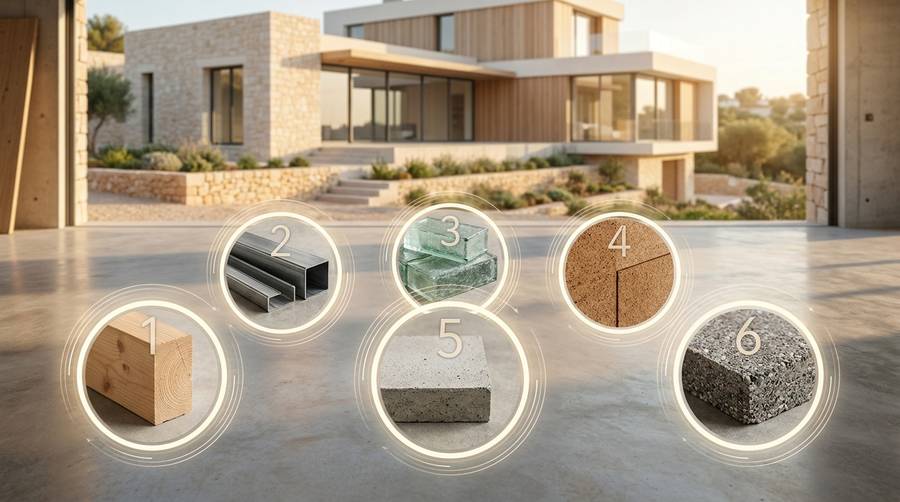
For deeper guidance on circular products and metrics, consult Materiales circulares en vivienda industrializada and 6 materials circulares para vivienda industrializada.
Short case studies: metrics and lessons
Real metrics help separate marketing from reality. Below are two concise, anonymized cases from recent projects in Spain showing times, costs and satisfaction.
Case A: Modular home with timber frame — timeline, cost and satisfaction
Project profile: 150 m2 single-family home on Mediterranean plot. System: light timber frame panels produced in factory and assembled on-site.
- Closed-shell time: 8 working days on site (foundation not included).
- Turnkey duration: 18 weeks from factory order to handover.
- Cost per m2 (turnkey): competitive with traditional build; initial premium of ~6% offset by lower schedule risk.
- Customer satisfaction: high — clients highlighted comfort, low on-site disruption and rapid delivery.
Case B: Home with precast concrete — energy efficiency and carbon footprint
Project profile: 180 m2 two-storey house using precast concrete panels with added external insulation.
- Closed-shell time: 5 days for panel erection.
- Turnkey duration: 20 weeks total.
- Operational performance: low cooling peaks due to thermal mass; achieved near-Passivhaus heating demand in local climate with active systems.
- Embodied carbon: higher than timber case but offset by long service life and lower maintenance needs.
Comparative summary and practical recommendations for Spain
Both systems deliver major benefits vs traditional masonry when factory processes and circular materials are used. Choose timber if low embodied carbon, speed and ease of disassembly are priorities. Choose precast concrete for robustness, acoustic performance and thermal mass. Steel suits projects prioritizing structural spans and reuse of high-strength components.
How to make the final decision: balanced criteria and recommended next steps
Deciding between materials and methods should be a structured process, not a gut call. Below is a compact decision flow and the practical next step we recommend for self-builders.
Balanced summary: who each material fits best
- Light timber frame: best for environmentally focused families who value speed, warm interiors and circularity.
- Precast concrete: suitable for clients seeking durable, low-maintenance homes with superior acoustic comfort.
- Steel frame: appropriate for bespoke spans, flexibility and projects planning future disassembly/reuse.
Key questions before signing a turnkey contract
- Can the supplier provide EPDs and traceability for major materials?
- What warranty covers panel connections, airtightness and finishes?
- How does the schedule allocate weather-sensitive tasks and foundation works?
- Does the financing plan match expected drawdown timing to avoid bridge loans?
Resources and services a comprehensive platform should provide
- Parcel search support and plot feasibility checks specific to industrialized systems.
- Pre-validated turnkey providers with documented LCAs and performance guarantees.
- Support to connect with green mortgage options or self-build financing providers.
Next step: request a feasibility review that compares two material/assembly scenarios for your plot — timeline, turnkey cost and a carbon snapshot. That single comparative report eliminates guesswork and informs lender conversations.
Choosing between a prefabricated house and a traditional build comes down to priorities: speed and predictability vs certain familiar trade-offs. Use objective metrics — schedule, kgCO2e/m2, lifecycle cost and aesthetic fit — to decide.
If you want, we can prepare a tailored comparison for your plot that includes timeline, estimated turnkey cost and a simple LCA summary to help present your case to lenders and planners.