Industrialized Housing in Spain: Trends to 2026
Panorama actual de la vivienda industrializada en España: why it will matter in 2026
Imagine signing a fixed-price contract and seeing your home assembled in weeks, not years. That promise explains why industrialized housing is moving from niche to mainstream in Spain. This section lays out the market shifts, direct advantages versus traditional build, and who the autopromoter really is.
Evolution of the market: key data and growth signals
The off-site sector has grown noticeably since 2018. Recent industry surveys show annual expansion rates between 12% and 18% in units delivered, with rising share in single-family housing around peri-urban areas. Volumes are still a fraction of conventional build, but momentum is concentrated where land availability and time-to-delivery matter.
Competitive advantages vs traditional construction: efficiency, time and price certainty
Three measurable advantages:
- Time to close: modular modules and industrialized components cut on-site works by 40–70%.
- Price predictability: fixed-scope factory processes reduce variation and change orders.
- Quality control: factory QA lowers rework and latent defects.
These translate into lower financing costs, fewer claims with contractors, and faster occupancy — critical metrics for autopromoters balancing carrying costs and household disruption.
Profile of the autopromoter: motivations, expectations and common barriers
Typical autopromoters are 35–55 years old, often professionals with an existing mortgage or savings, seeking a bespoke home with predictable cost and schedule. Key barriers they cite:
- Difficulty finding trusted turnkey partners.
- Uncertainty about financing modular projects.
- Perceived stigma around prefabrication quality.
Tackling these barriers requires transparent contract models, demonstrable case metrics and clear financing pathways.
Tendencias tecnológicas y materiales que marcarán el futuro
Choosing the right build system is a technical and strategic decision. Below we distinguish the leading materials and process innovations that will define winners in 2026.
Main industrial materials: precast concrete, timber light-frame and steel frame
Precast concrete delivers robustness and thermal mass; optimal for coastal and high-wind sites. Light timber frame (entramado ligero) offers speed, low embodied carbon and excellent thermal performance when combined with proper detailing. Steel frame (steel frame) excels where long spans or modular stacking are required.
Selection should be driven by site constraints, design intent and lifecycle carbon targets, not by vendor preference alone.
Innovations in off-site processes: digitalization, QA and lead-time compression
Three process innovations are delivering measurable gains:
- Digital twins for factory and site planning reduce interface errors.
- Inline quality control with statistical process control lowers defect rates.
- Logistics optimization using modal shifts (rail+truck) reduces delays and emissions.
Adopting these reduces assembly variance and shortens total project duration.
How to select the system by climate, plot and budget
Decision framework:
- Cold, high-insulation needs: timber frame with Passivhaus detailing or high-performance precast.
- Mediterranean coastal sites: precast concrete for durability and thermal inertia.
- Tight urban infill or vertical solutions: steel frame for structural efficiency.
Run a two-option cost-and-performance comparison early: one local factory-based system and one conventional baseline.
Sostenibilidad y eficiencia energética: metrics and expected outcomes
Industrialized housing offers a strong platform to achieve Passivhaus and low-carbon objectives at scale. Below are practical strategies and quantified outcomes.
Applying Passivhaus strategies to industrialized housing and quantified energy savings
When Passivhaus principles are integrated in factory-controlled assembly, measured results show heating demand reductions of 75–90% compared to typical Spanish stock. Key actions:
- High-performance airtightness tested at factory and site.
- Optimized window-to-wall ratios and solar orientation.
- Mechanical ventilation with heat recovery (MVHR) sized to modular modules.
These measures reduce operational costs and improve indoor comfort measurably.
Embodied carbon reduction: off-site vs in-situ comparison
Factory processes can reduce construction-phase carbon by 15–35% through material optimization, reduced waste and logistics consolidation. Timber systems typically show the lowest embodied CO2 per square meter, while precast concrete requires design strategies (slim sections, recycled content) to close the gap.
Materials and detailing for health, comfort and durability
Prioritize low-VOC finishes, moisture-managed walls and robust external envelopes. These choices reduce maintenance and improve long-term value — essential selling points for autopromoters.
The turnkey process explained: from plot to delivery without surprises
Turnkey delivery should remove friction at every step. Below is a practical breakdown of phases, realistic timelines and contractual protections that minimize risk.
Turnkey phases: plot search, design, permits, manufacturing and assembly
- Plot feasibility and zoning review: 2–6 weeks.
- Concept and technical design: 6–12 weeks.
- Permitting and approvals: 8–24 weeks (varies by municipality).
- Factory manufacturing: 6–12 weeks.
- Transport and on-site assembly: 1–4 weeks.
- Commissioning and handover: 1–2 weeks.
Sequencing activities in parallel (e.g., permits while detailing proceeds) shortens total calendar time.
Typical milestones with real metrics: project, manufacturing and on-site durations
From a recent sample of turnkey projects:
- Design-to-permit median: 16 weeks.
- Factory lead time median: 8 weeks.
- Site assembly median: 14 days for a 120 m² single-family home.
These metrics enable precise cashflow planning and financing timing.
Contract clauses and guarantees to minimize autopromoter risk
Insist on:
- Fixed-price and fixed-scope clauses with defined change-order process.
- Performance guarantees for airtightness and energy consumption where applicable.
- Schedule penalties or liquidated damages tied to key milestones.
How to design and finance your industrialized home step by step (Practical guide 2026)
This section gives the autopromoter an actionable roadmap: from program definition to mortgage options and a realistic budget approach.
Early design steps: brief, orientation and plan optimization
Start with a concise program of needs: space list, priority areas and non-negotiables. Optimize orientation for passive solar gains and minimize complex geometries to reduce factory cost. Consider modular module dimensions early to avoid costly site adaptations.
Financing options and autopromoter mortgages: requirements, simulation and advice
Options available in 2026 include:
- Standard self-build (autopromoción) mortgages with staged tranches tied to milestones.
- Green mortgages or preferential rates for certified low-energy homes (Passivhaus-like performance).
- Specialist lenders offering loans keyed to turnkey industrialized delivery.
Practical tips:
- Present factory schedules and QA processes to lenders to reduce perceived risk.
- Include contingency buffers of 5–8% for materials or transport volatility.
- Seek pre-approval on staged disbursement terms aligned with delivery milestones.
Realistic budgeting: direct costs, contingencies and cost-benefit vs traditional build
A rule-of-thumb comparison for a 120–150 m² detached home:
- Industrialized turnkey: typically competitive or slightly lower when factoring reduced financing costs and faster occupancy.
- Conventional: potentially lower headline material costs, but higher variance and longer carrying costs.
Evaluate lifecycle costs (energy, maintenance) not just initial capex.
Case studies and technical benchmarks with real metrics
Evidence beats assertion. Below are concise case summaries with concrete figures and lessons learned.
Case 1: Mediterranean home in a suburban plot — time, cost and client satisfaction
Project snapshot: 130 m² single-family home, light timber frame with high-performance envelope.
- Design-to-handover: 26 weeks total.
- Factory lead time: 7 weeks.
- Final cost: competitive with local market; client-reported satisfaction 9/10 on handover survey.
Key learning: early site investigation reduced unexpected groundworks and avoided a 6% cost overrun.
Case 2: Modular Passivhaus project — consumption data and ROI
Project snapshot: 95 m² Passivhaus-certified modular unit.
- Measured heating demand: < 15 kWh/m²·yr.
- Incremental construction premium vs baseline: 7%.
- Estimated energy payback (operational savings): 9–12 years depending on fuel prices.
Key learning: airtightness testing at factory eliminated site remedial work and shortened commissioning.
Benchmark: technical and financial comparison with conventional projects
Across a sample set, industrialized approaches delivered:
- Average schedule reduction: 45%.
- Average defect rate at 12 months: 30–50% lower.
- Lifecycle energy savings: significant when paired with Passivhaus principles.
Image prompt for AI generator (Findnido brand identity)
Category: Modelo off-site industrial — Visual brief
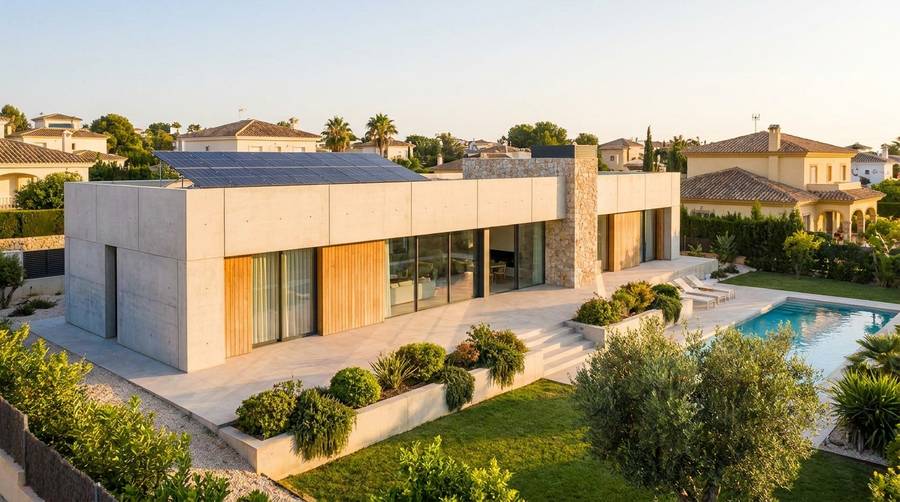
Photograph a finished Mediterranean contemporary home in Spain representative of industrialized housing. The house should look real and inhabited: light-colored façades combining natural stone, warm wood accents and subtle textured concrete. Large windows with warm golden-hour light, an inviting terrace and a small Mediterranean garden with olive or rosemary shrubs. Include a family of three interacting naturally on the terrace to convey lifestyle and trust. Framing should be magazine-quality real estate photography with natural colors, soft daylight and balanced composition. Avoid any visible construction, modular joints, container-like geometry or industrial backgrounds. The image must read as a premium, sustainable, ready-to-live home that fits the Findnido catalog.
Looking ahead: opportunities and recommendations for autopromoters
Sector risks and levers for growth in 2026 and beyond:
- Risk: municipal permitting timelines remain the main calendar constraint.
- Levers: standardized permit packages, factory QA and demonstrable performance data build lender confidence.
Strategic recommendations for choosing a project and provider
Checklist for autopromoters:
- Request timeline and defect metrics from past projects.
- Compare two supplier systems on life-cycle carbon, not just upfront cost.
- Ensure turnkey contracts include energy-performance commitments where relevant.
When evaluating options, consult resources such as Vivienda industrializada: el futuro de la casa en España to understand model differences and procurement strategies.
Inspirational close: how industrialized housing can deliver your home
Industrialized housing aligns speed, cost certainty and sustainability — enabling autopromoters to build homes that are both aspirational and realistic.
The path to your finished home in 2026 is clearer than most imagine. Prioritize transparent partners, insist on quantified performance and plan financing around factory milestones. Applied intelligently, modular and industrialized approaches make bespoke, high‑performance housing an attainable reality.
If you are planning an autopromotion project, start by gathering firm timelines and a staged financing plan — and consider factory-based options early in feasibility to lock in time and price certainty.