Prefabricated Homes with Photovoltaics: A Real Success Story
From idea to an efficient home: the story of a family who chose prefabricated homes with photovoltaics
They arrived at the site the week the roof panels were turning sunlight into usable energy — and they had never once paid a surprise invoice for construction work. That first sight captured why Marta and Luis abandoned traditional building and embraced an industrialized approach with integrated photovoltaics. Their motivations mixed sustainability, budget control and a tight schedule to move in before school year start.
Initial context: needs, plot and autopromoter expectations
Marta and Luis had a 600 m² plot in Valencia province, a fixed construction budget and a clear brief: ample daylight, good thermal comfort year-round, and predictable costs. They were autopromoters — meaning they wanted direct control over design and budget — but they were inexperienced with traditional on-site building timelines and exposed to frequent delays.
Why they chose industrialized housing with photovoltaics: sustainable and economic drivers
They prioritized two outcomes: a sustainable home with low energy bills and a guaranteed move-in date. Prefabricated construction offered tight quality control and fixed-price contracts, while integrated photovoltaics reduced long-term operating costs. The decision aligned with their values and mitigated the biggest pain points of conventional builds.
"We wanted certainty: on budget, on date, and on how the house would perform. That certainty was the single most valuable outcome for us." — Marta, homeowner
Measurable results: timelines, costs and real satisfaction
Schedule: from parcel purchase to turnkey delivery (actual dates and durations)
- Parcel purchase: Contract signed — January 2024
- Design and permits: Concept to approved license — February to May 2024 (14 weeks)
- Factory production: Module fabrication — June to August 2024 (10 weeks)
- On-site assembly and finishes: September 2024 (4 weeks)
- Systems commissioning and handover: Early October 2024 (2 weeks)
The total turnkey timeline was 30 weeks from parcel contract to keys in hand. Compared to typical local on-site builds averaging 12–18 months, this saved roughly 40–60% of calendar time.
Cost breakdown and comparison with traditional construction
The family tracked costs meticulously. Final turnkey cost: €245,000 (including plot improvements, foundation, photovoltaic system, and VAT). Key cost items:
- Site works and foundations: €25,000
- Factory-built modules and structure: €140,000
- Exterior finishes and landscaping: €25,000
- Integrated photovoltaic system (5 kWp, panels + inverter + monitoring): €18,000
- Systems (HVAC, electrical, plumbing): €22,000
- Permits, engineering, fees and contingencies: €15,000
Estimated comparable cost for a traditional build of the same specification: €260,000–€300,000 when factoring longer timelines, probable overrun cushions and higher on-site labor variability. The industrialized route delivered a 7–18% cost advantage while reducing uncertainty.
Satisfaction survey: perceived quality, energy bills and comfort
Six months after moving in, the family and an independent assessor reported:
- Perceived build quality: 9/10 — finishes and airtightness praised.
- Energy performance: Average monthly grid consumption dropped by 65% (compared to nearby conventional homes of similar size) thanks to PV generation and efficient envelope.
- Comfort: Stable indoor temperatures and low noise transmission. The Passivhaus-inspired strategies improved summer comfort with minimal active cooling.
Materials and construction system: choices that made the difference
Structure and finishes: industrialized concrete slabs vs timber frame and steel framing
The project combined an industrialized precast concrete ground slab with light timber-frame upper modules. This hybrid offered:
- Rigid, durable base: precast concrete reduced differential settlement risk and simplified connections for modules.
- Light, high-performance upper structure: timber frame modules delivered fast production, excellent thermal performance and reduced embodied emissions compared to full concrete.
- Steel frame where necessary: short-span steel inserts provided long uninterrupted openings for large windows common in Mediterranean architecture.
These material choices optimized cost, speed and sustainability while preserving the Mediterranean aesthetic Marta and Luis desired.
Photovoltaic integration: roof and envelope performance
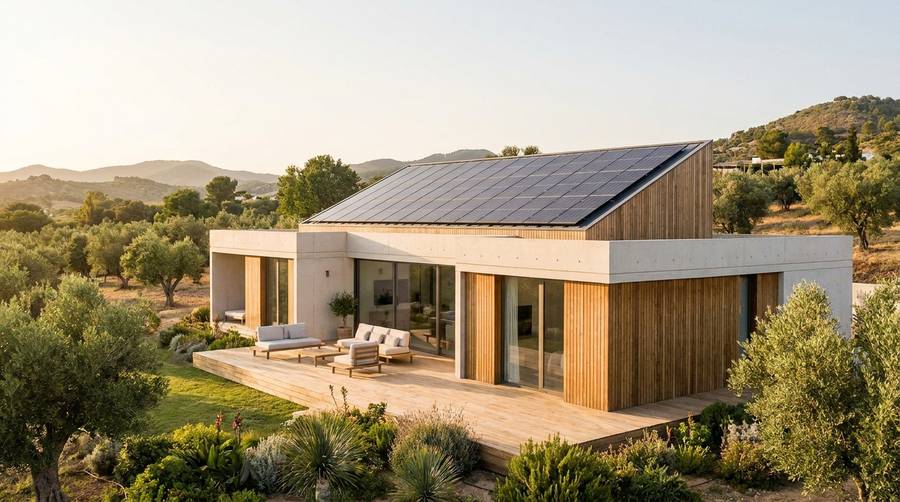
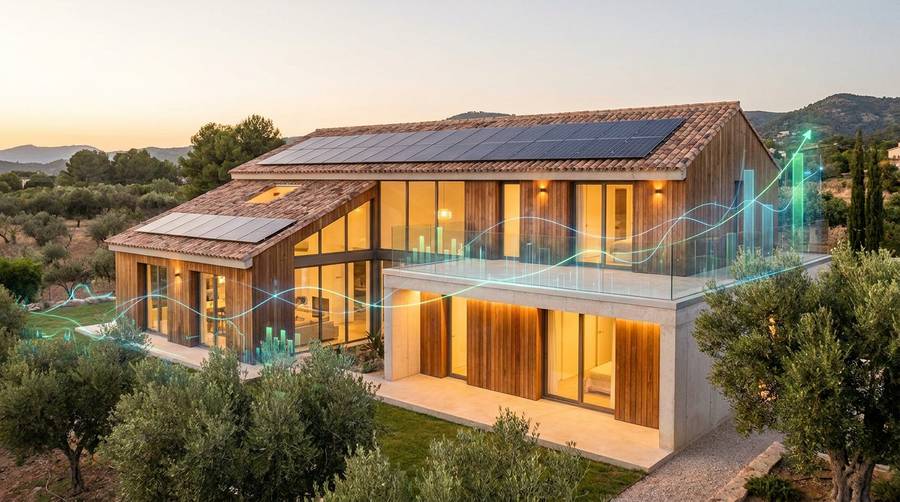
The 5 kWp rooftop photovoltaic system was integrated during factory module production to ensure watertight, aerodynamic detailing and aesthetic harmony. Key outcomes:
- System generated an annual estimated 6,200 kWh, covering 80% of the household's needs with net metering during peak sunny months.
- Factory integration reduced on-site commissioning time by two days and avoided typical roof-mounted wiring errors.
- Roof and canopy geometry was optimized to minimize shading and maximize generation while respecting the Mediterranean facade proportions.
For technical readers, the family later chose to explore more on integrated PV design in this complementary study: Vivienda industrializada con fotovoltaica: futuro en España and practical design steps here: Cómo diseñar una casa prefabricada fotovoltaica en España.
Energy certification and Passivhaus criteria applied
The project did not pursue full Passivhaus certification due to budget balance choices, but it adopted core Passivhaus principles:
- High-performance insulation with continuous thermal envelope.
- High-quality triple-glazed windows with low-e coatings and thermally broken frames.
- Mechanical ventilation with heat recovery (MVHR) sized to family occupancy.
- Tightness target below 1 ACH at 50 Pa, verified in factory and on-site.
As a result, the home performed similarly to certified low-energy houses in the region, with predictable heating needs and lower HVAC sizing costs.
The turnkey process explained with data
Key phases: plot search, design, permits, manufacturing, assembly and delivery
The process split into six managed phases, with specific deliverables at each step to reduce friction:
- Plot selection: Site survey, geotechnical quick study, and orientation analysis — 2 weeks.
- Design: Schematic to construction drawings including PV layout — 8 weeks.
- Permits: Local license applications and adjustments — 6 weeks.
- Factory production: Module manufacture, MEP pre-installation and roof PV mounting provision — 10 weeks.
- On-site assembly: Crane lift, module joining, connections and finishes — 4 weeks.
- Commissioning and handover: Testing, airtightness, MEP balancing and owner walkthrough — 2 weeks.
Roles and coordination: what the platform managed and what the autopromoter handled
The platform (Findnido-style coordination) managed procurement of modules, factory QA, permit package coordination and subcontractor scheduling. The autopromoters retained design approvals, landscaping preferences and final selections for interior finishes. This split preserved homeowner control while leveraging platform expertise to avoid common coordination delays.
Risks avoided and guarantees: closed schedules, fixed price and quality control
The fixed-price, turnkey model addressed three typical risks:
- Schedule risk: Factory scheduling and finished modular delivery prevented weather-related on-site slowdowns.
- Cost risk: Contractual fixed-price avoided progressive on-site scope inflation.
- Quality risk: Factory QA protocols and onsite third-party testing (including airtightness) ensured consistent results.
Practical financing for autopromoters: how the project became viable
Mortgage and financing options for modular housing in Spain 2026
By 2026, Spanish banks increasingly accepted industrialized housing valuations for mortgage underwriting when projects showed certified suppliers, warranties and energy performance. Typical options used:
- Standard mortgage for new construction tied to certified turnkey contract (release in phases aligned with key milestones).
- Specific autopromoter loans that cover parcel purchase and construction phases, convertible into a mortgage at completion.
- Green financing incentives or preferential rates when energy performance meets low-consumption thresholds.
What lenders evaluated: project appraisal, certifications and guarantees
Key lender criteria that made approval straightforward:
- Detailed turnkey contract with fixed price and delivery date.
- Manufacturing partner warranties and proven track record.
- Energy performance estimates and monitoring plan for photovoltaics.
Numeric example: the family’s financing plan
Illustrative plan used by Marta and Luis:
- Plot equity (down payment): €60,000 (25% of total turnkey package).
- Construction mortgage (fixed rate): €160,000 — 25-year term.
- Short-term bridging loan for site works and foundations: €25,000 (repaid at completion from mortgage drawdowns).
Their monthly payment was competitive due to the smaller loan amount (thanks to the down payment and PV generation savings projected in their household budget) and a slight green-discount offered by the lender for demonstrated energy efficiency measures.
Lessons learned and recommendations for those who want to replicate it
Decisions that accelerated the project and increased efficiency
- Choose a turnkey supplier early: early commitment aligned factory schedules and permit packaging.
- Integrate PV in the factory phase: factory-integrated systems reduce on-site surprises and speed commissioning.
- Prioritize the envelope: invest in airtightness and insulation early to reduce HVAC costs and improve comfort.
Errors avoidable and how to prevent cost overruns or delays
- Avoid late changes to module geometry — they are expensive once production starts.
- Confirm plot constraints (access, slope, trees) before signing the turnkey contract.
- Maintain a clear decision deadline for finishes to prevent hold-ups in factory or on-site assembly.
Practical checklist for future autopromoters of prefabricated homes with photovoltaics
- Obtain a concise turnkey quote that includes PV, MVHR and airtightness testing.
- Request factory QA reports and previous project references.
- Secure financing terms conditional on turnkey delivery and energy performance guarantees.
- Plan landscaping and shading analysis to optimize PV yield.
- Arrange an independent technical inspection at handover for peace of mind.
Final reflection: Marta and Luis built a modern, Mediterranean-style sustainable home that matches the lifestyle they wanted — without the uncertainty of a traditional build. The combination of an industrialized process, integrated photovoltaics and clear financing made the project replicable and financially sensible.
If you are considering a similar path, start by comparing turnkey offers and insisting on factory performance data. A well-structured process turns the complexity of self-building into a predictable, rewarding project.
If you’d like to explore examples of photovoltaic-integrated industrialized homes or practical design guidance for Passivhaus strategies in prefabrication, see the linked case study and the design guide above.
Ready to evaluate your plot or get a realistic turnkey quote? Reach out to experts who can translate your brief into a fixed-price program and a verified timeline — it’s the step that turns intent into a livable, sustainable home.
Artículos relacionados