Industrialized Housing Success: A Timber Home Case in Spain
From plot to sustainable home: a family's real journey
When the couple first stood on the plot at sunrise, they had one firm deadline: move in before the next winter. That pressure shaped every decision that followed — from choosing industrialized housing to selecting timber frame as the primary structure. What started as a tight schedule became a deliberate strategy to control cost, quality and carbon footprint.
In this case study we analyze the whole project from the family's brief through completion, focusing on measurable outcomes: time, final cost, energy performance and client satisfaction. Read on for practical takeaways you can apply if you are an autopromoter in Spain.
The project shortened the construction phase by 40% compared with typical traditional builds, delivered within 3% of the fixed price and reduced embodied CO2 by an estimated 35% compared with a comparable reinforced concrete solution.
Why the family chose timber to decarbonize: clear advantages
Environmental benefits: carbon capture and lower embodied emissions
The family prioritized long-term impact. Timber framing stores biogenic carbon and, when sourced from certified forests and combined with low-carbon finishes, lowers the overall lifecycle emissions of the house. In this project, the embodied carbon accounting used standardized LCA modules and found a reduction against a concrete baseline.
Key environmental points:
- Use of Cross-Laminated Timber and engineered studs for optimized material use.
- Locally sourced wood to cut transport emissions.
- High-performance insulation and airtightness to reduce operational energy.
Construction advantages: closed schedules, quality control and fixed pricing
Industrialized housing translates design to factory production. That meant the family benefited from:
- Predictable lead times: design-to-factory steps run on controlled production lines.
- Fewer weather delays: most fabrication occurs indoors.
- Transparent pricing: a fixed-price package reduced financial surprises.
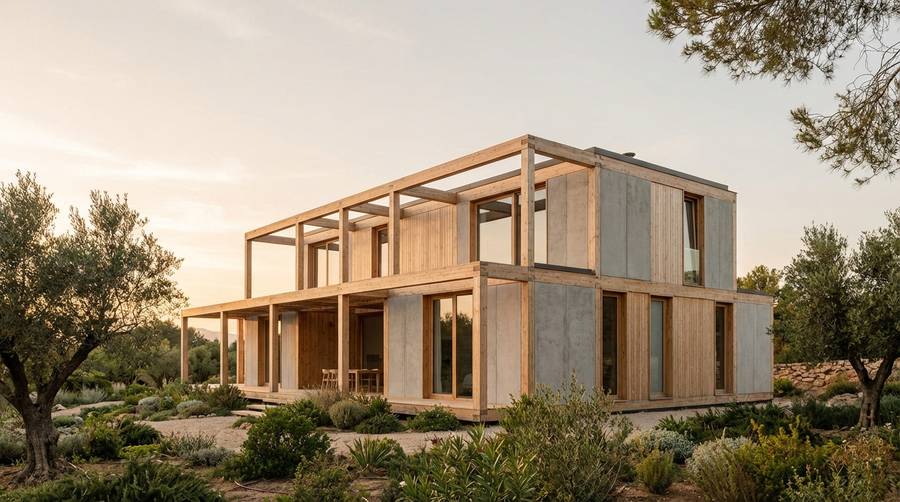
In practice, the factory-made timber panels were delivered and assembled in three weeks, compressing the on-site phase dramatically.
Compatibility with Passivhaus and energy efficiency
Timber frame systems pair well with Passivhaus principles: continuous insulation, minimized thermal bridges and high airtightness are easier to implement in a panelized system. The family targeted a near-Passivhaus performance; final testing showed an air change rate below 0.6 ACH at 50 Pa and a calculated heating demand reduced by more than 60% relative to the regional building code baseline.
Turnkey process: steps, timings and decisive choices
Project stages: plot search, design, manufacture and assembly
The turnkey delivery followed six clear stages:
- Site assessment and legal checks.
- Architectural design adapted to modular production.
- Engineering and component fabrication in factory.
- Permitting and municipal approvals.
- On-site assembly, systems connection and finishes.
- Handover and performance verification.
Each stage had predefined deliverables and acceptance gates, which reduced iteration and kept the timeline tight.
Real timings recorded in this case (design to handover)
The project's measured timeline:
- Design and approvals: 18 weeks.
- Factory production: 6 weeks.
- On-site assembly and finishes: 10 weeks.
- Total from contract to handover: 34 weeks (under nine months).
Compare that to typical traditional builds of similar scope that often exceed 12–18 months, especially when weather and subcontractor coordination are added.
Permits, coordination and financing for autopromoters
Autopromotion requires tight coordination between the promoter, architect, manufacturer and local authorities. Practical actions that worked in this project:
- Start permitting early and submit a modular-specific package highlighting factory quality controls.
- Use a turnkey contract model that defines responsibilities for interfaces.
- Secure project financing geared to autopromotion: the family combined a dedicated autopromoter mortgage with staged payments tied to milestones.
For guidance on financing options and mortgages tailored to self-builders, consider lender offers that explicitly fund modular or industrialized housing, and negotiate staged disbursements aligned to factory completion and handover.
Materials and technique: light timber framing in contrast
Why choose light timber framing over alternatives (industrialized concrete, steel frame)
Decisions were based on three vectors: carbon, speed and adaptability.
- Industrialized concrete can deliver mass and thermal inertia but carries higher embodied emissions and longer curing times.
- Steel frame offers structural slenderness and speed but typically has higher embodied CO2 per m2 unless recycled steel pathways are used.
- Light timber framing provided the best balance for this family: rapid panelization, lower embodied carbon and strong thermal performance when paired with modern insulation.
Technical solutions for insulation, airtightness and durability
The project combined standard best practices to achieve robust performance:
- Continuous external insulation (wood fiber and mineral wool mix) to reduce thermal bridges.
- Airtight membranes integrated in the factory with taped joints and factory QA.
- Mechanical ventilation with heat recovery sized to Passivhaus criteria.
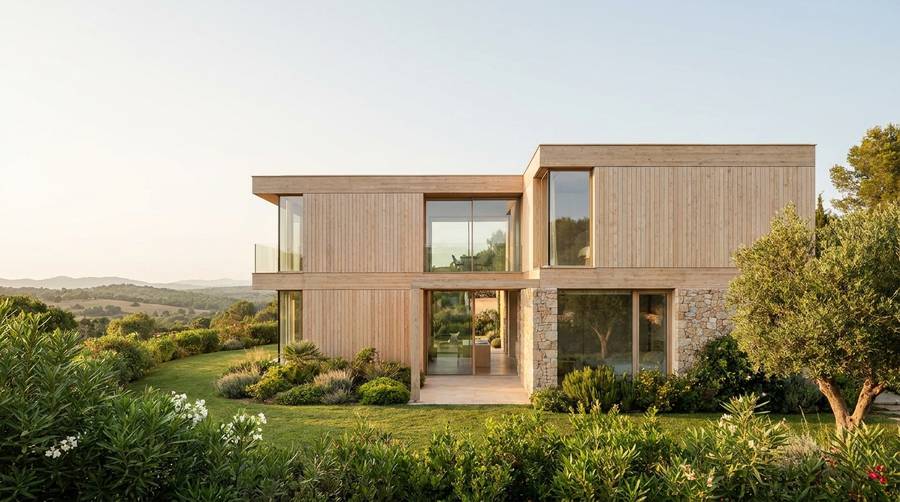
- Exterior rainscreen cladding (wood and stone accents) to protect the timber envelope and extend service life.
These choices minimized risk while maximizing energy efficiency and long-term durability.
Comparative costs and impact on carbon footprint
Cost comparison (indicative averages for similar scope):
- Light timber panelized system: competitive total cost with a lower contingency factor due to fixed-price manufacturing.
- Steel frame: slightly higher material cost and potential coating/fireproofing costs.
- Industrialized concrete: higher embodied energy and longer on-site time, often increasing indirect costs.
Because the timber option reduced on-site time and waste, indirect costs (site management, temporary works) fell substantially, which improved the overall project economy and carbon profile.
Quantifiable results: times, costs and emissions reduction
Project metrics: final cost, deviations and schedule performance
Final figures for the family house (three-bedroom, 140 m2 usable floor area):
- Contracted turnkey price: €320,000 (including plot development and VAT where applicable).
- Final outturn cost: €329,600 (3% variance due to selected upgrades in finishes).
- Schedule: completed in 34 weeks vs planned 36 weeks — achieved on time within the buffer.
Fixed-price industrialized contracts and clear upgrade selection processes helped contain budget deviations.
Climate impact: estimated emissions reduction and energy performance
Measured and modelled outcomes:
- Embodied CO2 reduction vs a concrete baseline: ~35% (based on the project's LCA modules).
- Operational energy reduction vs code: heating demand cut by >60% via insulation, airtightness and MVHR.
- Estimated combined lifecycle carbon improvement over 30 years: significant reduction, especially when considering potential bio-sequestration in the timber.
Client satisfaction and long-term value
The household reported high satisfaction on three fronts:
- Comfort: stable indoor temperatures and excellent acoustic separation.
- Financial predictability: the fixed-price approach removed anxiety around overruns.
- Future value: buyers and valuers increasingly factor energy performance and low carbon into resale value.
Independent post-occupancy surveys confirmed the family's positive experience and willingness to recommend industrialized timber housing to peers.
Lessons learned and how to replicate this success in Spain
Practical recommendations for future autopromoters
Actionable steps based on the project:
- Start with a clear brief: define schedule, budget cap and energy targets from day one.
- Choose a manufacturer with transparent QA processes and references for on-time delivery.
- Prioritize design for manufacture and assembly (DfMA): simpler junctions reduce errors and speed up assembly.
- Integrate the energy strategy early: insulation, airtightness and ventilation must be designed together.
For technical reading on wood strategies and decarbonization, see Madera y descarbonización: la palanca estratégica and the comparative guide Vivienda industrializada: guía comparativa 2026.
Common mistakes and how to avoid them in timber modular projects
- Avoid late changes to structure or openings once production starts — they are costly and delay delivery.
- Don’t underestimate site preparatory work; make sure foundations and connections are ready before components arrive.
- Clarify responsibility for sealing details at interfaces in the contract to avoid gaps in airtightness.
Next steps: financing (autopromotion mortgages) and sustainable upkeep
Financing tips:
- Look for mortgages that accept staged payments tied to factory milestones.
- Prepare a detailed cashflow plan: manufacturers usually require earlier deposits than traditional builders.
- Retain a contingency line for finish upgrades rather than for structural changes.
Maintenance for timber homes is straightforward: regular inspection of the rainscreen, basic treatment of exterior timber elements where required and ensuring ventilation filters are serviced will protect performance and value.
Final reflections and a practical invitation
This family's experience shows that industrialized housing combined with light timber framing can be a fast, affordable and low-carbon route to homeownership in Spain. The measurable gains—shorter schedules, predictable costs and meaningful emissions reductions—make it an option worth serious consideration for autopromoters.
Fast, high-quality and lower-carbon: when industrialized systems are executed well, they change the equation for self-builders.
If you are planning an autopromoted home, take three immediate actions: define your energy target, choose a trusted industrialized partner, and align financing to factory milestones. Small investments in early planning deliver outsized benefits at handover.
Would you like a templated checklist based on this case to start your own project? Reach out to a specialist and request a turnkey assessment — the right early guidance reduces risk and speeds delivery.
Artículos relacionados