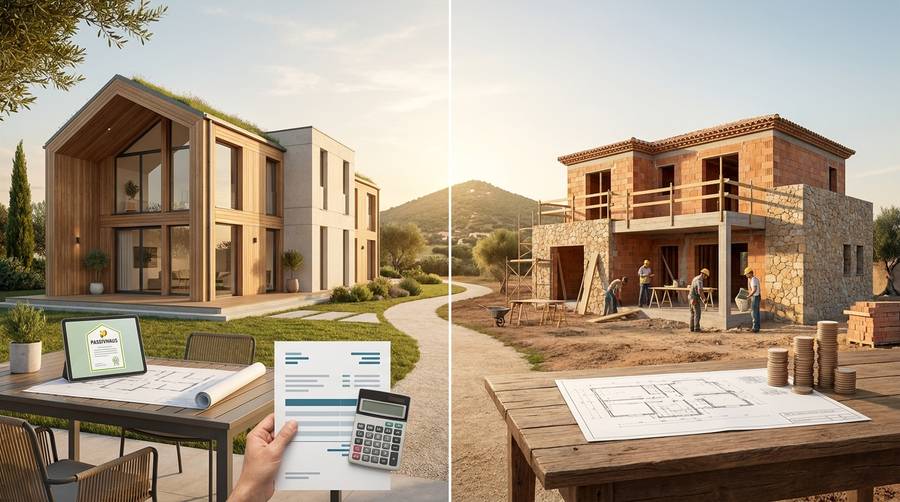
Prefabricated Home vs Traditional House: Pros and Cons
Why consider an industrialized home today: market snapshot and key takeaways
Imagine signing a fixed-price contract and walking into your finished home in under a year. For many Spanish self-builders in 2026, that scenario is realistic thanks to modern industrialized housing. This article cuts through marketing claims to provide a pragmatic, evidence-based comparison between prefabricated (modular/industrialized) homes and traditional on-site construction. You will find actionable advice, financing strategies, real case metrics and a clear decision framework tailored to autopromoters in Spain.
Market trends in Spain 2026 and demand for modular housing
The Spanish market has seen steady growth in industrialized housing driven by three forces: housing shortage in mid-size cities, tighter energy regulations, and improved factory processes that reduce lead times. Developers and families increasingly select systems that support energy performance compliant with near-Passivhaus standards and predictable budgets.
Quick summary: main advantages over traditional housing
- Cost predictability: fixed-price contracts reduce budget overruns common in traditional builds.
- Shorter, controlled timelines: parallel site work and factory production cut overall delivery time.
- Quality control: factory conditions lower variability in finishes and installations.
- Energy performance: modular systems facilitate airtightness and thermal continuity.
When industrialized housing is the most sensible option for self-builders
Choose a prefabricated approach when you value time certainty, need tight energy targets (e.g., near-Passivhaus), have access to a plot that allows for off-site assembly logistics, and prefer a fixed-budget structure. Traditional builds may win where design uniqueness, complex site constraints, or ultra-low initial cashflow are decisive.
In controlled studies and real projects, industrialized builds show average schedule reductions of 30–60% and budget variance under 8%, versus 15–30% overruns typical in site-built housing.
Comparison: advantages and disadvantages of prefabricated house vs traditional house
Advantages: cost control, reduced timelines and industrial quality
Cost control: Prefabrication firms typically offer a fixed-price turnkey contract. This shifts risk for component delays and many subcontractor unknowns from the buyer to the manufacturer. For autopromoters, this is especially valuable when bank financing has strict drawdown milestones.
- Transparent bill of materials: factory-built systems list components and warranties clearly.
- Economies of repetition: standardized production reduces labour variance and waste.
- Predictable finish quality: controlled environment reduces rework on finishes and joinery.
Time advantages: on-site groundwork and foundations can proceed in parallel with factory manufacturing. Typical timelines for a complete turnkey prefabricated home in Spain range from 6 to 12 months from permit to delivery, versus 12 to 24+ months for traditional builds.
Disadvantages: regulatory hurdles, administrative friction and perception
Regulatory complexity: some municipalities still apply traditional permits and inspections that were not designed for modular processes. Expect additional engineering reports or adapted plans in certain localities.
- Transport and assembly limits: road access, crane availability and parcel topography can add cost or prevent modular delivery.
- Perception and resale: although modern industrialized homes age well, market perception in some zones still favours traditional masonry; this impacts resale velocity rather than intrinsic value.
- Design limitations: extreme bespoke geometries can increase costs compared to traditional on-site customization.
Objective balance: when each model wins
Use a simple decision rule: if you require energy efficiency, schedule certainty and a controlled budget, prefabrication often wins. If your project demands very bespoke architecture or faces complex site access and you have flexibility on schedule, traditional may be preferable.
Materials and construction systems: cost, time and efficiency impact
Industrialized concrete: durability and thermal performance
Industrialized concrete systems (factory-cast panels or precast elements) offer very high durability and thermal mass. They excel in coastal and high-temperature swing climates where inertia helps even out indoor temperature. Initial material costs can be higher than light-frame systems, but lifecycle maintenance and fire performance are superior.
Light timber frame and steel frame: speed, design flexibility and carbon footprint
Light timber frame provides rapid assembly, low embodied carbon and excellent thermal performance when coupled with high-performance insulation and airtightness details. Steel frame (steel stud systems) combines speed with long spans and design flexibility. Both systems enable tight tolerances needed for Passivhaus-level airtightness.
- Timber frame: lower carbon, faster assembly, good acoustic performance when designed correctly.
- Steel frame: ideal for larger spans, slightly higher embodied carbon, excellent for modular stacking.
How to choose based on climate, Passivhaus goals and long-term costs
Match the system to your goals: for strict Passivhaus targets, favour envelope continuity and systems that ensure airtightness and minimal thermal bridging (timber or steel with factory-applied membranes). For coastal or humid sites, concrete or hybrid systems that resist moisture while providing thermal mass can be preferable. Produce a lifecycle cost comparison that includes maintenance, energy bills and potential insurance differentials.
Financing and new mortgages for modular homes and self-build
Mortgage products in Spain: self-build loan vs mortgage on finished home
Spanish lenders offer two main pathways: (1) construction/self-build loans with staged releases and higher monitoring requirements, and (2) traditional mortgages issued once the home is completed and appraised. Many modular manufacturers facilitate the second route by providing turnkey delivery and final valuation, which simplifies bank acceptance.
What banks ask for: documentation, timelines and guarantees
Banks evaluate industrialized projects based on:
- Detailed turnkey contract with fixed price and payment schedule.
- Technical dossier: drawings, thermal calculations, membranes and warranty data.
- Proof of manufacturer solvency and completion guarantees.
Expect banks to request staged inspections, an independent valuation and sometimes an advance deposit retained as collateral.
Financing strategies: combining loans, guarantees and public aids
Practical financing tactics for autopromoters:
- Negotiate a turnkey contract with a bank-friendly payment schedule aligned to milestone inspections.
- Combine a construction loan for groundwork with a conversion to a mortgage after final delivery; this avoids carrying high interest for long on the full amount.
- Explore public energy-efficiency subsidies for Passivhaus or near-zero homes to reduce loan volume.
Turnkey process and self-build stages that affect financing
From plot to handover: milestones that drive disbursements and guarantees
A typical turnkey timeline includes: plot purchase, project design and permitting, foundation and services, factory production, on-site assembly, finishes and systems commissioning, and final certification. Banks and manufacturers commonly split payments across these milestones to align risk and incentivize timely delivery.
Contracts, guarantees and insurance: protections the buyer must secure
Key protections to demand:
- Completion guarantee: a contractual clause or insurer-backed guarantee ensuring project completion.
- Structural warranty: 10-year coverage or equivalent for load-bearing elements.
- Transport and assembly insurance: covers damage during delivery and crane operations.
These instruments increase bank comfort and can lower financing costs if properly documented.
How to plan budget and schedule to convince a lender
Provide lenders with a concise packet: turnkey contract, Gantt schedule with critical path, independent technical report, and a conservative contingency (typically 5–10%). Demonstrating manufacturer references and case studies shortens underwriting time.
Practical guide and real cases: timelines, costs and client satisfaction
Case study 1: modular home on a rural plot — times and costs
Project facts: 120 m² single-family home on a rural plot in Andalusia. System: timber frame modular panels with full turnkey service.
- Permitting and groundwork: 3 months
- Factory production & delivery: 8 weeks
- Assembly and commissioning: 6 weeks
- Total time from permit to handover: 7 months
- Final cost: €1,450 / m² fixed turnkey (including foundations and landscaping)
- Client satisfaction (survey after 12 months): 9/10 — praised energy bills and build speed
Case study 2: urban self-build on a constrained lot — financing and energy outcome
Project facts: 140 m² infill lot near Valencia. System: hybrid precast concrete ground floor + steel frame upper floor to meet acoustic and fire requirements.
- Planning approvals: 4 months (extra heritage constraints)
- Production & assembly: 3 months
- Total time: 10 months
- Final cost: €1,650 / m² (higher due to site lifting and traffic management)
- Energy performance: predicted heating demand reduced by 65% vs local code; measured after 1 year: 58% reduction.
Decisive checklist for self-builders: questions and metrics to request before signing
- Ask for a full Gantt and clarify what happens if a milestone slips.
- Request manufacturer performance data (airtightness results, U-values, warranty scope).
- Obtain at least two independent valuations for lending purposes.
- Confirm transport limits (max module length/width) and access strategy for your plot.
- Insist on a completion guarantee or escrow mechanism for staged payments.
Decision keys: objective recommendations for autopromoters
Decisive criteria: budget, schedule, sustainability and design taste
Prioritise based on four weighted criteria:
- Budget certainty (30%): if critical, favour turnkey prefabrication.
- Schedule (25%): if time to occupancy matters, prefabrication wins.
- Sustainability (25%): both methods can reach high efficiency, but industrialized systems often reach tighter airtightness more easily.
- Design freedom (20%): traditional builds typically offer the most sculptural freedom.
How to negotiate with banks and modular providers from an informed position
Bring data: production timelines from the manufacturer, similar completed project metrics and a technical dossier. Ask the bank which documentation shortens underwriting and adapt the contract payment schedule accordingly. A clear escrow arrangement for funds tied to verifiable milestones increases trust and reduces lender friction.
Next steps: useful resources, contract templates and professional contacts
Before committing:
- Obtain at least three turnkey offers using the same brief and compare Gantt, warranties and exclusions.
- Hire an independent technical architect familiar with modular details to review the dossier.
- Consult your bank early with a preliminary dossier to identify documental gaps.
If you want a short checklist to start: request turnkey price per m², fixed delivery date, completion guarantee, transport plan and airtightness test targets.
Final thought: industrialized housing in Spain combines modern materials and streamlined processes to offer a compelling path for self-builders who value time, budget predictability and energy performance. The decision is project-dependent, but an informed approach—demanding data, guarantees and real-case metrics—lets you negotiate from strength.
Ready to take the next step? Start by assembling the turnkey offers and a technical dossier; compare timelines, warranties and financing routes to choose the path that fits your plot and priorities.