Prefabricated house vs Traditional: Balanced 2026 Guide
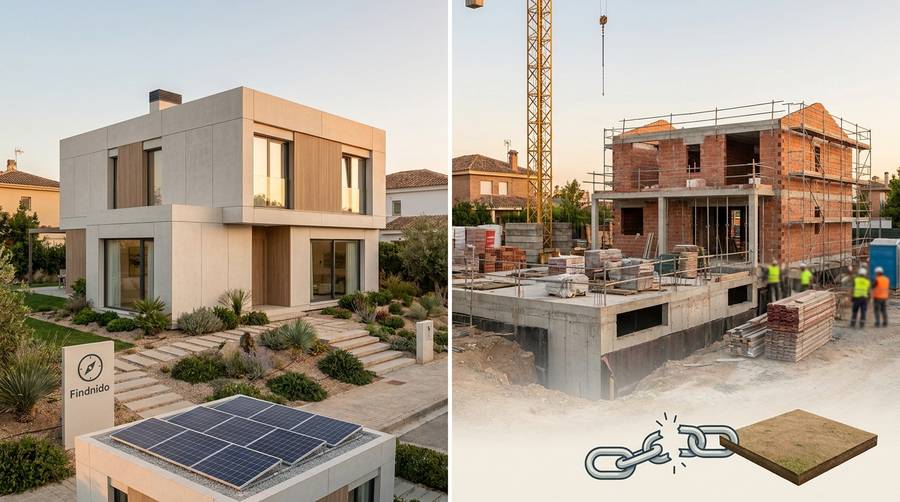
Imagine signing a fixed-price contract and seeing your new home sealed and weatherproof in weeks, not months. That contrast—between certainty and uncertainty—frames the choice many Spanish families and autopromoters face today when comparing a prefabricated house with a traditional build.
Why industrialized housing is gaining ground in Spain (2026)
Context: supply‑demand imbalance and the need for scalable solutions
The Spanish housing market still struggles with local supply bottlenecks, rising costs and long delivery times in many provinces. Industrialized housing—also called modular or off‑site construction—addresses these pressures by shifting a large part of the work to controlled factory environments. For families and small promoters this means more predictable schedules and budgets.
Benefits over traditional construction: speed, predictability and cost control
Prefabricated houses tend to offer three practical advantages:
- Shorter on‑site time: foundation and connection works are the main on‑site tasks; the superstructure arrives largely complete.
- Fixed or better-defined costs: factory workflows reduce variability and change orders that commonly inflate traditional budgets.
- Quality control: repeatable processes and factory inspections help deliver consistent finishes and performance.
Who benefits: families, autopromoters and local developers
Autopromoters who value timeline certainty, developers seeking faster turnover and families prioritizing energy efficiency all find industrialized housing attractive. It is especially relevant for those looking to align budgets with specific performance targets such as Passivhaus or near‑Zero Energy standards.
Prefabricated house vs Traditional house: balanced pros and cons
Advantages of industrialized housing: closed schedules, fixed price and controlled quality
Closed schedules. In a typical turnkey modular project the on‑site assembly phase can last from 2 to 8 weeks depending on complexity. The factory build runs parallel to site prep, compressing the overall calendar.
Price transparency. Many providers offer a fixed‑price turnkey option that includes design, fabrication, transport and final finishes. This reduces the risk of mid‑project budget overruns from weather delays or subcontractor shortages.
Consistent quality. Factory processes mean repetitive checks: moisture control, joinery tolerances, and installation of glazing and insulation under controlled conditions. This often results in better thermal continuity and fewer defects at handover.
Limitations and risks: market volatility, site adaptation and permitting
No solution is perfect. Key limitations include:
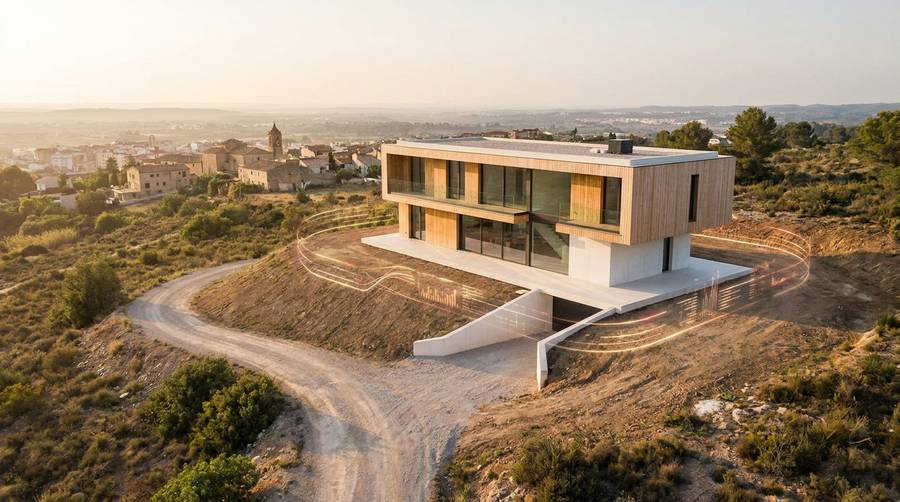
- Site constraints: steep slopes, limited access or unusual urban plots can complicate transport and installation of large modules.
- Regulatory variability: municipal planning departments interpret codes differently; permitting can slow a modular project just as it does a traditional one.
- Market perception: while quality has risen, some stakeholders still equate prefabrication with low quality. Avoid this by selecting proven suppliers and visiting completed homes.
When to choose each option: practical decision criteria
Use these pragmatic rules:
- Choose a prefabricated house if timeline certainty, energy performance and budget control are priorities.
- Prefer traditional construction if the plot has complex topography, heavy customization needs on site, or heritage/urban constraints that require in‑situ craftwork.
- For most suburban and rural plots aimed at modern, efficient homes, modular solutions are increasingly the better economic and environmental choice.
Data point: real case studies show factory-based builds often cut overall project time by 30–60% and reduce unexpected cost variances significantly compared to site‑built counterparts.
Modern materials and structural systems explained (without techno‑jargon)
Industrialized concrete: durability, finish and structural benefits
Precast or industrialized concrete panels deliver robust, long‑lasting envelopes with high thermal mass. Advantages include a clean finish, fire resistance and low maintenance. For coastal or contaminated soils, concrete offers a safe, durable solution.
Light timber framing and steel frame: speed, flexibility and thermal behavior
Light timber framing (entrama do ligero) is fast to assemble, naturally renewable and excellent for thermal performance when combined with modern insulation. Steel frame systems add structural slenderness and high precision, useful for open layouts or larger spans.
Accessible technical comparison: durability, maintenance and long‑term cost
In plain terms:
- Durability: concrete > steel > timber (varies with detailing and maintenance).
- Maintenance: timber needs more attention on junctions; concrete is low‑maintenance; steel demands protection in aggressive environments.
- Long‑term cost: initial differences are often offset by energy savings and faster occupancy. Choose materials that match climate and design goals.
Sustainability and energy efficiency: how modular homes meet Passivhaus
Passive design, insulation and airtightness: cutting consumption and carbon
Modular construction excels at achieving high airtightness and continuous insulation because panels and junctions are crafted in controlled settings. Good design considers orientation, shading and thermal bridges—these are as important as the wall system itself.
Materials and certifications: what to ask for and how to verify performance
Ask suppliers for:
- Declared U‑values and airtightness test results (Blower Door).
- Life cycle assessments (LCA) or EPDs for major components.
- Third‑party certification where available (Passivhaus components, BREEAM, etc.).
Real impact: energy savings examples and environmental metrics
Example case: a 140 m² modular home finished to high airtightness and continuous insulation achieved a 65% reduction in heating demand versus a similar traditional build in central Spain. Operational energy costs fell by two‑thirds, and embodied carbon studies showed a 10–20% saving depending on material choices.
Turnkey process for autopromoters: from plot to delivery
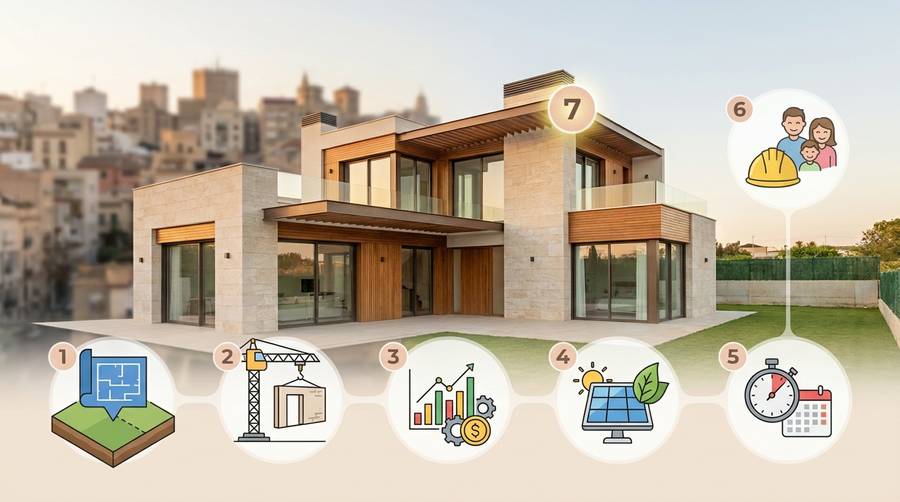
Phases: feasibility, design, fabrication, assembly and finishes
A clear turnkey workflow typically includes:
- Feasibility study: site survey, access analysis and initial cost estimate.
- Design and approvals: schematic design, planning application and technical approvals.
- Factory fabrication: production of modules or panels while site works proceed.
- Assembly and finishes: delivery, craning and sealing; final MEP connections and interior works.
- Handover: testing, commissioning and client walkthrough.
Timelines and coordination: typical milestones and permitting in Spain
Typical overall timelines (from design start to handover) can range from 6 to 12 months for straightforward suburban projects. Critical path items include the planning permit, electrical and water connections, and local inspections. Early engagement with the municipality reduces surprises.
What to include in a turnkey contract and how to compare offers
Insist on clarity in the contract about:
- Scope of works (what exactly is included and excluded).
- Payment milestones tied to deliverables.
- Warranties for structure, waterproofing and MEP systems.
- Acceptance criteria and remedy windows for defects.
Financing, mortgages and making the final decision
Financing options for autopromotion and modular homes in Spain
Financing a prefabricated house often follows two paths:
- Self‑build mortgage (hipoteca de autopromoción): staged disbursements aligned to project phases. Ideal when you manage site works and need progressive funding.
- Standard mortgage for new housing: if the supplier offers a turnkey sale, banks may treat it like any new residential mortgage once the property is completed and registered.
Criteria to choose: total cost, financial risk and payment flexibility
Key evaluation points:
- Compare total cost to completion, not just unit price.
- Review how risk is allocated—who bears extra costs from unforeseen site issues?
- Check payment schedules: align bank disbursements with actual project milestones.
Final checklist: metrics, references, case study and timelines
Before signing, verify the following:
- Two or more completed project references you can visit.
- Blower Door or equivalent airtightness tests for delivered homes.
- Estimated energy consumption and, if available, real bills from comparable houses.
- Firm timeline with penalties or incentives for delivery.
Case study: a 140 m² modular house near Valencia (real metrics)
Project snapshot:
- Plot: suburban plot, 600 m²; easy access.
- System: timber frame modules with continuous mineral wool insulation and high‑performance triple glazing.
- Timeline: 4 months from contract to handover (2 months factory, 3 weeks on‑site assembly, overlaps included).
- Cost: final turnkey price was within 3% of contract; financing via autopromotion mortgage with staged draws.
- Performance: airtightness 0.45 ACH50, heating demand reduced by ~70% vs baseline.
- Client satisfaction: post‑occupancy survey showed high satisfaction on timing, budget predictability and thermal comfort.
This example illustrates typical modular strengths: predictable budget, fast delivery and measurable energy savings.
Making the choice: actionable decision map for autopromoters
Step‑by‑step decision rules
- Assess site access and topography. If restricted, favour in‑situ or small‑panel systems.
- Define performance goals (e.g., Passivhaus). If targets are ambitious, modular factory control helps meet them.
- Request comparable completed projects and performance data.
- Get three offers with identical scopes and compare risk allocation, not just price.
Where to get further guidance
Read practical guides such as Vivienda industrializada: 7 claves para autopromotores en España and the strategic outlook Vivienda industrializada: visión 2026 para autopromotores for sector‑specific tips and models.
Deciding between a prefabricated house and a traditional build is first and foremost about aligning risks with priorities. If you prioritise speed, energy performance and budget certainty, a prefabricated route is compelling. If the plot demands unique on‑site solutions, traditional construction remains valid.
Ready to explore options for your plot? Compare detailed turnkey proposals, visit completed homes, and request line‑item warranties before committing. Taking those steps will turn a complex decision into a confident one.
Artículos relacionados