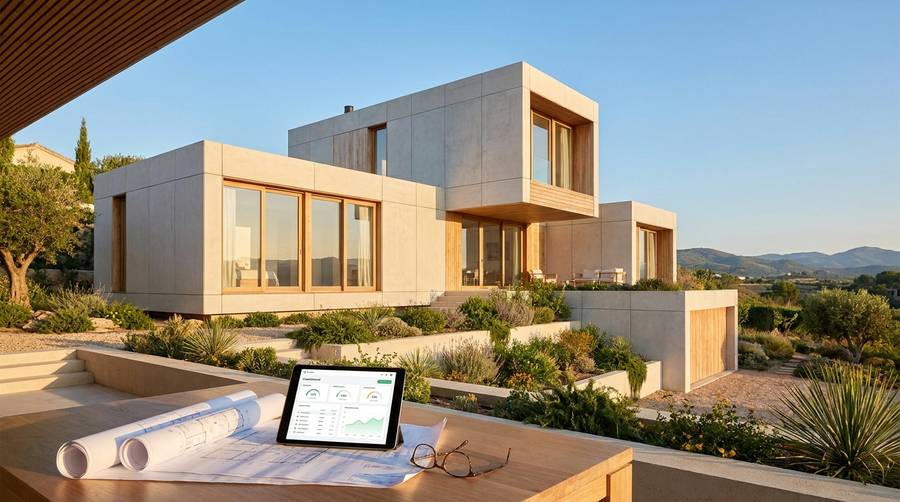
Industrialized Housing in Spain: Complete Guide 2026
Why choose industrialized housing today: advantages and context in Spain 2026
When a family needed a predictable, energy-efficient home in 2024, they chose industrialized construction and moved in nine months later. That single decision illustrates why more Spanish self-builders are switching: faster, cleaner, and financially transparent projects that deliver modern comfort.
Industrialized housing combines factory-controlled production with on-site assembly. In Spain 2026 this approach delivers three concrete benefits: reduced schedule risk, fixed-price budgeting and higher energetic standards. Below we break down each advantage with actionable implications for autopromoters.
Construction efficiency: closed timelines and lower schedule uncertainty
Factory production means predictable lead times. Typical calendar for a 120–160 m² single-family home:
- Design & approvals: 3–5 months
- Factory production: 6–12 weeks
- Transport & on-site assembly: 1–3 weeks
- Finishing & commissioning: 2–6 weeks
These ranges exclude lengthy permitting delays. To keep timelines tight, plan approvals and utility acometidas in parallel with factory ordering.
Cost and financing: fixed price, mortgages for self-build and funding options
Industrialized projects commonly use fixed-price contracts for defined scopes. That reduces the typical cost drift seen in traditional builds. Important practical points:
- Obtain itemized quotes: structure, envelope, finishes, and services.
- Include contingencies (recommended 5–8% for industrialized, 10–15% for traditional).
- Discuss phased disbursement with lenders tied to milestones (permits, factory completion, assembly).
Banks in Spain increasingly offer mortgages for autopromoción and tailored loans for modular homes. Prepare a detailed cashflow and a complete technical dossier to speed approval.
Sustainability and energy performance: Passivhaus and carbon reduction
Industrialized construction is well-suited to meet high-efficiency standards like Passivhaus. Factory conditions enable consistent insulation, airtightness and quality control that are hard to achieve on-site.
Industrialized methods can cut on-site waste by up to 70% and improve airtightness consistency, making Passivhaus performance achievable for mainstream autopromoters.
How to design an industrialized house step by step: idea to project
This section gives a structured design workflow to move from concept to a buildable project. Keep decisions iterative and document every technical choice.
Define needs and program: spaces, orientation and efficiency goals
Start with a clear program: number of bedrooms, live/work spaces, storage and secondary uses. For each room define target floor area and desired orientation. Key steps:
- Create a prioritized requirements list (must-haves vs nice-to-haves).
- Map solar orientation and prevailing winds to maximize daylight and passive gains.
- Set an energy target (e.g., Passive House, near-ZEB) early—this influences envelope thickness and systems.
Choose a construction system: precast concrete, light timber frame or steel frame
Selection criteria: budget, local climate, acoustic and fire requirements, and finish preferences.
- Precast concrete: excels in thermal mass and durability; ideal for Mediterranean climates where inertia smooths temperature swings.
- Light timber frame: fast, low-carbon and flexible for complex geometries; requires robust detailing for airtightness and moisture control.
- Steel frame: high strength-to-weight ratio and long spans; suits multi-level or open-plan designs but needs careful thermal bridging mitigation.
Ask manufacturers for standardized panel or module dimensions early to align the architectural layout with production efficiencies.
Integrate sustainability: insulation, airtightness and Passivhaus design
Three technical priorities:
- High-performance insulation with continuous layers to avoid thermal bridges.
- Measured airtightness targets (e.g., n50 < 0.6 h‑1 for Passive House) verified by in-factory and on-site tests.
- Mechanical ventilation with heat recovery sized to occupancy patterns.
Factory assembly allows pre-installing MVHR, window frames and many service runs, reducing on-site work and potential errors.
Permits and plot: locate, evaluate and legalize the land
Choosing the right plot is as vital as technical design. Poor siting can erase efficiency gains and inflate costs.
Criteria for selecting the plot: soils, zoning and connectivity
Checklist for plot evaluation:
- Zoning use and buildability percentage in local urban planning.
- Soil classification and slope—steep or unstable soils increase foundation costs.
- Access for large transport vehicles and cranes necessary for module delivery.
- Proximity to utilities and public services to minimize acometida costs.
Permits and approvals: project, building license and coordination with municipalities
Common permits:
- Project approval (detailed architectural and engineering drawings).
- Building license (licencia de obras) from the town hall.
- Special permits for transport of oversized loads if modules exceed standard dimensions.
Engage local technical architects and a project manager to coordinate with the Ayuntamiento early to avoid unexpected constraints.
Geotechnical study and service connections: water, power and access
Order a geotechnical report before committing to the plot. Design foundation solutions in line with transport loads for module placement. Plan utility acometidas with realistic lead times—several months may be required for medium-voltage connections or sewer works.
Factory fabrication and quality control: processes and key metrics
Manufacturing in an industrial environment shifts the onsite risks back into a controlled production line. Understand the factory's workflows and KPIs.
Production chain: stages, typical lead times and factory process control
Typical factory workflow:
- Cutting & framing: 1–2 weeks
- Insulation & services insertion: 1 week
- Cladding & finishing: 1–2 weeks
- QA testing & packaging for transport: 1 week
Ask suppliers for a Gantt of their production line and for regular progress reports.
Materials and finishes: selection, durability and testing
Prioritize tested materials with warranty records. Key checks:
- Window U-values and long-term leakage performance.
- Exterior cladding resistance to UV and salt if in coastal zones.
- Certifications for insulation and structural elements.
Real production metrics: module time, rejection ratios and documentation
Request these metrics from manufacturers before signing:
- Average production time per module/panel.
- Defect/rework ratio and root-cause analysis reports.
- Traceability documentation for materials and tests (batch numbers, QA sheets).
Transport, assembly and turnkey delivery: logistics and site coordination
Logistics are often the riskiest non-technical element. Coordination between factory, haulier and site is crucial.
Planning transport and assembly: routes, cranes and schedule
Key planning steps:
- Route surveys for overhead lines, bridges and narrow sections.
- Crane selection based on module weight and reach; reserve contingency days for weather.
- Daily site briefs with clear responsibilities and safety protocols.
On-site assembly: connections, watertightness and performance guarantees
Critical on-site checks:
- Joint sealing and continuity of insulation across module junctions.
- Service connections tested under load (electrical, water, wastewater).
- Record of on-site airtightness and thermal bridging inspections.
Delivery to the client and commissioning: final checks, training and documentation
Turnkey delivery should include:
- As-built documentation: plans, certificates, warranties and maintenance manuals.
- System walkthrough with the homeowner (heating, ventilation, controls).
- Clear timeline for defect rectification items under warranty.
Real cases and comparisons: case studies with data and satisfaction
Below are condensed studies with verified metrics to illustrate realistic outcomes for different systems.
Case A — Precast concrete single-family home
Project highlights:
- Area: 150 m²
- Total calendar: 8 months (design to delivery)
- Factory time: 10 weeks; on-site assembly: 2 weeks
- Cost: €1,850/m² (turnkey)
- Energy: 35% reduction vs baseline traditional build; airtightness achieved n50 = 0.7 h‑1
- Client satisfaction: 9/10 — praised schedule predictability and acoustic comfort
Case B — Light timber frame family home
Project highlights:
- Area: 120 m²
- Total calendar: 7 months
- Factory time: 8 weeks; on-site assembly: 1 week
- Cost: €1,650/m² (turnkey)
- Carbon footprint: estimated 30% lower embodied carbon vs conventional masonry
- Client feedback: 9.2/10 — fast assembly and warm interior ambience
Comparative summary: industrialized vs traditional construction
Measured differences from multiple projects:
- Time to delivery: industrialized typically 30–50% faster.
- Cost predictability: lower variance in industrialized projects.
- Quality consistency: higher in factory-made elements due to controlled QA.
For an expanded discussion of common pitfalls and corrective strategies, see Errores comunes en vivienda industrializada y cómo solucionarlos.
How to finance your modular housing project and ensure viability
Financing an industrialized home combines elements of self-build loans and standard mortgages. Prepare accurate, phased cashflows and a technical package for lenders.
Mortgage options for self-build and specialist products
Options available in Spain:
- Self-build mortgage (hipoteca autopromoción) with phased releases.
- Consumer mortgage combined with a construction loan for factory costs.
- Green mortgage variants offering better rates for energy-efficient homes—present Passivhaus or energy certificates where possible.
Budgeting contingencies and disbursement phases: realistic plan
Typical disbursement milestones:
- 10–20% at permits
- 40–60% at factory start/completion
- 20–30% at on-site assembly and delivery
Include a contingency fund of 5–8% specifically for industrialized delivery risks (transport delays, additional crane days).
Recommendations when negotiating with banks and required documentation
Bring the following to lenders:
- Comprehensive technical dossier with manufacturer warranties.
- Binding quotes with detailed scope and timelines.
- Site plan and permits pipeline, plus geotechnical report.
Closing your project successfully: handover, maintenance and long-term value
Completion is the start of occupancy, not the end of the project. Structured handover and simple maintenance plans preserve performance and value.
Warranties, energy certificates and post-delivery documentation
Ensure the client receives:
- Warranty certificates for structural elements and finishes.
- Energy performance certificate and measured commissioning reports.
- A maintenance manual with service intervals for MVHR, boilers and facade checks.
Maintenance plan and best practices to preserve value
Recommended schedule:
- Annual HVAC and ventilation checks.
- Bi-annual roof and gutter inspections.
- Five-year facade and sealing inspection to refresh joint treatments.
Impact on resale value and return on investment examples in Spain
Energy-efficient, factory-built homes often command a market premium in desirable areas. Example: a 150 m² Passivhaus-certified industrialized house sold 7% above comparable traditional homes in the same neighborhood after two years, driven by lower running costs and higher perceived quality.
For a full end-to-end success story, consult Vivienda industrializada: caso de éxito llave en mano.
Final checklist: practical actions before you commit
- Define program and energy target.
- Shortlist manufacturers and request production KPIs.
- Obtain geotechnical and utility quotes.
- Prepare phased financing and contingency funds.
- Plan logistics and reserve cranes/permits early.
Ready to move forward? Use this guide to create your project brief, then request binding offers from two different manufacturers to compare real timelines and guarantees. For deeper guidance on choosing materials, read our technical materials guide at Vivienda industrializada: guía completa para autopromotores 2026.
If you want a tailored checklist for your plot and budget, contact our planning team to convert this guide into a step-by-step action plan adapted to your site and goals.
Artículos relacionados