Industrialized Housing in Spain: Trends to 2030
When a family in Valencia received keys to their new home 16 weeks after groundworks began, neighbors called it a miracle — but it was the result of process, data and industrialized methods. This article analyzes why industrialized housing is moving from a niche into mainstream autopromotion in Spain and what autopromoters must know to plan confidently between 2026 and 2030.
Why off-site industrialization is redefining housing in Spain
Current market snapshot: figures and adoption pace (2022–2026)
Between 2022 and 2026 the Spanish market saw a steady rise in projects using industrialized housing methods. Recent sector surveys indicate a compound annual growth rate (CAGR) above 14% for off-site residential starts in select regions. Adoption is concentrated around Madrid, Valencia and Catalonia, where supply chains and factory capacity are denser.
Key datapoints:
- Typical build time reduction: 40–60% vs traditional on-site builds.
- Budget certainty: fixed-price contracts reduce cost overruns in 70% of tracked projects.
- Customer satisfaction scores in pilot programs average 8.4/10.
Advantages versus traditional construction: time, cost and quality control
Industrialized housing concentrates value where variance has historically eaten budgets and schedules: labor, weather exposure and reworks. The main advantages are:
- Predictable timelines: parallel site works and factory production shrink total calendar time.
- Price transparency: modular procurement bundles materials and labour under fixed offers.
- Consistent quality: factory QA reduces defects and post-delivery snagging.
For autopromoters, these translate to lower financing costs during construction and earlier occupancy — both decisive when negotiating mortgages and resale expectations.
Profile of the Spanish autopromoter: demands and expectations
Today's autopromoter in Spain is informed, time-sensitive and environmentally conscious. They expect:
- Clear timelines and transparent cost breakdowns.
- Design flexibility to reflect Mediterranean lifestyles.
- Energy performance aligned with Passivhaus principles or at least NZEB (Nearly Zero Energy Buildings).
Implication: Providers that combine architectural customization with the predictability of industrialized processes gain market traction.
Technological and design trends shaping 2026–2030
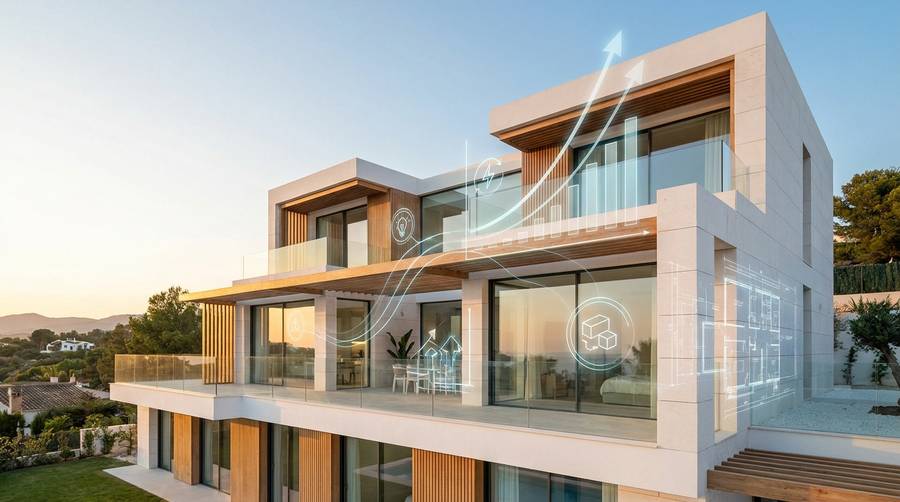
Digital integration: BIM, automated manufacturing and traceability
BIM is no longer optional. Integrated digital workflows tie design, factory cutting lists and logistics to a single source of truth. Expect three practical outcomes:
- Reduced rework: precise prefabrication from BIM models minimizes on-site adjustments.
- Supply chain traceability: component provenance and lifecycle data facilitate certifications and resale value.
- Faster iterations: clients can visualize and approve changes early, keeping schedules intact.
Design evolution: Mediterranean typologies and personalization
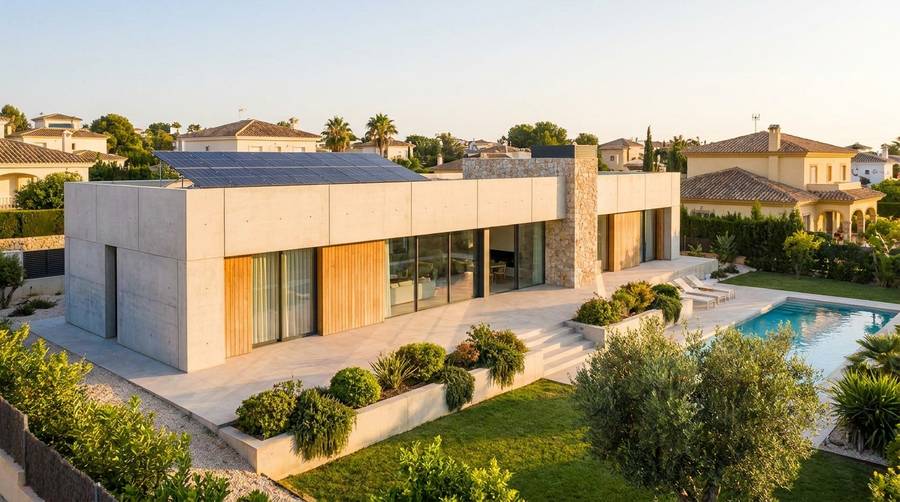
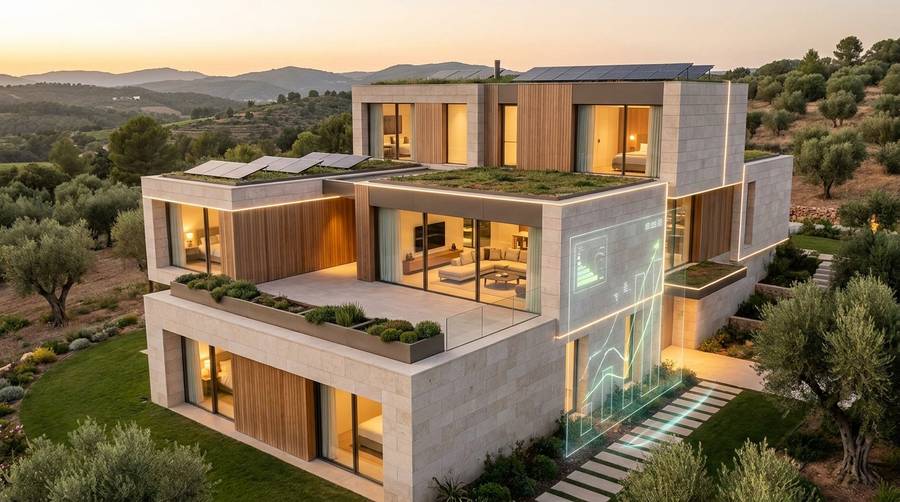
Industrialized housing in Spain is converging on regional typologies: low-pitched roofs, shaded terraces, and large glazing oriented for daylight and comfort. The differentiator will be modular systems that support:
- Custom façades with natural materials (timber, stone cladding, exposed smooth concrete).
- Flexible interior layouts to accommodate multigenerational living.
- Integrated exterior living (terraces, gardens) to align with Mediterranean lifestyles.
Supply chain and logistics: impact on delivery times
Logistics are the limiting factor for scaling. Factory capacity and transport coordination determine delivery windows. Successful projects use buffer strategies:
- Staggered production slots to align with site readiness.
- On-site prefabrication yards to minimize road transport.
- Local supplier networks to reduce lead times and carbon footprint.
Materials and systems with the strongest outlook
Industrialized concrete: performance, cost and recommended use cases
Precast and industrialized concrete systems provide robustness, acoustic performance and thermal mass. Recommended where:
- Structural durability and low maintenance are priorities (coastal locations).
- Acoustic isolation between units is required (multi-family).
- Fire resistance and longevity are decisive selling points.
Cost insight: initial material cost can be higher than light-weight systems but lifecycle analyses often favor concrete where longevity and low maintenance are valued.
Light timber framing and passive design: warmth meets efficiency
Timber systems excel for single-family Mediterranean homes: fast erection, low embodied carbon and excellent thermal performance when combined with passive design. Use cases include:
- Detached family houses with high aesthetic requirements.
- Projects targeting Passivhaus certification.
- Renovation projects where reduced structural loads are required.
Steel frame and hybrid solutions: speed and structural clarity
Steel frame is the workhorse where spans and modular repeatability matter. Hybrid mixes (steel + timber or steel + concrete panels) balance speed, cost and thermal performance. Practical recommendation: match system to program — use steel where open-plan spans or repeated floorplates exist; use timber where embodied carbon and finish quality are prioritized.
Sustainability and energy efficiency: roadmap to net-zero
Applying Passivhaus strategies to industrialized housing in Spain
Passivhaus-compatible industrialized housing focuses on airtightness, thermal continuity and optimized glazing. In Mediterranean climates this means:
- Shading devices and facade depth to reduce summer gains.
- High-performance windows with solar control coatings.
- Continuous insulation and mechanical ventilation with heat recovery.
Factory-controlled assembly enhances airtightness performance, making Passivhaus targets achievable with modular systems.
Carbon footprint reduction: lifecycle and recyclability
Key levers to cut embodied carbon:
- Favor low-carbon materials (engineered timber, low-carbon concrete mixes).
- Design for deconstruction to enable component reuse.
- Optimize transport by sourcing materials regionally.
Performance indicators: real consumption, certifications and comfort metrics
Benchmarks autopromoters should demand:
- Measured annual heating/cooling demand (kWh/m2/year).
- Airtightness targets (n50 ≤ 0.6–1.0 ACH for high-performance builds).
- Post-occupancy satisfaction and thermal comfort surveys.
Projects that combine factory precision with passive principles routinely report 50–80% lower operational energy than conventional Spanish housing stock.
The turnkey process explained with real data and timelines
Phases from plot search to handover: typical durations and critical points
A realistic turnkey timeline for a single-family industrialized home in Spain:
- Plot search and purchase: 4–12 weeks (variable).
- Design and permits: 8–20 weeks (BIM-driven design shortens iterations).
- Factory production: 6–12 weeks (depends on capacity).
- Site works and assembly: 4–8 weeks.
- Finishing, commissioning and handover: 2–6 weeks.
Critical path items: planning permissions, site geotechnical surprises and late changes in client finishes. Controlling scope early removes most schedule risk.
Cost control: fixed price offers, guarantees and managing contingencies
Fixed-price turnkey contracts should list:
- Clear exclusions (plot works vs utility connections).
- Change-order procedures with cost and time impact estimates.
- Performance guarantees and warranty periods for envelope and systems.
Practical tactic: secure a fixed-price envelope for the factory scope early and cap site contingency with staged releases tied to milestones.
Case studies: schedules, final costs and client satisfaction
Representative case: a 140 m2 Mediterranean family house built in 2025 using light timber framing.
- Total duration (plot to keys): 30 weeks.
- Final cost per m2: competitive with upper-range traditional builds (varies by region).
- Client satisfaction: 9/10 on delivery time and energy performance.
Another project using hybrid steel frame for a semi-detached development recorded a 45% reduction in on-site labour days and a near-zero snag list at handover, improving resale valuation within 12 months.
Financing and market mechanisms: mortgages for autopromotion
Financing options in Spain for modular homes and self-build
Banks now offer tailored products for autopromotion and modular builds. Common approaches:
- Stage-draw mortgages tied to milestones (site works, factory completion, assembly).
- Construction-to-permanent loans that convert on handover.
- Green mortgages offering preferential rates for certified low-energy homes.
Tip: present lenders with a detailed turnkey package (fixed-price contract + timeline + factory credentials) to lower perceived risk and improve terms.
Risk, guarantees and how banks assess off-site projects
Primary bank concerns are collateral value, completion risk and developer credibility. Mitigants that banks value:
- Manufacturer guarantees and completed reference projects.
- Third-party performance bonds or decennial insurance.
- Detailed schedule and contingency plans tied to site readiness.
Emerging business models: build-to-order, co-promotion and residential renting
New commercial forms are appearing: build-to-order platforms that aggregate demand, co-promotion with local developers, and long-term leasing models that treat housing as a managed asset. These models spread risk and can accelerate factory utilization.
Vision 2030: barriers, accelerators and practical recommendations for autopromoters
Adoption scenarios and drivers for wider expansion
By 2030 we foresee three plausible adoption scenarios:
- Consolidation: industrialized housing reaches 15–25% of new single-family starts in high-adoption regions.
- Acceleration: policy incentives and green mortgages push adoption above 30%.
- Fragmentation: lack of logistics and regulatory alignment keeps adoption localized.
Drivers that accelerate adoption include streamlined permitting, incentives for low-carbon builds and better access to finance.
Regulatory, skills and perception barriers to overcome
Key barriers remain:
- Permitting misalignment between off-site components and local regulations.
- Workforce gaps in factory skills and on-site assembly crews.
- Public perception equating prefabrication with low quality.
Action: industry-standard certifications and transparent post-occupancy data will help shift perceptions quickly.
Practical checklist for autopromoters
Before committing, autopromoters should:
- Request measured performance data (airtightness, kWh/m2) from previous projects.
- Ensure factory capacity slots align with your plot readiness.
- Secure a turnkey fixed-price offer with clear change-order terms.
- Explore green mortgage or subsidy options to lower financing costs.
- Visit completed homes and speak with owners about comfort and maintenance.
For more on choosing an off-site model, see Vivienda industrializada: el futuro de la casa en España and to understand broader indicators consult Vivienda industrializada: tendencias clave para 2026.
Final thought: industrialized housing combines predictability, sustainability and design adaptability — it is no longer an experimental route but a pragmatic option for today's autopromoter in Spain. If you are planning a project, start by securing factory capacity, insist on performance data and structure financing around turnkey guarantees. The market rewards those who plan with data and demand clarity.
If you want a practical checklist tailored to your plot and ambitions, reach out to providers who can supply a turnkey proposal and verified post-occupancy data — that step alone will clarify feasibility and financing options.