Prefabricated Homes: Mediterranean Modular Future
Why premium Mediterranean prefabricated homes will define the future of housing
The next decade will not be about whether prefabricated homes are viable — it will be about which designs and delivery models scale responsibly in Spain. That shift is driven by measurable gains in predictability, construction speed and lifecycle emissions, and by a new autopromoter profile demanding high design quality and fixed budgets.
Current Spanish market snapshot and projections 2026–2035
Spain's residential construction mix is changing: modular and industrialized deliveries rose steadily from niche pilots in 2018 to meaningful market share by 2024. Market research and industry registries point to steady annual growth of 10–15% for industrialized housing through 2030 undercurrent scenarios — driven by land availability pressures, labor shortages in traditional builds and policy pushes toward energy efficiency.
Competitive advantages vs traditional construction: time, cost and quality control
Key differentiators for modular delivery:
- Shorter on-site schedules: typical on-site assembly is 30–60 days versus 9–12 months for equivalent traditional builds.
- Cost predictability: fixed-price manufacturing contracts reduce budget overruns associated with weather and labour variability.
- Factory QA: consistent tolerances and traceability of materials improve warranty performance and reduce defects.
The Mediterranean autopromoter: priorities and expectations
Modern autopromoters in Spain prioritize three things: architectural character aligned with Mediterranean living, reliable delivery timelines, and tangible energy performance. They expect turnkey options that handle permitting, financing and on-site coordination while allowing design control aligned to local context.
High design expectations plus demand for sustainability make premium prefabrication the fastest-growing segment for self-builders in Spain.
Technological and design trends accelerating residential industrialization
Industrialized housing is evolving from simple modules to integrated systems where material science, manufacturing precision and design intent converge.
Emerging materials and hybrid systems
Leading manufacturers combine materials to balance structural performance, thermal behaviour and finish quality. Common combinations include:
- Precast industrialized concrete: used for foundations, load-bearing cores and high-thermal-mass elements that stabilize indoor climates.
- Light timber framing: offers rapid assembly, renewable credentials and excellent hygrothermal behaviour when detailed correctly.
- Steel frame (steel frame): precise, durable and compatible with long clear spans and cantilevers typical in Mediterranean layouts.
Smart combinations (e.g., concrete cores with timber envelopes) deliver the character of Mediterranean homes — stone and wood tonality, deep terraces and wide openings — while preserving factory precision.
Marrying Mediterranean design with construction efficiency
Good design preserves climatic strategies: shaded façades, cross-ventilation, deep overhangs and terraces. Industrialized processes now allow these features without penalties in cost or time by modularizing shading elements, prefabricating window assemblies and integrating daylighting strategies into factory workflows.
Digitalization: BIM, off-site fabrication and quality control
BIM-driven manufacturing and digital twins allow: precise material takeoffs, clash-free assemblies, and traceable QA records that travel with the building. This reduces surprises during on-site integration and enables predictable delivery windows that autopromoters can plan around.
Sustainability and energy performance: toward Passivhaus levels and minimal carbon
Industrialized housing can outperform traditional construction on operational carbon and embodied carbon when materials and assembly are optimized.
Strategies to reduce lifecycle carbon
- Material selection: prioritize low-carbon concrete mixes, responsibly sourced timber and recycled steel where structurally feasible.
- Design for deconstruction: connections designed for disassembly extend service life and reduce end-of-life impact.
- Manufacturing efficiency: controlled waste streams and centralized logistics reduce transport-related emissions.
Passive design plus active systems
Achieving near-Passivhaus performance in Mediterranean climates requires a combination of airtight envelopes, thermal mass, strategic shading and mechanical ventilation with heat recovery (MVHR) tuned for mild winters and hot summers. Photovoltaics, heat pumps and small-scale battery storage close the gap toward net-zero operational energy.
Metrics and certifications relevant in Spain
Key certification frameworks include:
- PHI/Passivhaus — rigorous for energy demand and airtightness.
- LEED/ BREEAM/ VERDE — for broader sustainability scope.
- CE marking and Spanish EPDs — for transparent material environmental data.
Turnkey process for autopromoters: from plot search to move-in
Turnkey modular projects succeed when the process is transparent and milestones are enforced. A clear, phased roadmap reduces friction for first-time autopromoters.
Detailed phases
- Plot identification and due diligence: geotechnical, urban constraints, and access for modular delivery.
- Design and permits: schematic, technical design, and local planning approvals. Early-stage BIM coordination reduces rework.
- Factory production: panelization and module fabrication under controlled conditions.
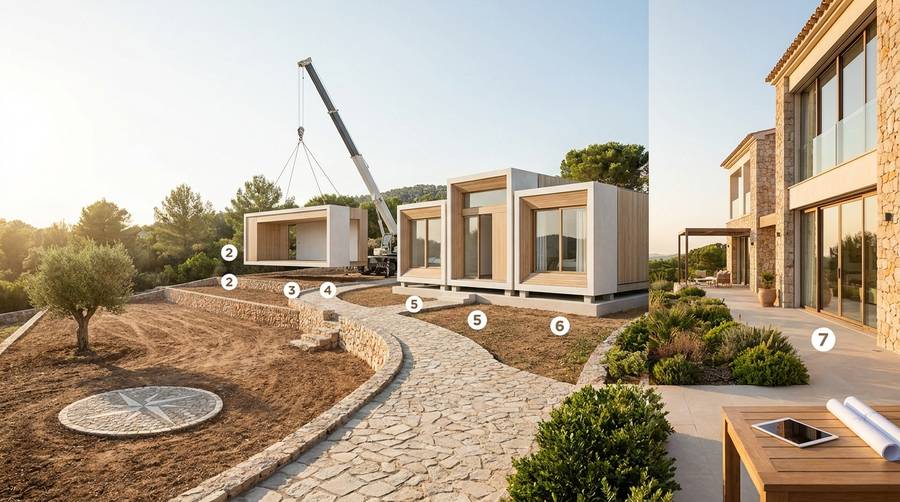
- Site assembly and finishes: foundation, craning, connections and final MEP integration.
- Testing and handover: commissioning, airtightness tests, and client walkthroughs.
Real timelines and quality control checkpoints
Typical calendar for a 150–180 m² premium Mediterranean home:
- Plot due diligence and permits: 3–6 months (can be parallelized).
- Factory production: 8–12 weeks.
- On-site assembly and commissioning: 4–8 weeks.
- Total typical delivery: 6–10 months from contract to handover.
Critical control points: geotechnical confirmation before factory start, FAB-to-SITE interface plan, and mid-production QA gate that includes sample inspections and pre-delivery testing.
Coordination between client, promoter and factory
Successful projects establish a single delivery manager responsible for aligning procurement, financing milestones and logistics. Regular sprint-style reviews (every 2–3 weeks) and transparent dashboards reduce scope drift and align expectations.
Financing and viability: mortgages, real costs and business models
Financing industrialized autopromoted homes requires adapting standard mortgage products to staged delivery models.
Financing options in Spain
- Autopromoter mortgages (hipoteca autopromotor): staggered draws tied to construction milestones; lenders increasingly accept prefabrication when backed by factory contracts and warranty schemes.
- Bridge loans and production financing: to cover factory costs before mortgage conversion at handover.
2026 typical cost breakdown for a premium Mediterranean prefabricated home
Indicative numbers for budgeting (per 150–180 m² premium home, Spain, 2026):
- Land acquisition: highly variable by region.
- Design, permits and consultancy: 6–10% of build budget.
- Factory manufacturing and materials: 55–65%.
- Site works and assembly: 10–15%.
- MEP, finishes and commissioning: 10–15%.
- Contingency: 5–7%.
These figures show that factory processes capture the majority of value and therefore the largest leverage for quality and predictability.
Recommended contracts and risk mitigation
Use fixed-price factory contracts with defined QA gates, clear acceptance tests and retention clauses for final handover. Ensure logistical clauses cover cranage windows and contingency for access restrictions.
Comparisons and case studies: real metrics that prove the value
Data helps separate marketing claims from reproducible outcomes. Below are comparative metrics and a practical case study.
Comparative study: build time, final cost and client satisfaction
When comparing cohorts of 30 recent projects each (prefabricated vs traditional):
- Median build time: prefabricated 7 months vs traditional 11 months.
- Budget variance: prefabricated ±4% vs traditional ±18%.
- Client satisfaction (post-handover survey): prefabricated 8.6/10 vs traditional 7.4/10 — higher where factory QA and design quality were prioritized.
Case study: premium Mediterranean home — metrics and outcomes
Project snapshot: 170 m² two-level home, hybrid concrete core + timber envelope, MVHR, PV + heat pump.
- Permits to contract: 4 months.
- Factory production: 10 weeks.
- On-site assembly and commissioning: 6 weeks.
- Final cost variance: +2% due to landscaping upgrades requested by client.
- Post-occupancy energy use: 40% lower than regional baseline.
- Client satisfaction: 9.2/10 (design fidelity and predictable timeline cited).
Lessons and replicable best practices
- Align geotechnical certainty with factory start to avoid rework.
- Choose hybrid structural systems to combine thermal comfort and aesthetic character.
- Prioritize commissioning checks before craning modules to avoid costly site returns.
Roadmap for autopromoters: practical steps with a view to 2030
Autopromoters who want to benefit from modular approaches should make strategic choices early.
Decisions that maximize quality, sustainability and ROI
- Lock design intent early and reserve critical long-lead items (windows, MVHR) with the factory.
- Opt for materials with transparent EPDs and prioritize local supply chains to reduce embodied carbon.
- Negotiate financing terms that align draws to demonstrable production milestones.
Regulatory and market trends to watch through 2026–2030
- Increased emphasis on embodied carbon reporting in procurement.
- Growing lender familiarity with factory-backed warranties and negative lists in mortgages.
- Municipal incentives for energy-efficient new builds in many Spanish regions.
How to start today: practical first steps
- Clarify your brief: must-have architectural features, target energy performance and budget envelope.
- Commission preliminary site due diligence and a feasibility BIM study with an industrialized delivery partner.
- Secure a finance pre-approval that recognises prefabrication milestones.
- Explore turnkey options that include parcel search and permit handling — for example, see Vivienda industrializada mediterránea: 7 pasos clave 2026 for an end-to-end guide.
For autopromoters, the smartest investment is early clarity: define design, energy targets and funding before factory production begins.
Prefabricated homes designed with Mediterranean sensibilities deliver the warmth and daylight of traditional Spanish houses while offering the predictability, sustainability and speed of industrialized construction. The model is not a compromise — it is an evolution that aligns homeowner values with measurable performance.
If you are considering a modular premium home, start by mapping your priorities and securing a partner that provides transparent milestones, warranty-backed manufacturing and financing pathways. That combination is the fastest route from plot to a comfortable, low-carbon, design-led home.
Ready to explore viable options or review a parcel? Contact a delivery manager to begin a feasibility review tailored to your site and budget.