Prefabricated Housing with Photovoltaic: Spain’s Residential Future
Why prefabricated housing with photovoltaic will define Spain’s residential future
Imagine a family moving into a finished, energy-positive home in nine months—not years—while locking a predictable final price and cutting lifetime emissions by a third. That scenario is increasingly realistic in Spain as prefabricated housing converges with integrated photovoltaic (PV) solutions, regulatory momentum and new financing paths for self-builders.
This analysis synthesizes industry metrics to 2026, technical comparisons, project-level KPIs and actionable recommendations for developers, autopromoters and policy makers.
Current market snapshot and 2026 projections
Spain’s industrialized housing segment has grown steadily: conservative estimates show annual production rising by 8–12% year-on-year through 2025, driven by demand for speed, cost certainty and energy efficiency. Adoption of integrated PV systems on modular roofs has accelerated as component costs fell and certification frameworks matured.
Key figures to watch:
- Typical delivery lead time for traditional builds: 18–30 months.
- Typical delivery lead time for prefabricated housing: 6–12 months.
- Average CAPEX variance in traditional builds: ±12–20%; in prefabrication: ±3–7% due to fixed-package contracts.
Why speed, fixed price and efficiency matter
Shorter timelines reduce financing costs and exposure to material-price inflation. Fixed-price packages common in industrialized housing shift risk from buyers to manufacturers, enabling clearer budgeting for autopromoters.
Projects that combine industrialized construction with integrated photovoltaics report delivery times cut by up to 60% and lifecycle energy savings that materially change payback calculus for homeowners.
Technological trends: PV integration in modular construction
PV integration is evolving from aftermarket add-ons to architected systems. That shift affects performance, aesthetics and maintenance.
Integrated PV vs add-on panels: performance and aesthetics
Integrated photovoltaic solutions (bIPV or visually integrated panels) offer:
- Higher architectural cohesion—improved curb appeal and potentially higher resale value.
- Reduced installation complexity—panels installed during the building phase allow better coordination with electrical and roof systems.
- Potentially lower balance-of-system costs due to shared labor and simplified logistics.
However, fully integrated systems require early-stage design choices and stronger coordination between manufacturer and PV installer.
Storage and energy management systems
Energy storage is now a standard consideration. Key trade-offs include battery capacity vs. cost, and the benefit of smart energy management (EMS) for maximizing self-consumption. For many Spanish climates, pairing 4–8 kWh of battery capacity with a 3–6 kWp PV array moves a typical household to 40–70% annual self-consumption depending on orientation and demand patterns.
How to measure success: relevant indicators
- kWh/m²/year: primary metric for generation normalized by floor area.
- Autoconsumption %: share of generated energy consumed on-site.
- Payback period: time to recover PV and storage CAPEX through energy savings and value uplift.
Materials and structural systems compatible with PV
Matching structural systems and PV requires a materials-first approach. Choice of frame affects roof geometry, structural loads, thermal bridges and installation access.
Industrialized concrete and steel frame compatibility
Precast concrete elements and steel frame systems provide high structural stiffness and predictable load-bearing behavior. They support larger, flatter roof spans suitable for optimized PV arrays. Advantages include:
- High durability and low maintenance over decades.
- Compatibility with flush-mounted PV on flat or slightly pitched roofs.
Light timber frame plus photovoltaics: thermal and sustainability benefits
Light timber frame solutions excel in thermal performance and embodied carbon reductions. For many self-build projects, timber frames enable:
- Superior insulation performance per thickness—beneficial in retrofit-style modular envelopes.
- Lower embodied carbon than steel or concrete, enhancing the carbon balance when paired with PV.
Technical and cost-benefit comparison
When choosing a system, evaluate:
- Durability (expected lifespan of structure vs PV lifetime).
- Thermal performance (U-values, thermal bridging potential).
- Embodied carbon (kgCO2e/m²).
- Immediate CAPEX and lifecycle OPEX for maintenance and replacements.
Rule of thumb: steel and concrete often suit larger, multi-storey modules or flat roofs; timber shines in single-family houses prioritizing low embodied carbon and fast assembly.
Passivhaus design and Mediterranean architecture: efficiency without losing identity
Combining Passivhaus principles with Mediterranean contemporary design yields high comfort and low energy demand while keeping local aesthetics.
Passive strategies to pair with PV
- High-performance envelope: continuous insulation, airtightness and thermal bridge minimization.
- Orientation and shading: solar gain control avoids overheating in summer while harvesting in winter.
- Natural ventilation and heat recovery: lower mechanical cooling loads and improved indoor air quality.
Integrating PV discreetly in Mediterranean designs
Spanish contemporary homes favor light façades, shallow roofs and terraces. PV can be integrated as:
- Low-profile panels within pitched roofs or parapet-mounted arrays on flat roofs.
- PV canopies over terraces that double as shading elements.
Design must avoid the ‘industrial’ look: use consistent materials and align panel fields with roof geometry.
Certification and measurable outcomes
Applying Passivhaus metrics in Spain typically reduces thermal demand by 70–90%. When combined with PV sized to match residual demand, many projects achieve near-zero or net-positive operational carbon profiles.
From land search to delivery: the turnkey process for PV-enabled projects
A well-documented turnkey (llave en mano) process reduces surprises for autopromoters.
Key project phases
- Parcel selection: solar potential, grid connection point and local planning constraints.
- Design and factory production: modular layout, integrated PV layout and utility coordination.
- Permitting: early engagement with local town halls reduces administrative delays.
- Site assembly and commissioning: roof-integrated PV installed either pre-delivery or during on-site works.
- Handover and performance verification: commissioning of PV and EMS, and issuance of guarantees.
Realistic timelines and milestone control
Representative project timeline for a 120–150 m² single-family prefabricated home with integrated PV:
- Parcel search and reservation: 1–3 months.
- Design and permits: 2–6 months (concurrent with factory scheduling).
- Factory production: 6–12 weeks.
- Site works and assembly: 2–6 weeks.
- Commissioning and handover: 1–2 weeks.
Contrast that with traditional builds where permitting, sequential trades and weather exposure extend timelines by many months.
Coordination and contracts
Clarify responsibilities in contracts between manufacturer, PV installer and client. Ensure guarantees for:
- Structural and envelope performance.
- PV generation output ranges (where applicable) and product warranties.
- Battery and EMS functionality and maintenance schedules.
Financing and mortgages for self-builders of prefabricated homes with PV
Financing options are evolving: banks increasingly recognize prefabrication and PV as value-enhancing features.
Available models in Spain (2026)
- Self-build mortgages (hipotecas de autopromoción) staged by construction milestones, now adapted to prefabrication calendars.
- Green loans and mortgages offering better rates for certified low-energy homes or those with sizable PV capacity.
- Vendor financing or project loans from manufacturers in collaboration with financial partners.
How PV affects valuation and credit conditions
Integrated PV can improve appraised value by lowering operational costs and improving energy performance certificates. Lenders consider:
- Reduced monthly energy expenses in affordability calculations.
- Potential for expedited approvals when manufacturers provide fixed-price turnkey packages with warranties.
Practical steps to secure financing
- Prepare a concise financial pack: fixed-price contract, projected energy savings, PV specs and expected payback.
- Highlight certifications (e.g., Passivhaus or equivalent) and warranties to strengthen the risk profile.
- Consider staged drawdowns aligned to factory production and on-site milestones to reduce interest exposure.
Cases and comparisons: quantified lessons
Neutral, metric-driven comparisons help autopromoters choose the right approach for their climate and budget.
Case study 1 — Family home, Mediterranean coast
Project profile: 140 m² industrialized timber-frame house with 5 kWp PV, 6 kWh battery. Key outcomes:
- Factory-to-handover time: 4 months from production start.
- Final project CAPEX: €220,000 (including PV and battery).
- First-year self-consumption: 52%; estimated annual generation: 6,200 kWh (44 kWh/m²).
- Customer satisfaction (surveyed): 4.6/5—main drivers: delivery time and predictable cost.
Neutral comparison: prefabricated with PV vs traditional with aftermarket PV
For a comparable 140 m² home:
- Total delivered cost (prefab + integrated PV): often 5–12% lower when accounting for shorter financing duration and lower contingency reserves.
- Delivery time advantage: prefab 4–8 months vs traditional 18–28 months.
- Installation coordination: integrated PV reduces rework and simplifies warranties.
5–10 year projections: savings and payback
Scenario modeling across Spanish climates suggests:
- Typical payback for PV+storage on prefabricated homes: 7–12 years, depending on incentives and self-consumption behavior.
- Lifetime operational savings reduce total cost of ownership by 20–35% over 30 years compared to non-PV homes.
Image for the article (description for AI generator in Findnido style)
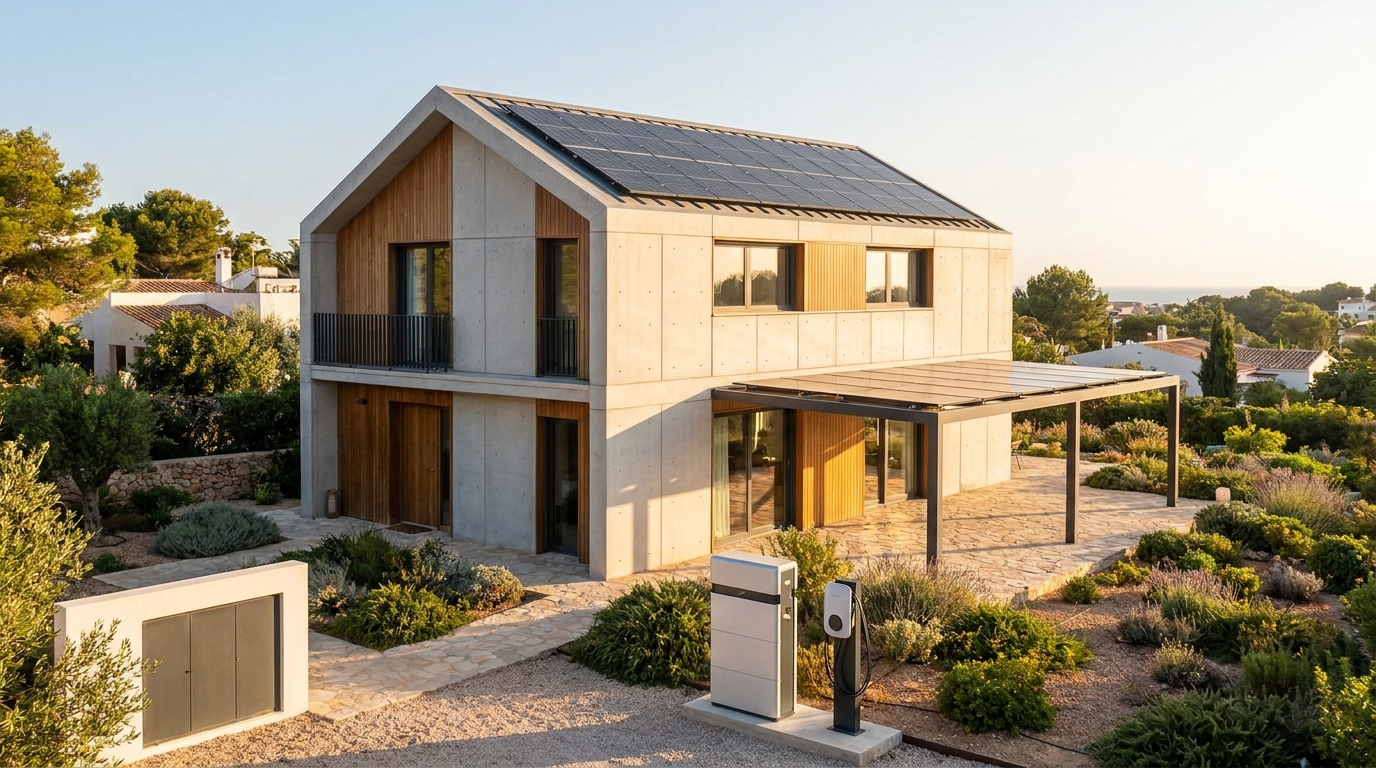
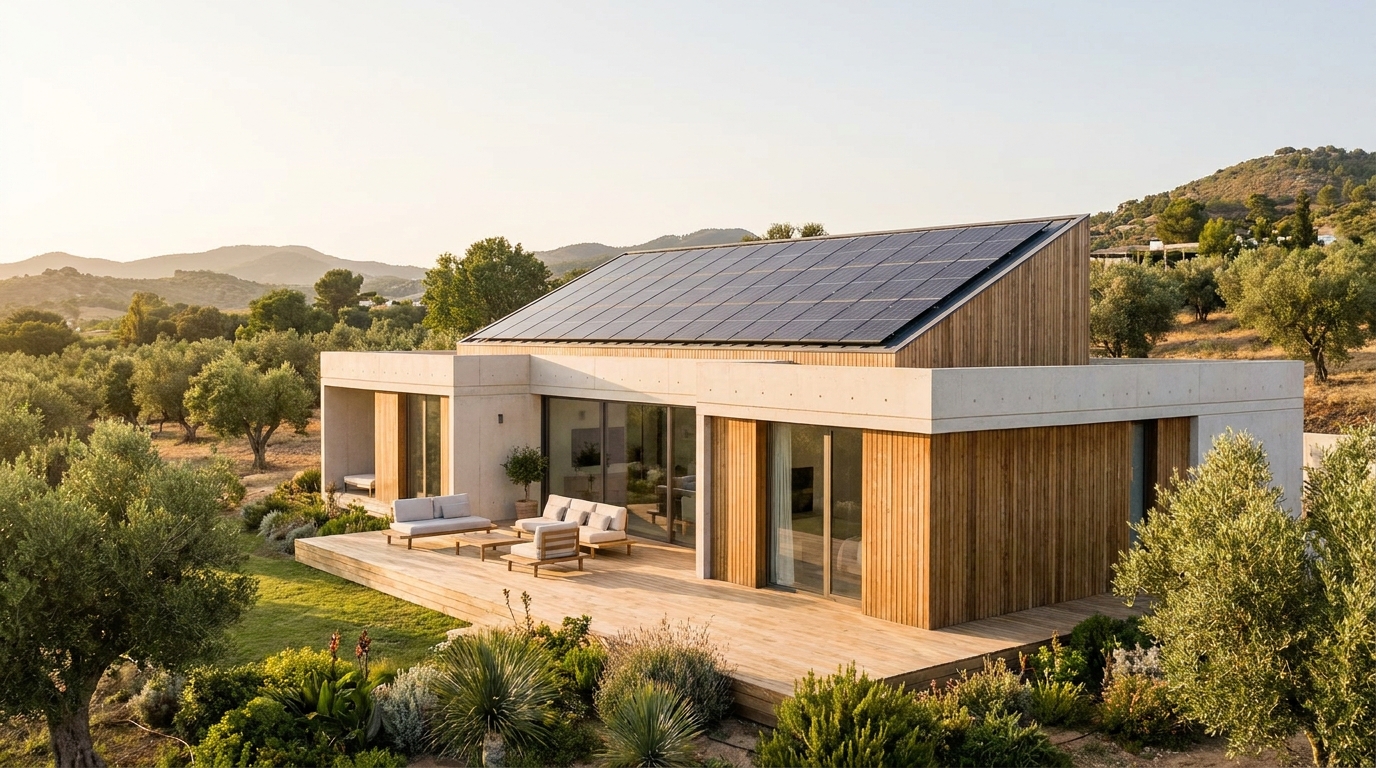
Photograph of a finished Mediterranean contemporary single-family home in Spain, staged at golden hour. The house shows a light façade with natural materials—wood accents, stone cladding and smooth concrete. Large windows reveal warm interior light. A discreetly integrated photovoltaic field sits flush with a slightly pitched roof or parapet, designed to blend with rooflines. The garden and terrace are furnished, with potted plants and a family or couple casually interacting outdoors to convey everyday life. Framing and color grading reflect architectural magazine quality: natural colors, warm light and balanced composition. The scene feels premium, sustainable and lived-in—no construction equipment, no exposed structural elements, and no boxy container aesthetics. The image aligns with Findnido brand identity: aspirational, trustworthy and modern.
Final reflection: strategic steps to scale adoption by 2030
Scaling prefabricated housing with integrated PV requires aligned incentives, transparent financing and standardised technical pathways. Practical starting actions:
- For promoters: develop fixed-price PV-integrated packages and publish reference KPIs (kWh/m², lead times, warranties).
- For administrations: streamline permits for factory-built modules and standardized PV approvals.
- For autopromoters: insist on measurable guarantees, third-party commissioning and staged payments tied to performance milestones.
Metrics to monitor as adoption scales:
- Average delivery time (days) from contract to handover.
- Median CAPEX variance vs contract price.
- Average kWh/m²/year generated and autoconsumption percentage.
- Customer Net Promoter Score (NPS) and maintenance call rates post-handover.
By 2030, a mature market for prefabricated housing with photovoltaic systems can materially reduce Spain’s residential carbon footprint while delivering homes faster and with fewer cost surprises. The shift depends on clear measurement, sensible financing and designs that respect local identity.
If you’re planning a self-build or considering prefab options, start by requesting a technical pack with projected kWh/m² figures, a fixed-price turnkey quote and a staged financing plan—these three documents will reveal whether a project is truly turnkey and bankable.
Ready to compare options for your plot? Reach out to specialists who can provide sample KPIs and a realistic turnkey timeline tailored to your parcel.
Artículos relacionados