


Industrialized Housing Passivhaus: A Spanish Success
From idea to plot: how the Passivhaus industrialized home began
The day they signed the land contract, the couple already knew their home had to be different: ultra-efficient, timeless in Mediterranean aesthetics, and built with a fixed price and a predictable schedule. That decision shaped every technical choice that followed.
Project context and owners' objectives (comfort, efficiency, fixed budget)
The homeowners were first-time self-builders in Spain. Their priorities were clear: passive comfort year-round, low operational costs, and financial certainty. They rejected open-ended renovations and wanted a solution that offered both modern performance and a Mediterranean look that fit the neighborhood.
Choosing the parcel and site constraints in Spain
They selected a suburban plot with good sun exposure but a slope to the south. Local zoning limited ridge height and required a warm façade material palette. These constraints favored a compact, highly insulated volume that respected local aesthetics.
Why Passivhaus and industrialized construction: the narrative and technical reasons
They chose a Passivhaus-certified approach to guarantee comfort and verified energy performance. Industrialized construction (modular elements produced in controlled conditions) promised tight quality control and shorter on-site time—critical to keep costs predictable and to accelerate mortgage drawdowns linked to construction milestones.
The challenge: constraints and risks to overcome
Urban restrictions, climate and orientation: problems to solve
The site required a compact envelope, careful glazing placement to avoid overheating in summer, and enhanced insulation for occasional cold snaps. Achieving Passivhaus targets on a sloped, Mediterranean plot meant balancing shading strategies with high-performance glazing and ventilation.
Financial and schedule risks for self-builders: mortgage and cost control
Autopromoters often face two big risks: cost overruns and financing delays. In this case, using a turnkey industrialized approach created clear milestones for the mortgage lender and capped most construction variables under fixed-price contracts.
Perceptions about prefab quality: how concerns were addressed
To counter the stigma of low-quality prefabrication, the team prioritized visible finishes and tested assemblies in the factory. Photorealistic mock-ups, on-site display panels, and a staged client visit to the production line demonstrated the craftsmanship behind the system.
The Passivhaus solution executed with modular construction
Selected construction system and rationale
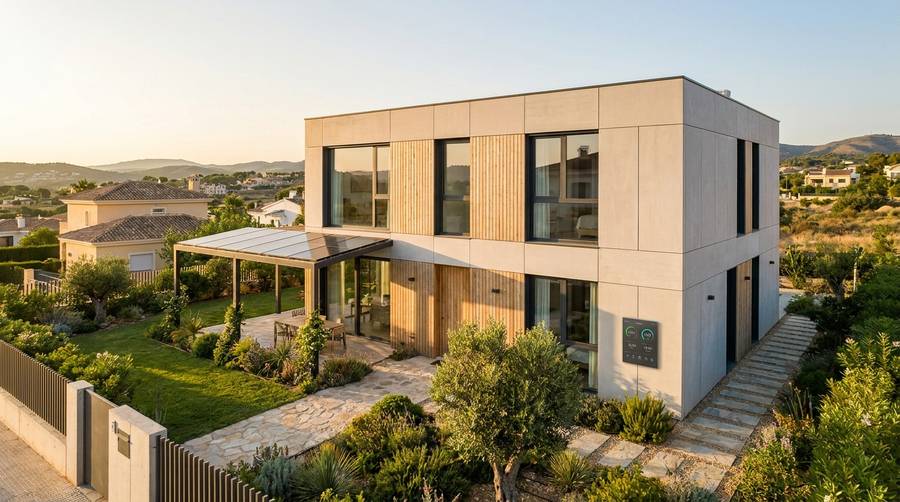
The final assembly used a timber light-frame primary system with factory-applied mineral wool insulation and ventilated façades featuring local stone and timber detailing. This combination offered fast factory production, high thermal performance, and the warm textures desired for Mediterranean architecture.
Passivhaus strategies: insulation, airtightness, ventilation and thermal bridges
Key technical measures implemented:
- Continuous external insulation achieving U-values below 0.15 W/m²K on walls.
- Airtightness target of n50 < 0.6 h-1, verified in factory panels and at assembly.
- Mechanical ventilation with heat recovery sized to Passivhaus standards, with bypass for occasional overheating.
- Thermal bridge-free detailing at cantilevers, balconies and window junctions using factory-sealed connections.
Design decisions that respect Mediterranean aesthetics and real life
Large south-facing windows with external shading, recessed terraces, and a light stucco façade combined performance with tradition. Interior layouts prioritized cross-ventilation and flexible living spaces to reflect everyday family routines.
"We wanted a home that felt like it had always belonged in the street — efficient, quiet and warm in winter, cool in summer, without looking like a factory product."
Turnkey process step by step: from project to delivery
Key phases and a realistic timeline
The project followed a clear sequence with measured durations:
- Design and approvals: 10–14 weeks (site surveys, PHPP modeling, permits)
- Factory production: 8–10 weeks (panel/module fabrication, QA)
- On-site assembly: 2–4 weeks (foundation tie-ins, craning, envelope sealing)
- Commissioning and handover: 2–3 weeks (MVHR balancing, airtightness test, client walkthrough)
Compared to typical traditional build timelines, the controlled factory window compressed weather-related delays and shortened the overall schedule.
Coordination with financing (self-build mortgages) and payment milestones
The fixed-price turnkey contract allowed the homeowners to negotiate a staged mortgage release: land purchase, foundation completion, factory production start, on-site assembly, and final completion. Clear deliverables at each milestone reduced lender risk and avoided mid-project funding shortfalls.
Quality control and Passivhaus certification at each stage
Quality assurance included factory checklists, third-party airtightness tests at panel level, on-site continuity tests, and final PHI verification. This layered QA process ensured the delivered performance matched PHPP predictions.
Measurable results: energy savings, time and budget
Real metrics from the case: consumption, carbon and annual bills
Measured in the first 12 months, the house recorded the following:
- Primary heating consumption: 8 kWh/m²·year (space heating)
- Total delivered energy for dwelling services: ~25 kWh/m²·year
- Estimated CO₂ reduction vs conventional build: ~65% (operational emissions)
- Annual energy bill for heating and hot water: reduced by approximately €650 compared to a standard new build of equal size.
These numbers validated the upfront investment in high-performance envelopes and efficient systems.
Times compared to traditional construction: factory weeks vs on-site months
The factory production (8–10 weeks) plus a short assembly phase (2–4 weeks) resulted in a total on-site disruption of under six weeks. By contrast, a similar conventional build would typically require 9–14 months of on-site activity.
Final cost vs initial budget and customer satisfaction
The project closed within 3% of the initial turnkey estimate. The homeowners reported high satisfaction on build transparency, acoustics, thermal comfort, and the predictable cashflow enabled by staged mortgage releases.
Technical and competitive comparison without acrimony
Advantages over traditional construction: efficiency, fixed schedule and fixed price
Industrialized housing offered three clear benefits for this self-build:
- Predictable schedule: reduced exposure to rain and labour variability.
- Fixed-price clarity: clear scope and fewer change orders.
- Better performance control: factory QA led to consistent airtightness and assembly quality.
Comparing industrial materials: thermal performance and sustainability
Each industrialized material has trade-offs:
- Timber frame: fast, lightweight, excellent embodied carbon profile when sourced responsibly.
- Concrete industrialized elements: robust, high thermal mass but higher embodied CO₂—best used selectively.
- Steel frame: precise and durable, useful for larger spans; consider thermal break details to avoid performance loss.
In this project, the timber light-frame delivered the best balance of speed, embodied carbon and finish quality for Mediterranean living.
Limitations and when another route may be preferable
Industrialized Passivhaus is not always the optimal choice. Consider alternatives if:
- The project demands extremely irregular forms or site-built stone façades that cannot be factory-reproduced.
- Local supply chains for prefabricated systems are absent, inflating logistics costs.
- Very low upfront budgets prevent meeting Passivhaus envelope costs (other efficiency pathways may be staged over time).
Lessons learned and a practical guide to replicate the approach
Advice for self-builders: choosing plot, team and financing
Practical steps distilled from the project:
- Choose a plot early with favourable solar access and reasonable access for crane and deliveries.
- Engage a Passivhaus-savvy architect and a manufacturer with verified factory QA.
- Negotiate mortgage milestones aligned with the turnkey contract to avoid cashflow gaps.
Practical checklist: Passivhaus parameters and turnkey contract items
- Set airtightness targets and verification steps (factory and final tests).
- Define thermal bridge details in contract drawings and include a tolerance table for U-values.
- Specify MVHR commissioning and client training as contractual deliverables.
- Include a fixed scope for finishes to avoid cost creep on site.
Next steps if you want to start today (resources, key questions and contact)
If this approach resonates, begin with a two-step feasibility:
- Run a site feasibility and PHPP pre-assessment with an architect experienced in industrialized Passivhaus.
- Request fixed turnkey proposals from at least two certified manufacturers, and align mortgage milestones before signing.
For an illustrative completed Passivhaus industrialized example and homeowner satisfaction data, see Passivhaus industrializada: caso real de éxito.
Final note: industrialized housing, when paired with Passivhaus rigor and a transparent turnkey contract, can deliver a real home that meets Spanish design expectations while offering measurable savings and predictable timelines.
If you want personalised next steps for your plot or a checklist adapted to your budget, get in touch—starting with a short feasibility review can save months and reduce financial risk.
Artículos relacionados
Passivhaus Industrialized Home: A Real Success Story
A family in Spain moved into a Passivhaus industrialized home in under a year — fixed price, measured performance, and living comfort that transformed daily life. This case study breaks down choices, timelines, costs and practical lessons for self-builders.