Buying Land for a Modular Home: Pros & Cons
It’s tempting to picture your finished modular home on a sunlit Spanish plot—but choosing that plot poorly can turn the dream into a costly delay. This article walks you through the decisive trade-offs of buying land for a modular (industrialized) home, giving clear criteria, practical checklists and real metrics so you can reach a confident decision.
Why buy land for a modular home: a quick overview
Modular housing changes the risks and rewards of site selection. Instead of long, unpredictable on-site builds, much of the value lies in factory-controlled production, fixed schedules and predictable budgets. But land still dictates feasibility, cost and long-term performance.
Advantages of choosing industrialized housing vs traditional construction
- Shorter on-site timeline: module installation often takes weeks instead of months.
- Budget certainty: many modular projects are delivered with fixed-price contracts.
- Controlled quality: factory conditions reduce variability and defects.
- Better energy performance: modern factory-built envelopes can meet or exceed Passivhaus principles.
- Lower embodied emissions: optimized material use and less waste reduce carbon footprint in many cases.
When buying a parcel pays off economically and in time
Buying land makes sense for modular construction when:
- You need a predictable timeline (e.g., moving dates, lease end).
- You value fixed budgets and reduced change orders.
- You can optimize orientation and access to exploit energy savings.
- Local regulations support industrialized solutions or offer incentives.
Common errors when evaluating land for modular projects
- Assuming every parcel is equally suitable for off-site modules—transport limitations or foundation needs can eliminate options.
- Underestimating connection costs (sewer, electricity, water) or urbanization fees.
- Ignoring microclimate and orientation impacts on energy performance.
- Failing to confirm legal constraints: covenants, easements and building envelopes.
Choosing the right plot is not just about location—it's the technical backbone that determines if your modular home will be affordable, energy-efficient and delivered on time.
Comparison: buying land for modular versus traditional site-built homes
Initial and predictable costs (urbanization, permits, fees)
Modular: you often pay similar land acquisition costs but benefit from clearer budgeting for the building itself. Factory bids typically itemize costs—reducing surprises.
Traditional: on-site estimates frequently change with unforeseen conditions, weather delays or subcontractor variances.
- Permit fees are similar, but modular projects may require additional transport or crane permits.
- Urbanization costs (access roads, connections) are identical in both, but the timing of works can differ—modular reduces on-site labor time.
Project and execution timelines: closed and controllable schedules
Modular projects: Typical factory production time for a medium-size home (120–160 m²) ranges from 8 to 16 weeks; on-site assembly and finishing from 2 to 8 weeks—total often under 6 months from firm order.
Traditional builds: A comparable home routinely requires 10–18 months, with higher risk of delay.
Risks and flexibility: on-site adaptations vs factory constraints
Modular: changes after production begins are costly. Early design finalization and thorough site checks mitigate this.
Traditional: higher flexibility to change mid-build, but at the cost of time and budget unpredictability.
How to evaluate a plot step by step for a modular home
Technical-urban checklist: land use, buildability and covenants
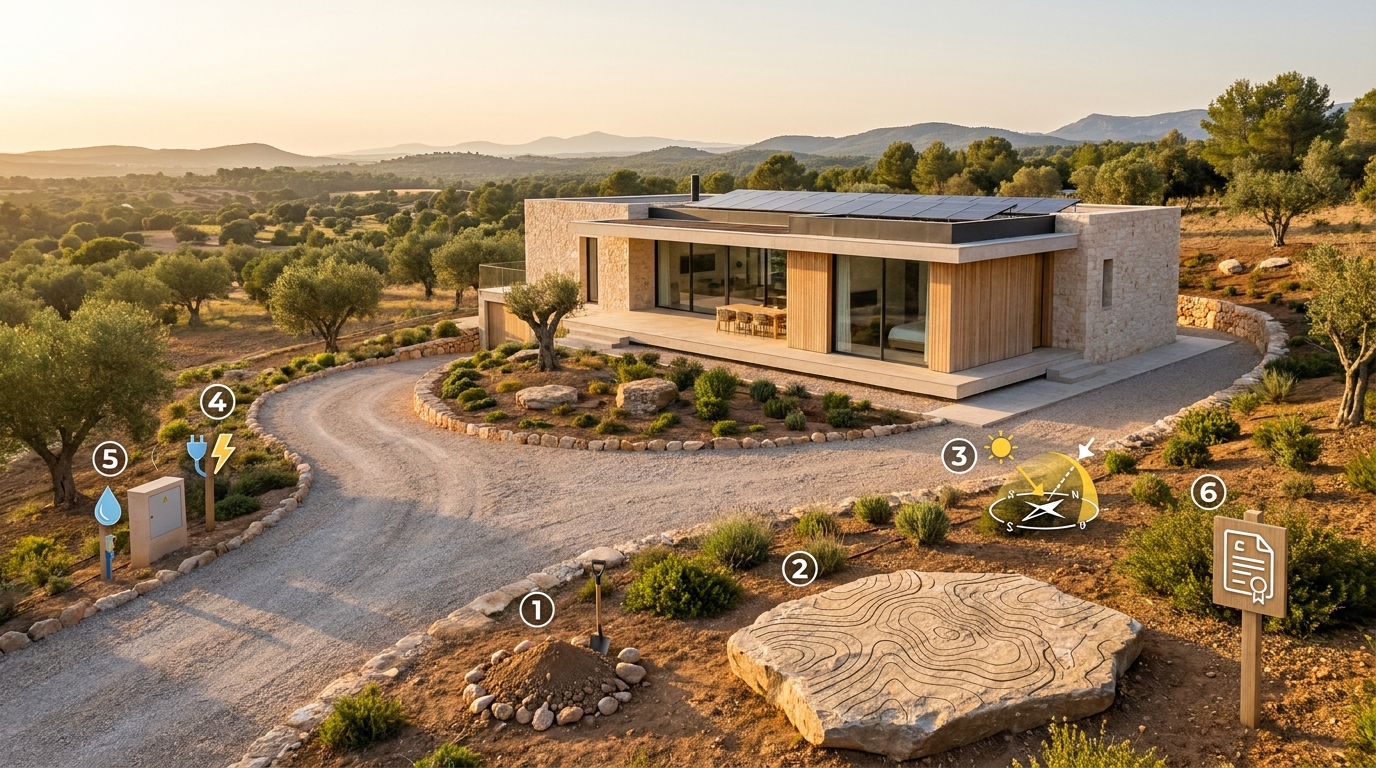
- Verify land classification in the municipal plan (plan general) and permitted uses.
- Confirm maximum buildable area, maximum height and setbacks.
- Check for easements, right-of-way and heritage restrictions that limit prefabricated assemblies.
- Request a cadastral report and recent nota simple to detect hidden encumbrances.
Topography, access and orientation: impact on design and energy
Topography: steep sites increase foundation complexity. Modular solutions can adapt, but costs rise for stepped foundations or retaining works.
Access: modules require transport and crane access—confirm road width, bridge capacities and permitted travel routes.
Orientation: to achieve high energy performance (e.g., near-Passivhaus) prioritize southern exposures for living spaces and consider shading for summer comfort.
Connections and utilities: water, sewer, electricity and hookups
- Confirm distance to network points; long runs increase trenching costs.
- Check sewer gradient—flat sites might need pumping stations.
- Ask the grid operator about capacity and timeline for new connections.
- Plan renewable energy placement (solar) early—roof orientation and local permits matter.
Practical pros and cons of parcels for modular homes
Advantages: time savings, controlled quality and fixed budgets
- Predictability: factory workflows lower defect rates and allow firm deadlines.
- Speed: less time exposed to weather and local contractors means fewer change orders.
- Quality: consistent insulation, airtightness and finishes that help achieve high energy standards.
- Cost transparency: clearer line items for manufacturing vs site works.
Disadvantages: regulatory limits, transport logistics and foundations
- Regulatory fit: some municipalities have prescriptive rules that complicate modular typologies.
- Logistics: narrow roads, tight turns or nearby bridges can block module delivery and raise costs.
- Foundations: while modules reduce on-site time, foundations often still require traditional works adapted to each site.
How to mitigate drawbacks: project and planning solutions
- Engage a modular-experienced architect early to align design with local regs.
- Conduct a transport feasibility study before purchase to identify crane and route needs.
- Consider split foundations or pre-cast foundation systems to reduce on-site time.
Sustainability and technical factors that condition land purchase
Materials and systems—concrete, light timber frame and steel frame relation to site
Concrete industrialized systems: robust and thermally massive—suitable for sites with thermal inertia needs but may increase embodied carbon depending on mix.
Light timber frame: low embodied carbon and fast production; ideal when light foundations and fast assemblies are priorities.
Steel frame (steel frame): high precision and durability; consider corrosion risk in coastal plots and insulation detailing to avoid thermal bridges.
Energy efficiency and Passivhaus: orientation, shading and the building envelope
To reach Passivhaus or near-Passivhaus performance, the plot must allow:
- Optimal solar orientation for living spaces.
- Proper shading opportunities (trees, pergolas) to avoid overheating.
- Space for continuous, high-performance insulation and airtight detailing tied to foundation and openings.
Carbon footprint and on-site renewable options
Embodied carbon: choose systems with documented LCA; timber systems often score better, but design decisions matter more than the label alone.
On-site renewables: roof orientation, landscape shading and available roof area affect PV yields. Consider battery storage and EV readiness early in the design.
Financing and the turnkey process: from land to delivery
Mortgage options for self-build and modular financing
In Spain, financing can follow three common paths:
- Land mortgage plus construction loan: two-stage financing where the land loan converts into construction finance.
- Self-build mortgage: tailored loans that release funds by milestones—modular projects often require fewer disbursement stages.
- Turnkey financing: a single mortgage covering land and turnkey delivery—simpler for borrowers but check the interest and conditions carefully.
Tip: When negotiating a mortgage for a modular turnkey project, present the factory schedule, warranty and fixed-price contract to reduce lender perceived risk.
Turnkey phases: land search, design, manufacturing, assembly and handover
- Land search and technical due diligence: legal checks, geotechnical survey and transport study.
- Design and permits: architect aligns modular components with regulations and finalizes factory-ready drawings.
- Manufacturing: modules produced in a controlled environment—quality assurance and testing occur here.
- Site preparation and assembly: foundations, utility hookups and module craning and joining.
- Finishing and handover: interior finishes, systems commissioning and final client walk-through.
Case studies and real metrics: timelines, costs and client satisfaction
Representative examples (aggregated):
- 120 m² timber-frame home near Valencia: land purchase to handover in 26 weeks; total delivered cost ~€1,450/m²; client satisfaction 4.7/5 on timely delivery and thermal comfort.
- 150 m² steel-frame home in Murcia with PV: 32 weeks total; cost ~€1,600/m² including PV and battery-ready system; post-occupancy heating demand under 25 kWh/m²-year.
- 140 m² concrete-panel solution in Catalonia: 36 weeks; cost ~€1,700/m² due to complex foundation; excellent acoustic performance and long-term durability reported by owners.
Insight: modular delivery compressed on-site phases by 60–80% compared with comparable local traditional projects in these samples.
Final decision: clear criteria to choose the ideal plot
Mental priority table: budget, timeline, sustainability and lifestyle
- If budget and timeline are top priorities: prioritize plots with easy access, flat topography and nearby utilities.
- If sustainability and low running costs matter: select plots with optimal solar exposure and space for renewables and consider timber or high-performance insulated systems.
- For lifestyle and views: balance orientation with privacy, shading and microclimate impacts.
Key questions to ask the developer and manufacturer before signing
- Can you provide transport and crane studies specific to my plot?
- What is included in the turnkey price and what counts as extras?
- Do you supply performance guarantees (airtightness, U-values, energy demand)?
- How are change orders handled and what are typical costs?
- What warranties cover manufacturing, structure and systems?
Recommended next steps: survey, technical visit and a commercial proposal
- Order a geotechnical and topographic survey before purchase.
- Request a transport feasibility and preliminary foundation strategy from a modular-experienced engineer.
- Ask manufacturers for a detailed turnkey proposal tied to the exact plot conditions.
Choosing the right plot for a modular home reduces risk and unlocks the main benefits of industrialized housing: speed, quality and predictability. If you are evaluating a specific parcel, start with the geotechnical, legal and transport checks and bring a modular-savvy architect into the process early. That combination gives you negotiating power and a realistic delivery timeline.
If you'd like, we can review a plot file and provide a tailored feasibility memo highlighting transport constraints, foundation options and a realistic schedule—send the site documents and we'll prepare a concise technical brief to help your decision.
Artículos relacionados