vivienda industrializada: Modular vs Traditional Homes
Why choose a vivienda industrializada for your new plot?
Imagine signing a fixed-price contract and receiving a finished, energy-efficient home in months — not years. That certainty is the core promise of industrialized housing for autopromoters in Spain. This section explains the concrete benefits and realistic limits so you can decide quickly and confidently.
Modular construction can reduce on-site time by up to 60% and cut construction waste by 30–50% compared with traditional builds when managed end-to-end.
Key advantages: efficiency, fixed schedules and price certainty
Predictable timeline: Factory production and parallel site works mean the house can be closed (weatherproof) fast — typically 8–20 weeks from delivery to on-site assembly for a standard single-family home.
- Faster delivery: Design and approvals run in parallel with manufacturing.
- Fixed-price advantage: Components and labor are contracted in the factory, limiting many traditional unknowns.
- Less on-site disruption: Shorter site presence reduces delays from weather and subcontractor coordination.
Impact on sustainability and energy efficiency (e.g. Passivhaus criteria)
Industrialized homes are often better suited to meet advanced energy targets because factory processes control insulation continuity, airtightness and quality of assemblies.
- Controlled insulation and airtightness: Quality checks in factory reduce thermal bridges.
- Material optimization: Offsite production reduces waste and enables the use of engineered materials that perform well over time.
- Compatibility with Passivhaus: Many modular systems can achieve or approach Passivhaus performance when paired with certified windows, ventilation heat recovery and correct detailing.
Use cases: when modular is the better option for self-builders
Choose vivienda industrializada when you prioritize time, predictable costs and high energy performance. Typical scenarios:
- Small to medium single-family homes where factory repeatability delivers savings.
- Sites with limited access where long on-site programs raise risk.
- Projects with tight budgets that benefit from fixed-price packages and lower waste.
How to choose the ideal plot for a modular house
Buying the right plot is as important as selecting the construction system. A good parcel reduces complications at permitting and foundation stages and unlocks design efficiency for a vivienda industrializada.
Urban planning constraints and municipal rules: essential checks
Before committing, verify:
- Plot classification (residential, urbanizable, protected).
- Maximum buildable area, footprint and height limits.
- Setbacks, required parking, and green-space obligations.
Request a simple municipal certificate or consult a local architect to confirm constraints early.
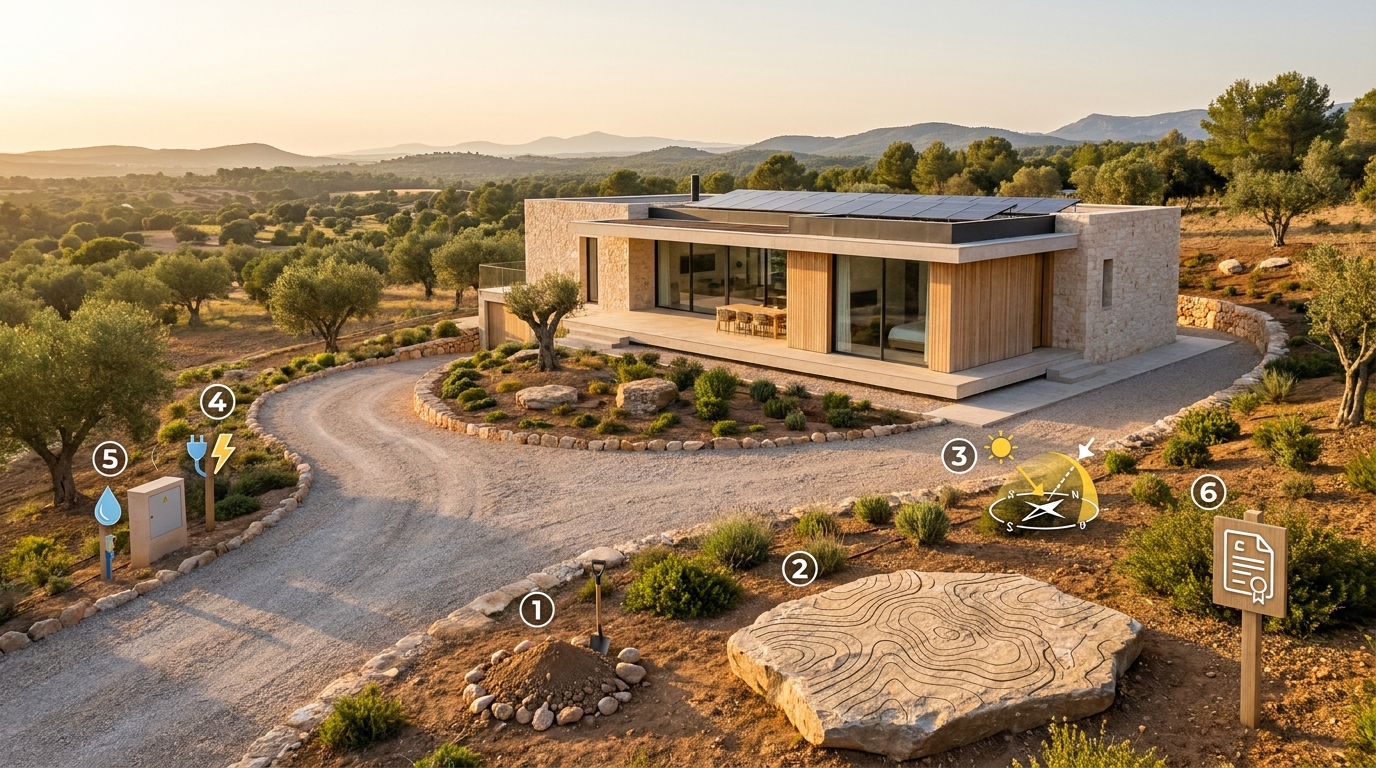
Topography, access and services: what to value before buying
Practical factors that affect cost and schedule:
- Topography: Slopes may require more complex foundations and increase costs for a modular system.
- Access: Modular transport requires sufficient road width and turning radii for large trucks and cranes.
- Utilities: Proximity to water, sewer, electricity and telecoms cuts connection costs and simplifies coordination.
Size, orientation and siting options to optimize design and efficiency
Good orientation reduces energy demand. For a Mediterranean context:
- Maximize southern exposure for winter solar gains; design shading for summer.
- Plan compact shapes to limit envelope area per m².
- Allow space for terraces and outdoor living that enhance perceived size without increasing footprint.
See our practical guide for plots: Comprar terreno para vivienda modular: guía práctica.
Objective comparison: modular home versus traditional build on your plot
Weighing time, cost and long-term performance objectively helps you choose the right route for your goals. Below are real-world metrics and balanced observations.
Construction time and schedules: real data and comparative examples
Typical timelines (single-family dwelling, Spain):
- Traditional: 12–24 months on site (depending on scale & permits).
- Modular (vivienda industrializada): 4–9 months from start of site works to occupancy when permits are in place.
Case study: a 140 m² house built with steel-frame modules achieved enclosure in 6 weeks after foundations were ready; total project completed in 7 months vs a projected 14 months for a traditional build on a comparable plot.
Costs and economic predictability: initial price, contingencies and long-term value
Cost categories to compare:
- Initial construction cost: Modular can be competitive or slightly higher depending on finishes. Predictability is the main financial advantage.
- Contingencies: Traditional projects typically include larger contingency lines because weather, labor shortages and on-site changes are more likely.
- Resale and life-cycle value: Quality materials and energy performance support long-term value; buyers increasingly accept modular homes when they look like conventional quality housing.
Tip: negotiate a price that itemizes finishes and MEP (mechanical, electrical and plumbing) scope to avoid late change orders.
Build quality and durability: materials, guarantees and maintenance
Assess these factors when comparing systems:
- Materials: Concrete modules deliver high thermal mass and acoustic performance; timber frames offer excellent insulation and lower embodied carbon; steel frame combines speed with structural flexibility.
- Factory QA: ISO-like processes in factories reduce defects and enable traceability of components.
- Guarantees: Look for multi-year warranties on structure and weatherproofing, and clear post-delivery defect periods.
Construction materials and systems for industrialized houses
Choice of system depends on climate, plot conditions and performance goals. Below are practical comparisons of common options used in Spain today.
Industrialized concrete: structural and acoustic advantages
Precast concrete systems deliver high durability, sound insulation and fire resistance. They are ideal for sloped urban lots where mass helps with thermal inertia but are heavier and require robust foundations.
- Pros: Longevity, acoustic performance, fire safety.
- Cons: Transport and crane logistics can add cost; less flexible for late design changes.
Light timber frame and steel frame: weight, insulation and speed
Both systems are widely used for vivienda industrializada:
- Timber frame: Very good thermal performance, low embodied carbon, quick to assemble.
- Steel frame: High precision, slim sections, excellent for open plans and fast on-site assembly.
Choose timber in rural or low-rise suburban contexts where carbon footprint matters; choose steel when structural spans or design flexibility are priorities.
How to choose based on climate, plot and sustainability targets
Match the system to objectives:
- For Passivhaus-level targets, prioritize airtightness and continuity of insulation above all.
- For coastal Mediterranean sites, control moisture and use materials resistant to salts and humidity.
- When embodied carbon is a priority, timber and optimized concrete mixes are preferable.
The turnkey process: from finding land to delivering the finished home
A well-managed turnkey process reduces surprises. Here’s a practical phase-by-phase guide tailored to Spanish autopromoters.
Project phases: feasibility, design, factory production and assembly
Typical turnkey flow:
- Feasibility study: Plot review, budgetary estimate and planning check.
- Design and approvals: Final design, technical documents and building permit.
- Factory production: Component manufacturing under QA protocols.
- On-site works and assembly: Foundations, module installation, connections and finishes.
Coordination on site: foundations, utilities and assembly timelines
Essential coordination items:
- Ensure foundations fit factory tolerances — any deviation can delay module placement.
- Sequence utility connections so that MEP commissioning aligns with finish works.
- Plan crane lifts and access windows with logistics lead times in mind.
Handover and aftercare: quality controls, certifications and warranties
At delivery expect:
- Final QA checklist and as-built documentation.
- Energy performance certificates and, where applicable, Passivhaus certification documentation.
- Clear defect rectification timelines and operation manuals for systems.
Financing and mortgages for self-build and modular housing
Financing modular projects is similar to traditional self-build, but banks value fixed-price contracts and certified energy performance. The right documentation shortens appraisal times and improves lending terms.
Financing options: self-build mortgage vs developer credit
Common options:
- Self-build (autopromoción) mortgage: Releases funds in stages tied to milestones and requires technical documentation.
- Promoter credit: Some manufacturers offer financing packages or partner with lenders to simplify funding.
Documentation and project valuation for banks
Essential documents for lenders:
- Detailed fixed-price contract with the manufacturer.
- Building permit and technical project.
- Energy performance estimates and certifications, which can improve loan conditions.
Strategies to optimise financing: closed budgets and energy certifications
Practical tips:
- Use fixed-price turnkey offers to reduce contingencies demanded by banks.
- Secure energy labels (or Passivhaus certification evidence) to support lower operational cost assumptions in valuations.
- Prepare a clear payment schedule and independent cost audits if needed.
How to decide: checklist for buying a plot and choosing modular
Use this concise decision tool to validate your path forward.
Key questions you must answer before buying the plot
- Does the municipal classification allow the house you want?
- Are access and crane logistics compatible with modular transport?
- Can you secure a fixed-price turnkey offer including foundation works?
- Do energy targets (e.g., near-Passivhaus) fit your budget and objectives?
Final scenario comparison: cost, time, sustainability and risk
Summary guidance:
- If time and budget predictability are top priorities: vivienda industrializada often wins.
- If ultimate design freedom or highly irregular site constraints dominate: traditional may be better.
- If sustainability and low lifetime operating costs matter: modular with good certification reduces risk and improves value.
Recommended next steps for self-builders in Spain (2026)
Practical roadmap:
- Commission a feasibility check that combines municipal review and a manufacturer compatibility assessment.
- Obtain two turnkey proposals with itemized budgets and timelines.
- Secure pre-approval for financing using those fixed-price quotes and energy documentation.
For help with plot selection and next steps see our guides: Vivir en Massamagrell: guía para una vivienda unifamiliar and Vivienda unifamiliar en Massamagrell: historia real.
Deciding between vivienda industrializada and traditional construction is a trade-off. If you need speed, predictability and energy performance, modern modular systems are often the pragmatic choice. If you require full on-site customization or a highly irregular plot, traditional construction may still be preferable.
Ready to evaluate your plot with a clear, realistic plan? Contact a local specialist, gather two turnkey quotes and compare them against the checklist above to move forward with confidence.
Artículos relacionados