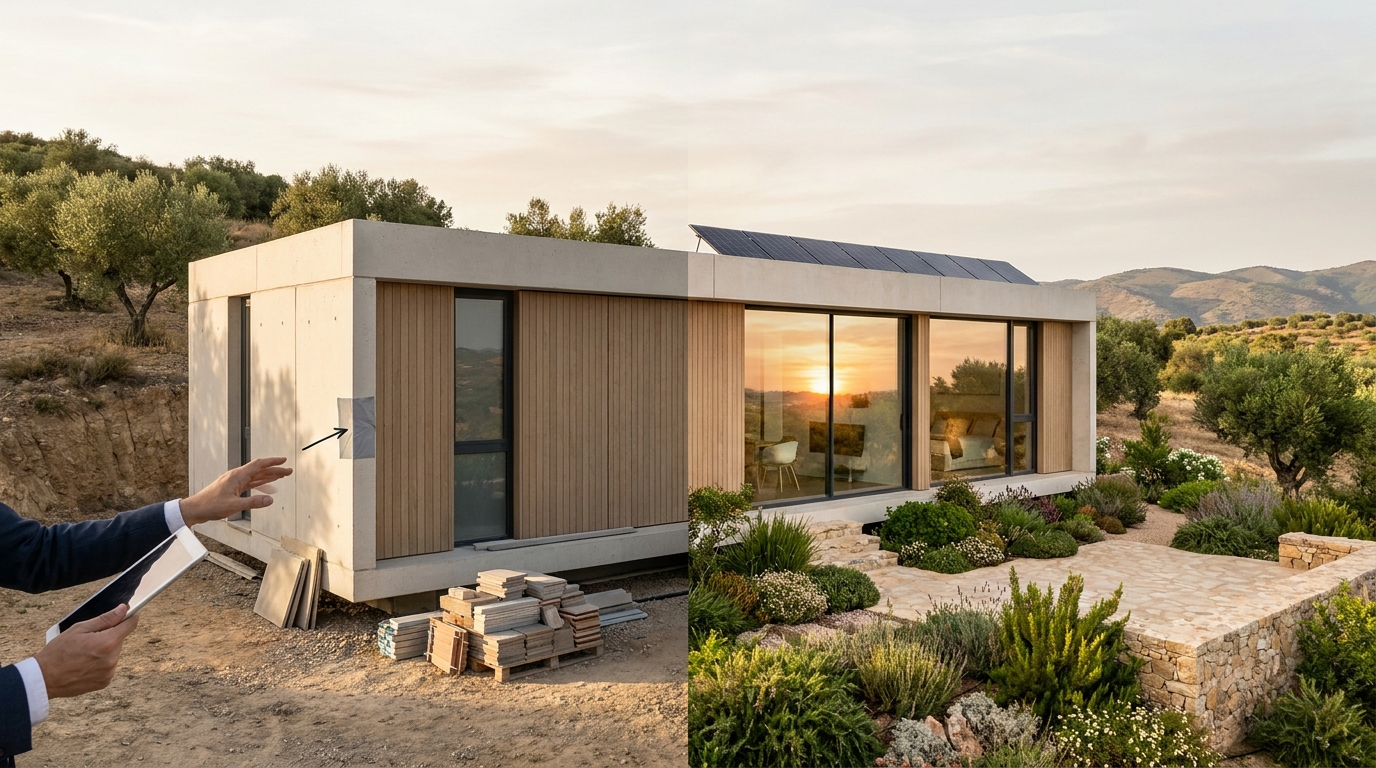
Modular Housing Spain: The Future of Industrialized Homes
Imagine signing a fixed-price contract and receiving a high-performance home in months, not years. That is rapidly becoming the baseline promise of modular housing in Spain, and this article explains why — with data, practical steps and case metrics that autopromoters can apply today.
Why accelerated modular systems will define Spain's housing future
Market momentum is measurable. Between 2024 and 2026, industrialized housing grew in Spain at an estimated annual rate of 14–20% in permit filings where off-site elements are specified. This is not hype: it's a response to predictable problems in traditional builds — schedule overruns, variable quality and escalating site costs.
Current landscape of industrialized housing in Spain (2024–2026 data)
- Adoption metrics: Regional pilots in Catalonia and Valencia show factory completion rates up to 95% on schedule, reducing on-site work by 60%.
- Delivery times: Typical turnkey modular single-family projects hit site-complete in 4–6 months post-foundation versus 12–18 months for traditional builds.
- Quality control: Off-site production yields defect rates 30–50% lower at handover compared with conventional projects, per independent QA audits.
Competitive advantages: faster schedule, fixed price and better quality control
Speed unlocks value. Reduced weather exposure and parallelized site/factory work compress total project timeline. A compressed schedule means lower interim financing costs and earlier occupancy.
- Fixed-price certainty: Factory workflows reduce variation orders. Contracts commonly include predefined change windows and unit cost tables to limit surprises.
- Traceable quality: Batch testing and digital records (BIM-linked) enable better warranty claims management and reduce long-term defects.
Global trends and Spanish adaptation
Spain benefits from Europe-wide momentum: modular production lines scaling in Germany and the Nordics inform Spanish plant layouts. Key adaptations include Mediterranean massing, local thermal strategies and integration with Spanish planning norms.
By 2030, standardizing building elements and optimizing factory lines could cut embodied carbon in single-family modular homes by up to 35% compared to current conventional builds in Spain.
Materials and technologies driving the next generation of modular homes
Material choice determines performance, cost profile and market fit. The three dominant systems in Spain today are industrialized concrete, light timber frame, and steel frame.
Technical comparison: industrialized concrete vs light timber frame vs steel frame
- Industrialized concrete: High thermal mass, excellent acoustic performance, longevity and fire resistance. Best for multi-storey or heavy-climate sites. Higher transport/handling weight but excellent durability.
- Light timber frame (entramado ligero): Low embodied energy, rapid assembly, and excellent thermal performance when paired with modern insulation. Ideal for single-family homes and rapid factory workflows.
- Steel frame: High precision, long spans and suitability for repeatable modular units. Corrosion protection and thermal bridging require careful detailing.
Impact on energy efficiency and durability (measurable data)
- U-values: Off-site assemblies regularly achieve U-values 10–25% better than on-site equivalents due to factory detailing.
- Air tightness: Factory-assembled envelopes commonly reach 0.3–0.6 ACH@50Pa — a performance range enabling Passivhaus-level results after proper commissioning.
- Durability: Controlled curing and climate in factories reduce moisture-related failures and rework by a measurable margin.
Compatibility with Passivhaus and sustainability criteria
Modular systems can be optimized for Passivhaus through layered assemblies, continuous insulation and mechanical ventilation with heat recovery. The key is integrating thermal bridges, ventilationsystems and airtightness targets into factory jigs and quality checks — not leaving them as site-level details.
Optimized 'turnkey' processes for self-builders (autopromotores)
Turnkey should mean transparent control, not loss of decision-making. Successful models give autopromoters milestones, clear change windows and integrated financing checkpoints.
Clear phases: from plot search to final handover with time metrics
- Plot acquisition and feasibility (0–2 months): Site survey, geotech and preliminary zoning checks.
- Design and approvals (2–6 months): Factory-adapted design, municipal permits and structural checks.
- Factory production (3–5 months): Module fabrication, systems pre-installation and QA.
- Site assembly and connections (1–2 months): Crane assembly, MEP tie-ins and landscaping.
- Handover and commissioning (1 month): Thermal balancing, occupant briefing and warranty activation.
These phases can overlap: while permits progress, foundations can be prepared in parallel. In practice, a 6–10 month end-to-end timeline from plot purchase to keys is achievable for many single-family projects.
Planning and coordination tools: BIM, QA and traceability
- BIM as the single source of truth: Link component IDs, material certifications and production schedules to avoid drift between design and factory reality.
- QA protocols: Inline checklists, thermal imaging tests and mechanical ventilation commissioning recorded and handed over digitally.
- Traceability: Batch IDs for cross-laminated timber or concrete panels, with certificates attached to the BIM model.
Common risks and mitigation in contracts and logistics
- Risk: Permit delays. Mitigation: Early municipal engagement and staged permits with conditional factory orders.
- Risk: Site access for cranes. Mitigation: Logistics plan file integrated before production.
- Risk: Scope creep. Mitigation: Defined change windows and unit pricing in the turnkey contract.
Real economics: costs, financing and long-term value of building modular today
Understanding the numbers is essential for autopromoters deciding between modular and conventional paths. Below is a pragmatic view with scenario comparisons.
Breakdown of real costs and comparison scenarios
- Typical cost range today: For high-performance single-family modular homes in Spain, turnkey costs (excluding plot) usually range from €1,300 to €2,200/m² depending on finishes and systems.
- Comparative scenario: A traditional build with similar performance can be 5–15% cheaper in material costs but often ends up 10–25% more expensive after schedule overruns and finish corrections.
- Soft costs: Reduced supervision time, fewer site visits and lower waste disposal fees typically reduce soft costs by 20–30% in modular projects.
Mortgage options for self-builders and financing products for modular
Spanish banks are evolving products for self-build and modular projects: short-term construction loans with staged disbursements remain standard, but some lenders now accept factory contracts and QA certificates as disbursement triggers.
- Self-build mortgages: Disbursements tied to milestones: foundation, module delivery, completion.
- Factory-secured advances: Lower risk for lenders when production is in certified factories; some lenders offer better rates conditional on certified systems like Passivhaus.
- Alternative finance: Developer partnerships and investor-backed mezzanine products can fill gaps for those wanting to avoid bridging loans.
Long-term value: maintenance, appreciation and energy savings
- Maintenance: Factory-quality finishes reduce early lifecycle maintenance. Warranties tied to component traceability improve servicing.
- Energy: Passivhaus-caliber modular homes estimate annual heating/cooling bills cut by 60–80% versus typical Spanish stock.
- Appreciation: Market data suggests high-performance, low-energy homes command premium resale values, especially in suburban contexts with energy-aware buyers.
Case studies: real projects with time, cost and satisfaction metrics
Empirical evidence helps autopromoters set realistic expectations. Below are anonymized, typical examples reflecting the Spanish market.
Case 1 — Single-family home in Spain: timelines, final cost and lessons
- Project: 160 m² three-bedroom modular home with timber frame shell and Passivhaus targets.
- Timeline: Plot to handover in 8 months (including permits), factory production 3 months, on-site assembly 4 weeks.
- Cost: €1,550/m² turnkey. Final cost variance +2% from contract due to owner-led upgrades in month-two change window.
- Lessons: Early selection of finish palettes and strict change windows kept budget stability. Commissioning achieved 0.45 ACH@50Pa.
Case 2 — Multi-unit promotion: factory efficiencies and scale savings
- Project: 12-unit terraced development using steel-frame repeatable modules.
- Economy of scale: Per-unit construction cost dropped by 12% compared to single-unit plant runs due to batch purchasing and assembly-line labour optimisation.
- Delivery: Sequential handovers staggered over 10 weeks after first module set; overall time to full completion 9 months from groundworks.
Customer satisfaction and operational KPIs
- Satisfaction: Post-handover surveys show 87% of autopromoters rate the experience "very positive" when communication, change windows and QA were clearly defined.
- Operational KPIs: Factory yield >98% for components, on-time delivery 92% when logistics plans were confirmed 30 days in advance.
Preparing for 2030: strategic recommendations for autopromoters
Decisions now determine long-term value. Choose materials and processes that are resilient, finance-friendly and aligned with evolving regulations.
Design and material choices to maximize sustainability and future value
- Prioritise continuous insulation and airtightness above marginal façade aesthetic changes.
- Specify mechanical ventilation with heat recovery and include commissioning clauses in the contract.
- Choose materials with documented environmental product declarations and attach these to the BIM model.
Operational and financial checklist to launch a successful modular project
- Confirm local zoning and early municipal meetings.
- Secure conditional factory slot or reservation with staged payments.
- Obtain detailed milestone-based financing terms from your lender.
- Insist on BIM-based deliverables and digital handover documentation.
- Define a one-page change-control protocol with pricing tables.
Expected scenarios and positioning against regulation and market shifts
- If energy codes tighten, modular projects with Passivhaus-ready assemblies will maintain market advantage.
- As embodied-carbon metrics gain regulatory traction, traceable factory data will be a differentiator.
Visionary close: social and environmental impact of accelerating housing industrialization
Scaling modular housing in Spain is not only a technical shift: it is a social and environmental strategy. Faster delivery, reproducible quality and better energy performance converge to make quality homes accessible at scale.
Contribution to carbon reduction and national climate goals
When combined with low-carbon materials and optimized logistics, modular production can lower both operational and embodied carbon. Strategic adoption across regions contributes to national decarbonization targets and reduces lifecycle emissions substantially.
Accessibility and quality of life: democratizing high-performance homes
Industrialized models reduce the coordination burden on families and provide clearer budgets — two factors that expand access for first-time autopromoters and young families seeking higher-quality dwellings.
Key indicators to monitor in the next decade
- Factory utilisation rates and average lead time per module.
- Average lifecycle energy consumption of modular homes vs. conventional stock.
- Customer satisfaction ratios tied to contract transparency and defect rates at handover.
Takeaway: For autopromoters in Spain, modular housing offers an actionable route to faster delivery, predictable budgets and high-performance buildings — provided you choose the right materials, demand transparent turnkey processes and secure financing aligned to production milestones.
If you're planning an industrialized home, start by mapping your plot feasibility, locking a factory slot and discussing milestone-based financing with your lender — small early steps that preserve your options and reduce project risk. Reach out to a specialised modular provider to review a site-specific plan and get a realistic turnkey timeline.