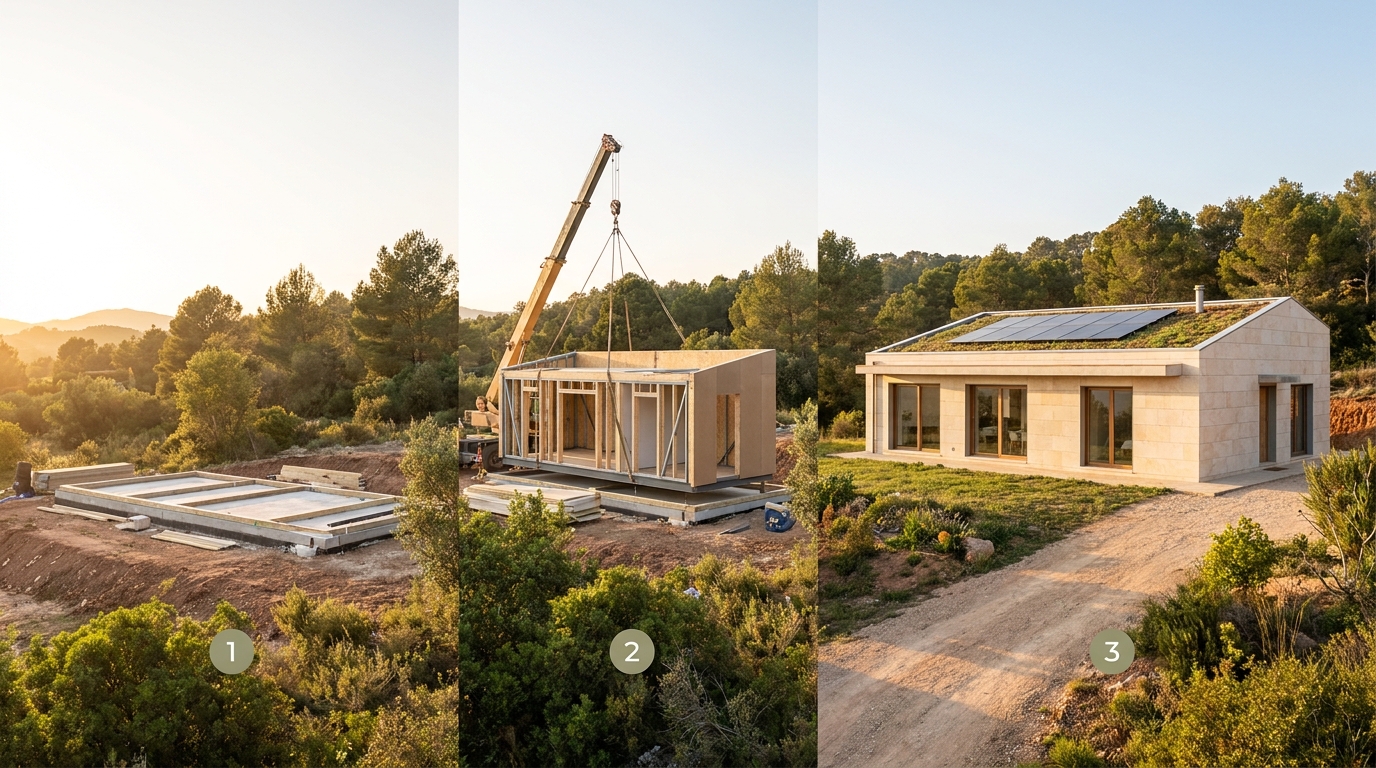
Affordable Prefabricated Home: Common Mistakes and Fixes
Why choose an affordable prefabricated home (and the risks if you don't analyze offers carefully)
It looked like a bargain—until hidden costs, delays and poor insulation turned it into a headache. Many prospective self-builders are drawn to the clear advantages of an affordable prefabricated home, but the same features that make it attractive can hide risks when offers aren’t thoroughly vetted.
This section isolates the real benefits and the precise errors that turn savings into overruns.
Real advantages vs. traditional construction: speed, fixed pricing and efficiency
- Faster closed envelope: Factory-controlled production reduces weather-related stops—typically reducing on-site time by 40–60%.
- Fixed-price contracts: Properly written, they control budget drift common in traditional builds.
- Predictable quality and waste reduction: Repetition in factory lines lowers material waste and improves finishing consistency.
- Better thermal continuity potential: When designed for high performance, modular detailing enables continuous insulation and fewer thermal bridges.
Common mistakes underestimating energy performance and sustainability
Assuming a cheap facade equals adequate energy performance is risky. Many economical models offer basic thermal envelopes that fail to meet Passivhaus-inspired standards. Buyers often discover higher running costs and condensation issues after occupancy.
- Designs without proper airtightness strategy fail blower-door expectations.
- Opaque U-values given without details on junctions or installation quality are meaningless.
- Ventilation solutions are often underspecified—leading to poor indoor air quality or higher energy bills.
Practical tip: quick checklist to evaluate a manufacturer’s offer
- Ask for detailed section drawings of junctions (floor-wall-roof) and U-values plus measured airtightness targets.
- Request a sample specification sheet listing brands and insulation densities.
- Verify lead time and what triggers price changes—material fluctuations, site conditions, or logistical surcharges.
Companies sell a price; smart buyers verify the performance behind it. The cheapest model on paper often costs more in operation and fixes.
Frequent selection mistakes and how to fix them
Choosing a model should be a technical and regulatory decision—not an emotional one. Below are common selection errors and direct remedies.
Confusing initial price with total cost: hidden costs and how to spot them
- Missing site works: Levelling, retaining walls, long access routes and special foundations are frequently excluded.
- Utility connections: Hookups for water, sewage, electricity and telecoms can add significant sums if not assessed beforehand.
- Transport and crane fees: Large or remote parcels often incur extra logistics costs.
Solution: request a full-cost breakdown in the quote, including a clear list of assumptions about the parcel. Add contingency items and cross-check with local contractors for site-specific estimates.
Choosing a model without checking parcel compatibility and local regulations
Not all modular footprints or heights work on every plot. Local planning rules (parameters like buildability, setback, ridge height) can invalidate a chosen model.
Solution: perform a pre-check with the municipal planning office or a local architect. Obtain a preliminary feasibility note that confirms dimensional and aesthetic compatibility before signing.
Practical solution: technical and habitability checklist before signing
- Plot slope and bearing; access for delivery and crane placement.
- Maximum permitted eaves/ridge and facade material requirements.
- Sewer connection point, minimum distance to neighbours, and vegetation protection orders.
- Energy performance baseline: target kWh/m2 and ventilation strategy.
Project and design failures: impacts and corrections
Poor design decisions show up as discomfort, excessive energy bills and expensive retrofits. Here are the most frequent design missteps and practical corrections.
Failing to adapt design to climate and efficiency (Passivhaus)—possible corrections
Many affordable models are drawn as generic units. Without climate-adapted orientation, shading and insulation strategy, they underperform.
- Correction: re-orient glazing for solar gain in winter and control in summer. Add overhangs or shading devices.
- Correction: upgrade airtightness detailing at junctions and specify a mechanical ventilation with heat recovery (MVHR) if aiming for low heating demand.
- Correction: replace thin insulation layers with high-performance solutions (e.g., exterior continuous insulation or denser mineral wool) where junctions allow.
Layout errors that increase running costs and reduce comfort
Open-plan living without zoning, insufficient glazing on primary rooms, or poor thermal zoning will raise energy use and lower comfort.
- Place service spaces (bathrooms, laundries) as thermal buffers on colder facades.
- Cluster wet services to reduce plumbing runs and heat loss.
- Use compact volumes to reduce envelope area when possible.
Advice: work with an architect experienced in industrialized housing and example improvements
An architect who understands factory tolerances can optimize panel sizes, reduce waste and improve thermal continuity. Typical improvements include swapping standard windows for higher-performance units at strategic orientations and adding a compact MVHR sized for real occupant numbers—not theoretical values.
Materials and structure problems: how to identify and prevent them
Choosing the wrong structural system or misunderstanding its implications leads to maintenance issues and performance gaps. Below we compare systems and list contractual protections.
Mixing up systems (industrialized concrete vs steel frame vs timber) and their consequences
- Industrialized concrete: Robust, high thermal mass; needs precise detailing to avoid cold bridges and heavier foundations.
- Steel frame: Fast and dimensionally accurate; requires thermal break and careful condensation control.
- Light timber frame: Excellent thermal performance when correctly insulated; attention needed for fire strategy and acoustic separation.
Choose the system that fits the site, budget and long-term maintenance expectations—not just the cheapest panel price.
Quality and certifications: what to ask from the supplier to avoid surprises
- Factory production certificates (ISO, CE marks where applicable) and material technical sheets.
- Test reports: thermal transmittance (U-values), airtightness (blower-door results) and acoustic performance if provided.
- References: completed projects with client contacts and measured performance data where possible.
Practical solution: contractual clauses and quality control tests
- Include a clause requiring delivery of factory QA reports and on-site test results before final payment.
- Set measurable performance targets (e.g., airtightness ≤ 1.5 ACH50 or a specific kWh/m2/year) and penalties if unmet.
- Reserve a retainer or holdback until post-occupancy checks and corrections are completed.
Mistakes in permits, paperwork and financing—and how to solve them
Administrative delays are among the most predictable yet mismanaged risks. Financing errors can also derail a project—especially for self-builders.
Failures in managing the building permit and parcel constraints
Not starting early with local planning offices or misunderstanding parcel constraints can stop a project for months.
- Get a pre-application meeting with the town clerk; request written notes on key constraints.
- Check for protected trees, heritage overlays or easements before buying or committing.
- Use a local architect to prepare a minimal dossier to validate compliance quickly.
Financing for self-build: common mortgage mistakes and alternatives
Buyers often apply for the wrong product; some prefabricated projects don't match standard mortgage assumptions.
- Don’t assume a standard mortgage covers staged prefabricated delivery—talk to lenders experienced in modular housing.
- Consider construction-to-permanent mortgages or specialized self-build loans that release funds with milestones.
- Document the turnkey scope clearly: lenders want to see what is included in the 'turnkey' offer (connections, finishes, landscaping).
Practical route for the 'turnkey' process to avoid administrative delays
Create a step-by-step dossier including:
- Parcel documentation (Cadastral plan, topographic survey, utilities map).
- Preliminary project and structural concept endorsed by a licensed architect/engineer.
- Manufacturer’s build schedule and a logistics plan for delivery and installation.
Incidents during assembly, delivery and after-sales: how to reduce them
Most delivery-phase issues come from poor coordination, unclear acceptance criteria and missing post-sale guarantees. The remedies are largely procedural.
Problems during assembly: control timings and logistics
- Confirm crane dates, on-site storage capacity and access windows well before delivery.
- Designate a site manager responsible for interface tasks and coordination with the manufacturer.
- Have contingency plans for weather or transport delays—these are normal and should be priced upfront.
Handover: delivery checklist and how to document defects
Accepting the home without a formal checklist is common and costly. Use a structured handover protocol:
- Inventory of finishes and installed equipment with serial numbers.
- Photographic record of any visible defects and a timestamped log.
- Signed list of outstanding items with committed rectification dates and responsible parties.
After-sales and warranties: what to demand and sample protective clauses
- A minimum structural warranty and separate elements warranty for finishes and installations.
- Clear response times for emergency defects and standard defects.
- Retention clause: withhold a percentage of final payment until post-occupancy corrections are completed (e.g., 3–6 months).
Practical close: the definitive checklist to avoid mistakes and secure success
Below is a concise, actionable checklist to use before signing, during production and at delivery. Follow it to protect schedule, budget and long-term performance.
Summary checklist (before contracting, during construction and at delivery)
- Before contracting: feasibility note from local architect, full-cost quote, performance targets and sample QA reports.
- During production: factory QA delivery schedule, mid-lines inspections, logistics confirmation and site manager appointment.
- At delivery: signed handover checklist, photographic evidence of defects, retention and rectification timeline.
Key indicators to measure: times, costs, energy efficiency and satisfaction
- Schedule adherence: compare planned vs actual production and on-site assembly days.
- Final cost vs initial estimate, with categories for site works, logistics and manufacturer scope.
- Energy performance: measured consumption (kWh/m2) and airtightness (ACH50).
- Client satisfaction: rapid post-occupancy survey after 3–6 months.
Final recommendations for self-builders: resources, real examples and next steps
Start with measured comparisons, not marketing brochures. Review real case studies that include delivery times and final costs. If you want a practical reference on budget models, check Modelo prefabricado económico: guía 2026 and for specific cheap concrete options see Casa prefabricada económica: guía práctica 2026.
Final take: Treat the purchase of an affordable prefabricated home as a technical investment. Demand measurable performance, document assumptions and reserve funds for real-world contingencies. With these steps, the advantages of modular building—speed, predictability and sustainability—become reliable, not risky.
If you are planning a self-build in Spain and want a concise feasibility review of a particular model or parcel, start by sharing your plot details and manufacturer quote—our team can help validate performance targets and a realistic budget.