Industrialized Housing Guide: Build a Modular Home in Spain
Why choose industrialized housing: overview and benefits for self-builders
Imagine closing on a fixed-price build that finishes on time and performs better than many traditional homes. That promise is why more Spanish self-builders are choosing industrialized housing. This guide explains what industrialized housing is, why it fits the Spanish market in 2026, and the concrete benefits for families who want control over design, cost and quality.
What we mean by industrialized housing and its role in Spain 2026
Industrialized housing refers to homes manufactured using repeatable, factory-controlled processes. Components or modules are produced off-site, then transported and assembled on the plot. In Spain 2026 the model is mature: faster permitting, improved logistics, and wider acceptance among banks and local authorities make it a practical route for autopromotores (self-builders).
Key benefits: reduced timelines, fixed price and quality control
- Predictable schedules: Factory production shortens on-site time and reduces weather delays.
- Budget certainty: Clear contracts and fixed-price packages lower the risk of cost overruns.
- Higher quality control: Industrial QA processes reduce defects and rework.
How industrialization enables family projects and self-building
For families, industrialized housing simplifies coordination. Architects, manufacturers and installers work from a common model. The result: fewer unexpected choices during construction and clearer milestones for financing and occupation.
Industrialized construction reduces on-site uncertainty: projects that follow factory workflows show up to 50% fewer schedule delays than traditional builds in comparable climates.
Materials and modern building systems: how to choose
Choosing the right structural system shapes costs, performance and aesthetic options. Below are the most common systems used in contemporary modular housing in Spain.
Precast concrete: durability, performance and use cases
Precast concrete panels and elements offer excellent durability and thermal mass. They are ideal for low-maintenance façades and buildings that require high structural robustness. Use cases include coastal houses with higher humidity exposure and multi-storey modular units.
- Advantages: fire resistance, acoustic insulation, longevity.
- Considerations: heavier transport, foundations must be designed for point loads.
Light timber frame: thermal efficiency and environmental benefits
Light timber framing (entramado ligero de madera) stands out for its thermal performance and low embodied carbon. When combined with modern insulation and vapour control layers, timber frames achieve excellent airtightness and contribute to healthy indoor climates.
- Advantages: speed of assembly, renewability, excellent U-values.
- Considerations: design for moisture control and appropriate treatments for durability.
Steel frame: speed, design flexibility and structural notes
Steel framing gives great spans and design flexibility. It is a common choice for bespoke modern forms or where slimmer sections are required to maximize usable floor area.
- Advantages: consistent tolerances, quick assembly, large clear spans.
- Considerations: thermal bridging must be minimized with correct detailing.
Technical and sustainable advantages versus traditional building
Industrialized housing can deliver superior energy performance and lower life-cycle carbon if designed correctly. Below we compare technical and sustainability outcomes versus traditional masonry builds.
Energy efficiency and certifications (including Passivhaus approach)
Factory-controlled assemblies allow precise airtightness and insulation installation, key for reaching low energy targets. Many modular projects in Spain pursue Passivhaus or equivalent criteria to reduce heating and cooling needs.
- Airtightness: factory assembly typically achieves lower leakage rates.
- Thermal continuity: insulated panels and controlled junctions reduce thermal bridges.
- Certifications: meeting Passivhaus requires design integration from concept stage.
Reducing carbon footprint and sustainable material choices
Choosing timber or low-carbon concrete mixes and optimizing material use reduces embodied carbon. The factory approach minimizes waste and enables reuse of formwork, lowering environmental impact per square meter.
Practical comparison: timelines, real costs and quality control
Typical metrics you should expect:
- On-site assembly: 2–8 weeks for an average single-family home, depending on system.
- Total project time: 6–12 months from contract to handover, including permits and site works.
- Cost variability: industrialized options often deliver similar or slightly lower total costs than traditional builds once financing and time savings are accounted for.
Turnkey process explained step-by-step for self-builders
Turnkey delivery simplifies the self-build journey by bundling design, manufacture and onsite assembly. Below is a practical roadmap with the key milestones you will face.
Parcel search and assessment: planning, orientation and viability
Start with a site viability checklist: legal classification, buildability index, plot orientation, access and utilities. Engage a technician early to review allowable footprint and potential constraints. A good parcel assessment saves costly redesign later.
Design, manufacturing and factory control: timelines, milestones and warranties
Once you sign a turnkey contract, expect these factory milestones:
- Design freeze: final plans and specifications for production.
- Factory production: prefabrication of panels/modules under QA protocols.
- Pre-delivery tests: airtightness mock-ups, plumbing pressure tests and electrical checks.
Contracts should specify production timelines, snagging procedures and warranty terms.
Transport, assembly and handover: inspections, testing and documentation
Transport logistics are often the most sensitive part. Confirm transport size limits, crane access and temporary traffic permits. On-site assembly includes:
- Foundation connection and anchoring
- Module/element assembly and weatherproofing
- Final commissioning of systems and snagging
Handover requires a full dossier: as-built plans, test certificates, warranties and operation manuals.
Financing and mortgages for self-build and modular homes
Financing a modular home in Spain usually follows similar principles to autopromotion lending, but lenders review factory workflows and contractual protections closely. Knowing which documents to prepare increases approval odds.
Financing options: self-builder mortgage vs developer loan
Two main paths exist:
- Self-builder mortgage: staged disbursement tied to milestones (parcel purchase, foundation, assembly, handover).
- Construction credit: short-term loan replaced by a mortgage at completion.
Some banks are now comfortable with turnkey modular contracts because of fixed-price and shorter risk exposure.
What banks request: budget, schedule and guarantees
Prepare a clear package: detailed budget, factory production schedule, performance guarantees and builder warranties. Banks focus on the contract clarity and risk allocation between parties.
Strategies to improve loan viability with numeric examples
Practical tactics:
- Increase equity contribution to reduce loan-to-cost ratio.
- Use fixed-price turnkey contracts to reassure lenders.
- Stage payments to align with measurable milestones.
Example: a €300,000 turnkey home with 20% equity requires a construction loan for €240,000. If factory guarantees reduce perceived risk, the bank may offer better terms than for uncertain traditional builds.
Real case studies and technical comparisons: timelines, cost and satisfaction
Below are two anonymized studies with measurable outcomes. They show how different systems perform in real projects.
Case study 1: family home with light timber frame (times and cost breakdown)
Project summary: 140 m2 single-family home using light timber frame, delivered turnkey.
- Design and permits: 12 weeks
- Factory production: 6 weeks
- On-site assembly: 3 weeks
- Total time from contract to handover: 7.5 months
- Final cost: €195,000 (turnkey, excluding land)
- Client satisfaction: high—rapid feedback loop and minimal on-site disruption
Key takeaways: timber frame achieved excellent thermal comfort and low operating energy.
Case study 2: precast concrete home aiming for high energy rating
Project summary: 180 m2 two-storey house using precast concrete panels with mechanical ventilation and high insulation.
- Design and permits: 16 weeks
- Factory production: 8 weeks
- On-site assembly: 5 weeks
- Total time: 9 months
- Final cost: €270,000 (turnkey, excluding land)
- Performance: achieved near-Passivhaus energy performance with low heating demand
Neutral technical comparison: measurable outcomes vs traditional build
Comparing the above examples to comparable traditional masonry builds showed:
- Average schedule reduction: 30–50% shorter delivery time.
- Quality improvement: fewer moisture issues and better airtightness in factory-built solutions.
- Cost: similar overall when accounting for reduced financing and faster occupation.
First steps to launch your industrialized housing project
Start smart: follow a checklist and choose partners who provide transparency and evidence of delivery.
Initial checklist: plot, budget, technical team and calendar
- Confirm land classification, accessibility and utilities.
- Set a realistic budget with contingency (typically 5–10%).
- Hire or consult a technical team with industrialized housing experience.
- Agree on a project calendar linked to payment milestones.
How to choose a reliable supplier: criteria, questions and contract clauses
Key selection criteria:
- Proven deliveries and client references.
- Factory QA processes and warranty terms.
- Clear responsibilities for transport and on-site assembly.
- Liquidated damages or completion guarantees where appropriate.
Ask to see as-built examples and independent performance tests (airtightness, thermal, acoustic).
Resources and next steps: permits, grants and industry events
Practical actions:
- Begin permit conversations early with local planning authorities.
- Search for regional grants linked to energy efficiency or timber construction.
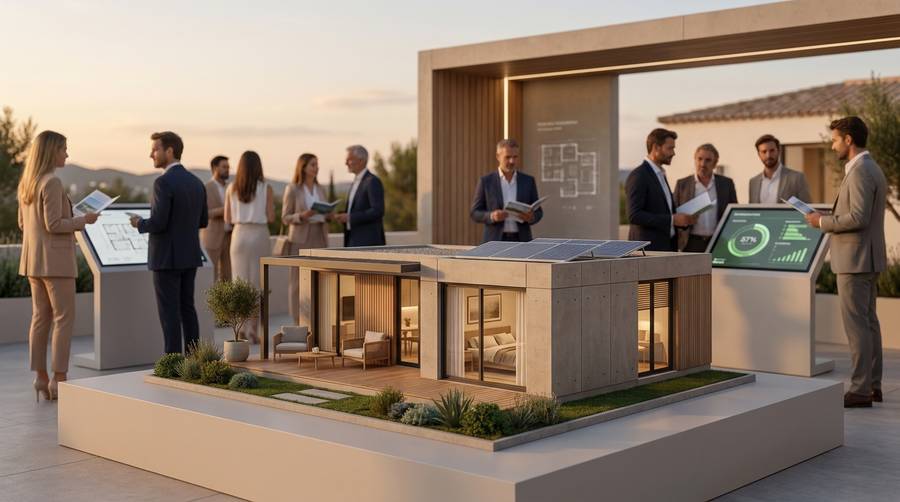
- Visit industry showcases and fairs—consider reading Errores en ferias de vivienda industrializada y cómo solucionarlos to prepare.
Final thought: industrialized housing puts control back into the hands of self-builders. With the right parcel, detailed turnkey contract and a reliable manufacturer, you can achieve a high-performance, beautiful home on a predictable schedule.
If you are ready to explore options, gather your plot details and budget, and request a tailored feasibility study from a trusted provider. Seeing concrete numbers early will help you decide the best route for your family.