Industrialized Housing Guide: Prefab Homes in Spain 2026
When Marta and Luis discovered a plot outside Valencia, they expected months of uncertainty. Instead, their new prefabricated home was designed, permitted and delivered in under nine months—on budget and with measurable energy savings. This guide explains how industrialized housing makes that outcome repeatable, what decisions matter most and how to avoid common pitfalls.
Why industrialized housing matters amid Spain’s housing crisis
Context: supply gap and need for predictable delivery. Spain faces a structural housing shortage in many regions. Traditional construction struggles with long timelines, rising material costs and variable quality. Industrialized housing—also called prefabricated or modular housing—addresses these issues by shifting work into controlled production, improving predictability and accelerating delivery.
Current residential market and supply challenges
Developers and self-builders alike confront three recurring problems: slow permitting, weather-related delays and budget overruns. Industrialized approaches reduce on-site hours and concentrate risk inside a factory process. That translates to faster envelope closure, fewer weather interruptions and more reliable schedules.
How industrialization shortens timelines and fixes costs
- Parallelization: site work and factory production happen simultaneously.
- Quality control: repeatable manufacturing keeps defects low.
- Fixed-price modules: clear scope reduces change-order risk.
In practice, clients see site works and assembly reduce typical project calendar by 30–60% versus traditional builds for single-family homes with similar specs.
Social and territorial impact
Faster, predictable housing can expand access in peri-urban and regenerating areas. Industrialized housing can be integrated into urban renewal projects, reducing displacement risks and enabling affordable delivery programs when public-private coordination exists.
Industrialized housing is not a cheaper aesthetic—it is a procurement and delivery model that turns time and uncertainty into measurable savings and social opportunity.
Advantages of prefabricated homes vs traditional construction: efficiency and quality
Prefabrication blends design control and construction efficiency. Below are the tangible advantages to evaluate when choosing a system for your house in Spain.
Construction efficiency: closed schedules and fewer surprises
- Shorter on-site programs: assembly often takes weeks rather than months.
- Lower weather exposure: interior fit-out happens in factory conditions.
- Logistics predictability: standardized components simplify planning.
Predictable costs: examples and comparisons
Real metrics from recent projects:
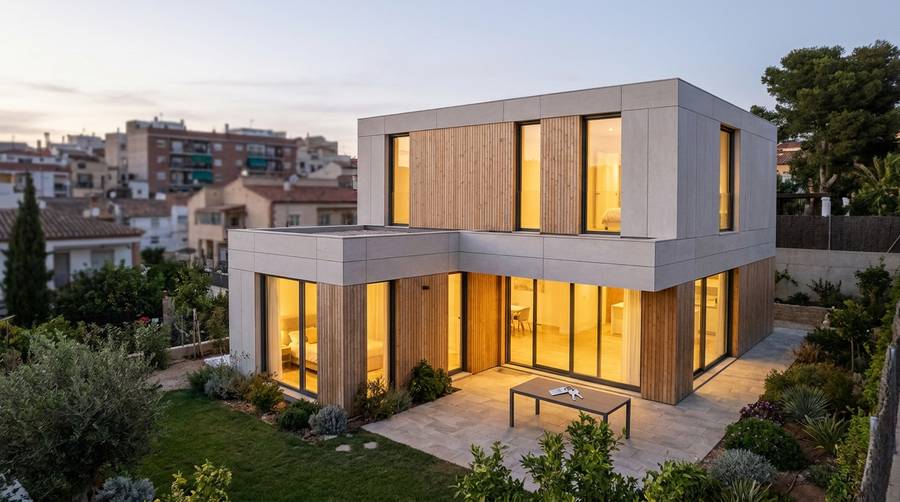
- Example A (Mediterranean single-family, 140 m²): total turnkey cost €120,000; on-site assembly 6 weeks; total program 8 months.
- Example B (Comparable traditional build): total cost €135,000; on-site work 28 weeks; total program 14–18 months.
These figures show how predictability in prefabricated homes can reduce both time and risk margin included by banks or contractors.
Quality, comfort and durability
Performance matters: thermal comfort, airtightness and user satisfaction. Industrialized homes routinely achieve better thermal continuity because assemblies are fabricated with stricter tolerances. That results in:
- Lower heating and cooling demand
- Better acoustic separation
- Higher occupant satisfaction scores in post-occupancy surveys
Materials and systems: choosing the right structure for your project
Material choice affects cost, schedule, thermal performance and carbon footprint. Below we compare three common systems used in Spain today.
Industrialized concrete: applications and strengths
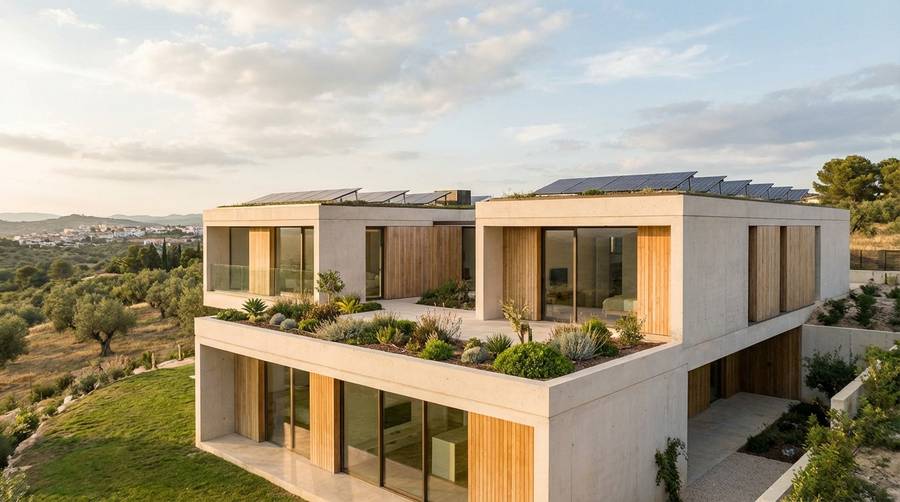
Precast or industrialized concrete is ideal for structural stability and fire resistance. Typical uses include foundations, load-bearing walls and modular slabs. Advantages:
- Excellent long-term durability
- High thermal mass—useful in interior comfort strategies
- Good acoustic performance
Choose concrete when site constraints or regulatory demands favor robustness.
Light timber framing and steel frame: technical and energy comparison
Timber frame (light wood) is fast, renewable and performs well thermally. It has a lower embodied carbon than concrete and integrates easily with thick insulation layers required by Passivhaus approaches.
Steel frame excels for long spans and architectural flexibility. It is dimensionally stable and suited for multi-storey modular stacking. Steel requires attention to thermal bridging and appropriate insulation strategies.
- Timber: faster assembly, lower carbon, excellent for single-family housing.
- Steel: structural flexibility, efficient for multi-level modules.
Sustainability criteria: carbon footprint, recyclability and Passivhaus
Prioritize systems that reduce operational and embodied carbon. Key criteria:
- Embodied carbon per m² (compare manufacturer EPDs)
- Recyclability at end of life
- Compatibility with airtight, ventilated (MVHR) systems to meet Passivhaus targets
Many modern prefab providers now publish EPDs and thermal performance data. Ask for them early.
How to design and plan your industrialized home in Spain: step-by-step (Guide 2026)
A clear process reduces surprises: plot evaluation, design, approvals, factory production and turnkey delivery. Below is a practical roadmap with milestones.
From plot to project: feasibility and urban rules
- Check local zoning and buildability: maximum footprint, height limits and setback rules.
- Assess topography and connections (water, electricity, sewage, access).
- Perform a site-specific energy and solar study to orient the building for passive gains.
Document these findings in a short feasibility brief to share with manufacturers and banks.
Modular design and thermal strategy: phases and finishes
Design unfolds in three key phases:
- Concept & massing: module sizes, window placement and roof strategy.
- Technical design: assemblies, U-values, airtightness targets and HVAC strategy.
- Prototype & finishes: selected materials, finishes and test assemblies.
Select finishes that are durable and regionally appropriate (stone, light wood, smooth rendered concrete) to retain the Mediterranean aesthetic.
Coordinating a turnkey team: schedule, milestones and client communication
For a turnkey delivery, agree these milestones in the contract:
- Land purchase or reservation and urban compliance clearance
- Final design approval and budget freeze
- Factory production start and key inspection windows
- Site assembly, commissioning and handover
Good practice: weekly progress reports and a shared cloud folder for all technical documents. Define warranty and snagging periods in writing.
Financing and permits: mortgages for self-build and the turnkey process
Financing industrialized housing is increasingly standard in Spain, but preparation matters. Lenders look for clarity in timeline, budget and guarantees.
Financing options for modular homes and self-build
- Self-build mortgages: tranche payments tied to milestones (foundation, enclosure, handover).
- Construction-to-permanent loans: single application that converts to a standard mortgage on completion.
- Green mortgages: preferential terms for high-efficiency homes with verified energy performance.
How to present your project to banks: required documents and metrics
To secure finance, prepare:
- Final turnkey contract with the manufacturer (price, schedule, warranty)
- Certificate of technical characteristics: materials, U-values, airtightness targets
- Project budget and cashflow plan by phase
- If available, manufacturer EPDs and energy model results
Banks prefer projects with fixed-price contracts and clear completion guarantees.
The turnkey process explained: contractual milestones and guarantees
Key contractual elements to negotiate:
- Clear scope and change-order pricing
- Completion date and liquidated damages for delays
- Performance guarantees (airtightness, thermal targets) and post-delivery warranty
Ensure a certified handover protocol and a defined snagging period where minor defects are fixed at no extra cost.
Case studies and technical comparisons: metrics, schedules and satisfaction
Real projects reveal measurable benefits when compared fairly. Below are anonymized, representative cases from recent Spanish projects.
Case study: Mediterranean single-family home
- Size: 140 m²; System: light timber frame with ventilated facades
- Timeline: 8 months total (design 2 months, factory 3 months, assembly 1 month, permits and finishing 2 months)
- Total turnkey cost: €120,000; energy demand: 30 kWh/m²·year after MVHR and upgraded insulation
- Client satisfaction: 4.7/5 on delivery and comfort
Comparative performance vs traditional build
Across sample projects, industrialized homes averaged 35% shorter programs and 10–20% lower unexpected costs due to controlled quality. Operational energy savings varied with design but averaged 25% vs older stock when combined with efficient HVAC and solar strategies.
Lessons and practical recommendations
- Select a manufacturer with transparent test data and references.
- Prioritize airtightness and ventilation to secure long-term savings.
- Fix finishes and scope early to prevent budget drift.
Decide with confidence: final steps and resources to start your project
Use a checklist to move from idea to contract. Below are the practical next steps.
Decision checklist: technical, economic and personal factors
- Plot viability: legal constraints and service connections confirmed
- Budget: include contingency and financing costs
- Performance targets: define thermal, acoustic and carbon goals
- Contract terms: fixed price, timeline and warranty agreed
Resources: guides, calculators and professional contacts
Consult practical resources such as energy calculators and manufacturer EPDs. For operational references, see our detailed overviews like Guía 2026: house prefab and industrialized housing and check common pitfalls in Industrialization housing: common mistakes and solutions.
Next steps with Findnido
If you want to move forward, start with a site visit and feasibility brief. A short advisory meeting clarifies budgets, system choices and a realistic timeline. Many clients proceed from that meeting to a fixed-price proposal.
Ready to explore options? Book a no-obligation consultation to review your plot and receive a tailored roadmap to turnkey delivery.
Choosing industrialized housing means choosing predictability: faster delivery, clearer budgets and measurable performance—if you pick the right partners and set clear targets from day one.
For tailored assistance, visit our case study of a rapid delivery project at Casa prefabricada que revirtió una urgencia habitacional and learn how industrialized strategies deliver real outcomes at scale.
Start by gathering your plot documents, target budget and preferred materials. Bring these to an initial advisory session and you’ll have a realistic, bank-ready plan within weeks.