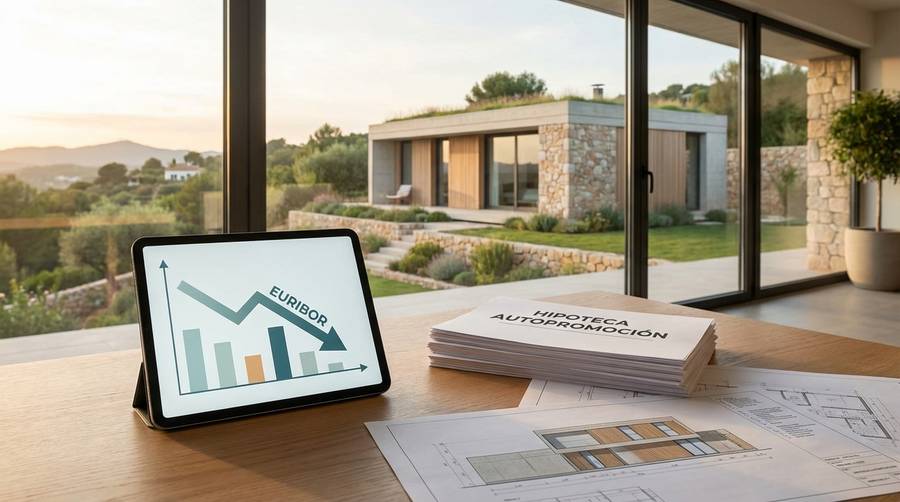
Euribor and Modular Home Mortgages
What is Euribor and why it matters for your mortgage
It only takes one unexpected interest adjustment to turn a feasible self-build into a budgeting problem. If you're planning a modular or prefabricated home in Spain in 2026, understanding Euribor is the first defense against interest volatility and surprise costs.
Definition and basic mechanics
Clear definition and how it works
Euribor (Euro Interbank Offered Rate) is the reference rate at which European banks lend to one another. Lenders use Euribor plus a margin to price many variable-rate mortgages. When Euribor rises, monthly payments on variable mortgages typically increase after the next revision period.
Recent evolution (context up to 2026) and driving factors
Between the early 2020s and 2026, Euribor movements reflected monetary policy normalization after pandemic-era stimulus, inflationary pressures, and market expectations about ECB decisions. The main drivers are:
- ECB policy rate decisions and forward guidance
- Inflation expectations and macroeconomic data
- Liquidity and credit risk in European banking
Difference between Euribor and other reference indices
Unlike national reference rates or fixed-rate benchmarks, Euribor is pan-European and short-term. Some lenders still offer mortgages linked to national indices (rare in Spain) or tied to fixed spreads over government bonds. For autopromoters building modular homes, Euribor remains the most common index for variable financing.
Key fact: For a variable mortgage of €200,000 at Euribor + 1% with a 30-year amortization, a 1% rise in Euribor typically increases monthly payments by ~€60–€70 depending on revision timing and amortization specifics.
How Euribor affects mortgages: core concepts
Knowing the mechanisms is practical — not academic. It lets you model cashflow and choose a financing structure that fits your risk appetite.
Variable vs fixed mortgage: how revisions work
Variable-rate mortgages adjust periodically—commonly every 3, 6, or 12 months—based on the reference Euribor value at each revision plus the bank's margin. Fixed-rate mortgages lock in an interest rate for a set period or the entire term, transferring interest-rate risk to the lender.
Numerical example: calculating payments at different Euribor levels
Example assumptions: loan €250,000; margin 1.2%; term 25 years.
- If Euribor = 0.0% → APR ≈ 1.2% → monthly payment ≈ €987
- If Euribor = 1.5% → APR ≈ 2.7% → monthly payment ≈ €1,136
- If Euribor = 3.0% → APR ≈ 4.2% → monthly payment ≈ €1,369
These figures illustrate how even moderate shifts materially affect affordability. For autopromoters, this impacts both the mortgage phase and any interim bridge financing.
Fees, revision periods and common clauses
Read the fine print: revision frequency, interest calculation method (act/360 vs act/365), and commission structures (opening fees, early repayment penalties) change total cost. Pay attention to clauses like interest rate floors or caps—these limit extremes but often come with higher margins.
Specific impact on industrialized housing and self-build projects
Modular construction changes the financing equation. Shorter build times and fixed-price contracts reduce exposure to long interest runs and cost overruns.
Financing differences: traditional build vs industrialized housing
Key contrasts:
- Time on site: Traditional builds often exceed 12 months; modular turnkey projects commonly complete in 4–6 months after groundwork.
- Cost predictability: Modern modular suppliers offer closed budgets, cutting contingency needs and lender risk assessments.
- Disbursement schedule: Traditional mortgages with staged payments versus shorter bridge loans or staged disbursements tailored to modular delivery.
Effect of Euribor on autopromoter mortgages and bridge loans
Autopromoters often combine:
- Land purchase financing (standard mortgage)
- Construction credit or bridge loans (short-term, higher margin)
- Completion mortgage or conversion to a long-term mortgage at delivery
Because bridge loans are typically short-term, a rising Euribor increases interim financing costs more acutely. However, the fast delivery of modular homes reduces the period you pay elevated bridge rates.
How shorter timelines and fixed budgets mitigate interest risk
By compressing the construction phase and locking prices with reputable manufacturers using systems like concrete industrialized panels, light timber framing or steel frame, the borrower reduces:
- The duration of exposure to rising Euribor
- The need for large cash contingencies
- The probability of seeking further credit due to overruns
Financial strategies step-by-step to protect your project
Plan finance with the same rigor as the technical design. The next steps are tactical and sequential.
Financing options: fixed, mixed and margins in self-build
Options to consider:
- Fixed-rate mortgage: Best for risk-averse buyers who prefer predictable long-term costs. Usually available once the project is complete.
- Mixed mortgage: A fixed component for part of the loan and a variable component for the rest; balances cost and protection.
- Construction-to-mortgage conversion: Short-term construction loan that converts to a mortgage on delivery—negotiate the conversion margin and caps in advance.
Tools and tactics: caps/floors, subrogation, early repayment
Practical levers:
- Rate cap: Purchase a cap on Euribor exposure to limit maximum interest, at a cost that can be budgeted.
- Rate floor awareness: Floors can limit how low your rate drops—check if your contract includes one.
- Bank subrogation: Consider subrogation if a new lender offers better terms post-delivery.
- Early repayment: Use unexpected cash to amortize principal and reduce sensitivity to future rate increases.
Cashflow planning: milestone calendar and contingency buffer
Create a timeline with the following milestones and financial triggers:
- Land purchase and associated mortgage entry
- Groundworks start and first construction draw
- Module delivery and installation date (fixed in supplier contract)
- Final delivery and mortgage conversion
Recommended contingency: a minimum 6–12 month equivalent of living-cost buffer plus an interest-rate shock reserve equal to 1–2% of total loan principal to absorb short-term Euribor spikes.
Comparisons and case studies with real metrics
Numbers inform decisions; anecdotes mislead. Below are indicative, anonymized scenarios drawn from recent autopromoter projects to illustrate outcomes.
Case study 1: autopromoter with variable vs fixed financing
Profile: Couple building a 140 m² modular home in Valencia region. Loan amount €210,000; term 25 years; construction time 5 months.
- Variable scenario: Euribor averaged 1.8% over financing period. Total interest paid (25 years) ≈ €95,000. Monthly at start ≈ €900; after rises ≈ €1,050.
- Fixed scenario: Fixed rate at signature 2.9% (slightly higher margin). Total interest paid ≈ €102,000 but predictable monthly ≈ €1,026.
Outcome: Variable saved ~€7,000 if Euribor fell, but exposed the family to short-term payment stress during peaks. The modular timeline reduced bridge loan duration to 5 months, saving ~€3,500 in interim interest compared with a traditional 12-month build.
Case study 2: modular developer – time reduction and interest effect
Profile: Small promoter delivering a 10-unit gated development with light timber framing. Traditional comparable project would take 14 months; modular delivery took 6 months.
- Interest on construction financing saved: approximately 40% due to shorter drawdown period.
- Client satisfaction score: 4.6/5 in post-delivery surveys (speed and predictability cited).
Indicative comparison table
Headline comparison (indicative)
- Cost total: modular often lower or similar to traditional when accounting for lost time and overruns.
- Duration: modular 4–8 months vs traditional 10–18 months.
- Satisfaction: higher when budgets are closed and delivery is predictable.
Practical guide: how to negotiate and apply for a mortgage for a modular home
Preparation is the lender's best first impression. Present a clean, well-documented file that highlights reduced construction risk.
Key documentation and bank requirements
Typical required documents:
- Identification and income proofs (pay slips, tax returns)
- Land title deed or reservation agreement
- Detailed project dossier: plans, specifications, and a closed budget from your industrialized housing supplier
- Work timeline and turnkey contract (Llave en mano) with penalties for delay
- Energy certificates or Passivhaus documentation if applicable
Persuasive arguments to present to the bank
How to frame your case:
- Emphasize a fixed, closed price from a reputable manufacturer and the short, guaranteed delivery timeline.
- Provide evidence of quality materials (engineered concrete panels, steel frame, or light timber framing) and certifications.
- Show an energy-efficiency strategy (e.g., Passivhaus-ready elements) to argue lower long-term risk and higher resale value.
For resources on how interest benchmarks affect mortgage negotiation, you may find practical guidance in Euríbor y vivienda industrializada: guía práctica 2026.
Step-by-step checklist from site selection to turnkey delivery
- Secure the plot and verify planning constraints.
- Obtain detailed turnkey quote and timeline from your chosen modular supplier.
- Request pre-approval from several lenders with construction-to-mortgage options.
- Negotiate bridge loan margins and conversion terms, including any caps.
- Sign the turnkey contract with milestone-linked payments.
- Manage disbursements strictly against verified milestones.
- Convert bridge loan to long-term mortgage on certificate of final completion.
Conclusions and recommendations for autopromoters in Spain (2026)
Choose speed, certainty and documented efficiency to shrink interest risk. Modular homes change the financing calculus in your favor if you plan deliberately.
Priority measures to reduce Euribor impact
- Negotiate shorter construction windows and fixed-price turnkey contracts.
- Consider mixed or fixed-rate solutions for a portion of the loan to limit volatility.
- Build a cash buffer equivalent to 6–12 months' expenses plus an interest shock reserve.
Decisions by profile
- Risk-averse, long horizon: prefer fixed-rate mortgages or higher fixed portion in mixed loans.
- Cost-sensitive, medium-term: accept some variable exposure but use rate caps and strong contingency planning.
- Developer/promoter: optimize construction schedule and supplier contracts to shorten credit exposure.
Next steps and resources
If you are preparing to finance a modular home, seek specialized financial advice and obtain at least three lender proposals. Check documentation carefully, and use the modular supplier's closed budget and timeline as a negotiation advantage. For practical tips on negotiating with lenders in the current environment, consult Euríbor y vivienda industrializada: guía práctica 2026 and consider the negotiation strategies in Euríbor y vivienda industrializada: cómo afecta tu hipoteca.
Final thought: industrialized housing reduces the time and unpredictability that make you vulnerable to rising Euribor. Combine that technical advantage with disciplined financial structuring and you increase the probability that your autopromotion will succeed on budget and on time.
Ready to move forward? Start by collecting closed turnkey quotes and asking lenders for construction-to-mortgage simulations—small diligence now avoids large costs later.
Artículos relacionados