Prefabricated House vs Traditional Home: Clear Pros and Cons
Imagine moving into a complete, energy-efficient home in months rather than years — and with a fixed price. That possibility is why many families and autopromoters in Spain are weighing a prefabricated house against a traditional build. This article gives a balanced, data-driven comparison so you can choose the best route for your project.
Why industrialized housing matters in Spain today
Context: supply–demand gap and the need for faster solutions
Spain faces a persistent mismatch between housing demand and supply in many regions. Urban pressure, zoning complexity and labor shortages have lengthened timelines for traditional construction. Industrialized housing responds to that gap by shortening on-site time and standardizing processes — a practical advantage for families who need certainty.
Macro benefits: time, cost control and standardization
Industrialized methods concentrate production in a factory environment, which brings three consistent benefits:
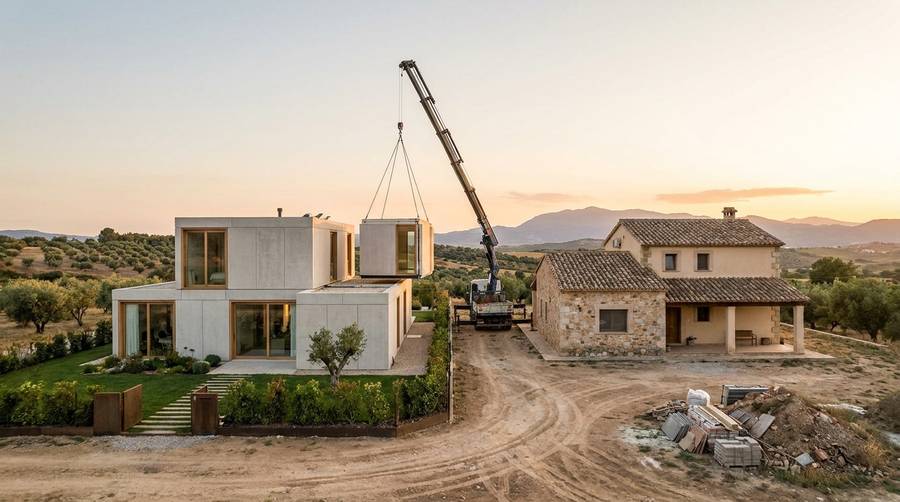
- Reduced build time: Site activity can be compressed to foundation works and a fast assembly phase.
- Fixed-price contracting: Factory workflows reduce unexpected labor variations and change orders.
- Quality control: Repeated processes and factory testing lower defects and rework.
Who benefits: families, self-builders and investors
Not every buyer is looking for the same thing. The main groups that tend to benefit most from a prefabricated house include:
- Self-build families who value schedule certainty and predictable budgets.
- Autopromoters who manage projects and prefer packaged, transparent solutions.
- Investors seeking faster delivery and reduced time to rental or sale.
Advantages and disadvantages versus traditional housing
Advantages: closed timelines, fixed price and quality control
Closed timelines and faster delivery — A modern prefabricated house often reaches habitable status in 3–9 months from factory start, depending on design complexity and site works. This is typically faster than a traditional build of the same size.
Price transparency — Turnkey packages commonly offer a contract with a defined scope and price. That reduces the financial uncertainty that many self-builders face with variable site labor costs.
Repeatable quality — Factory production allows systematic QA: airtightness testing, factory-applied finishes and integrated MEP systems lower the risk of hidden defects.
Disadvantages: regulatory limits, perception and customization
Planning and regulatory constraints — Local regulations and municipal inspectors still govern foundations, utilities and habitability certificates. Some areas may restrict certain construction methods or envelope details.
Perception — Although the market perception of prefabrication has improved, some clients still associate it with low quality. The most reliable way to counter this is by reviewing finished references and energy certifications.
Customization limits — While modern systems offer broad options, extreme bespoke designs can be costlier or require hybrid approaches combining factory elements with on-site work.
When each option makes sense: decision criteria
- Choose a prefabricated house if you prioritize schedule certainty, fixed budgets and proven energy performance.
- Choose traditional construction if the site demands a custom solution, or if local planning forces in-situ processes.
- Consider hybrid strategies (factory components plus in-situ finishes) for challenging sites or high customization needs.
Materials and systems: technical and sustainability comparison
Industrialized concrete vs steel frame vs light wood frame
Three mainstream systems dominate modern industrialized housing in Spain:
- Industrialized concrete: High thermal mass, durable, excellent acoustic performance. Prefabricated concrete panels and slab systems suit demanding climate zones and deliver long service life.
- Steel frame (steel frame): Lightweight, high precision, ideal for larger spans. Steel frames speed assembly but require careful thermal bridging treatment and corrosion protection.
- Light timber frame (entramado ligero de madera): Low embodied carbon, quick to produce, excellent for breathable envelopes and retrofit-compatible solutions.
Choosing a system depends on site, budget and sustainability goals. For example, timber often scores well for embodied carbon but may need enhanced detailing for acoustic separation in dense areas.
Energy efficiency and Passivhaus potential: real performance
Industrialized housing can achieve high energy performance because factory assembly improves airtightness and insulation continuity. Many projects built to Passivhaus principles use prefabricated panels or modules to guarantee the required quality levels for airtightness and thermal bridges.
When factory QA controls are applied, delivered airtightness levels commonly exceed on-site expectations — a decisive factor when pursuing Passivhaus certification.
Real performance depends on design, installation and commissioning. Insist on testing (blower door, thermographic inspection) before handover.
Carbon footprint and lifecycle metrics compared
Life-cycle assessment varies with materials and local energy mixes. General patterns:
- Timber systems typically show lower upfront embodied carbon per m².
- Concrete may have higher initial emissions but can offer lower operational energy thanks to thermal mass in certain climates.
- Steel has intermediate embodied impact; recycling rates and design for disassembly improve lifecycle scores.
For a self-builder aiming to reduce lifetime emissions, combine material choice with operational strategies: high insulation, efficient ventilation with heat recovery, and renewable energy production on-site.
The turnkey process explained step by step for self-builders
Plot search, permits and schematic project
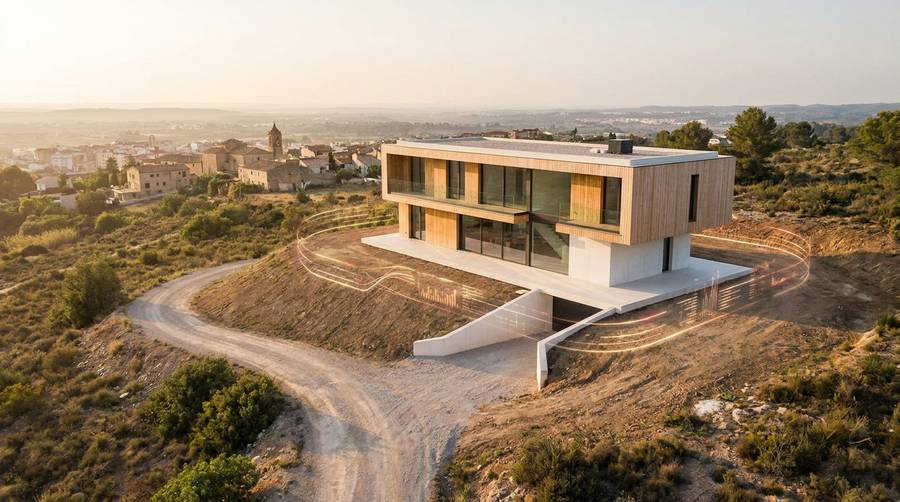
Start with site due diligence: orientation, slope, soil conditions and service access. A typical sequence:
- Secure the plot and obtain a topographic and geotechnical survey.
- Develop a schematic project with a designer experienced in industrialized housing.
- File planning and obtain municipal permits. Prefabricated proposals should include installation and foundation details for approval.
Production and assembly: typical times and guarantees
Factory production commonly runs 6–16 weeks depending on complexity; on-site assembly for a single-family home often takes 1–6 weeks after foundations are ready. Important contractual elements:
- Delivery schedule with milestones tied to payments.
- Performance guarantees, including airtightness and thermal insulation.
- Clear scope for finishes and MEP (mechanical, electrical, plumbing).
Handover and after-sales: reception, certifications and maintenance
At delivery, expect a formal reception process with documentation:
- As-built drawings and operation manuals for systems.
- Energy certificates and test reports (blower door, commissioning logs).
- Warranty terms for structure, finishes and systems — confirm response times for defects.
Practical financing: mortgages for self-build and modular homes
Types of financing available in Spain
Common options for autopromoters include:
- Self-builder mortgage (hipoteca autopromotor): Disbursed by stages linked to construction milestones.
- Construction loan: Short-term facility that converts to a mortgage on completion.
- Turnkey mortgage: Some lenders accept finished prefabricated properties as collateral for standard mortgages, once final certification is in place.
Documentation and valuation for industrialized housing
Banks require a clear project file: technical project, budget, builder credentials and schedule. For prefabricated houses, provide factory guarantees, completion certificates and comparable valuations to avoid undervaluation.
Tips to negotiate terms and payment schedules
- Negotiate milestone payments tied to objective deliverables (foundations, factory start, on-site assembly, certificate of occupancy).
- Obtain a fixed-price turnkey offer to minimize unexpected increases.
- Work with lenders experienced in self-build financing to reduce valuation friction.
Case studies and real comparatives to decide with data
Case A: 120 m² home in 2025 — times, costs and satisfaction
Project snapshot: single-family home, 120 m² net, timber frame industrialized panels, turnkey.
- Factory production: 9 weeks.
- On-site assembly and finishes: 10 weeks.
- Total delivery from contract: 5 months.
- Final cost: competitive with local traditional build offers; variance within ±5% of initial quote.
- Client satisfaction: high — main benefits cited were schedule certainty and predictable cost.
Case B: Passivhaus industrialized build — savings and ROI
Snapshot: 150 m² Passivhaus-certified home using prefabricated insulated panels and MVHR (mechanical ventilation with heat recovery).
- Airtightness achieved: 0.6 ACH at 50 Pa.
- Heating energy: < 15 kWh/m²·year.
- Incremental cost over standard build: 6–9% depending on components, with payback through energy savings and lower maintenance projected over 12–18 years under typical energy price scenarios.
Comparative summary: total cost, schedule and risks
High-level comparison:
- Cost: Similar total cost in many cases; prefabrication reduces contingency needs.
- Schedule: Prefabrication shortens on-site time significantly.
- Risk: Prefab shifts some risk to factory quality and supply chain; traditional builds carry labor and weather risk.
Practical guide to decide: final steps and recommendations
Checklist to evaluate proposals and reference visits
- Request completed project references with client contact.
- Verify blower door and commissioning reports for delivered homes.
- Compare fixed-price turnkey offers side by side, ensuring identical scopes.
- Visit finished homes at different ages to judge long-term finishes.
How to integrate sustainability and customization without surprises
Define three priorities early: energy performance target (e.g., near-Passivhaus), finish level and personalization scope. Lock technical targets in the contract and allow a controlled list of optional upgrades to avoid scope creep.
Next steps: from decision to a turnkey contract
When you decide to proceed, follow a clear timeline:
- Sign a preliminary agreement and secure the plot.
- Approve the technical project and factory shop drawings.
- Agree a milestone-based payment plan and a handover checklist including tests and warranties.
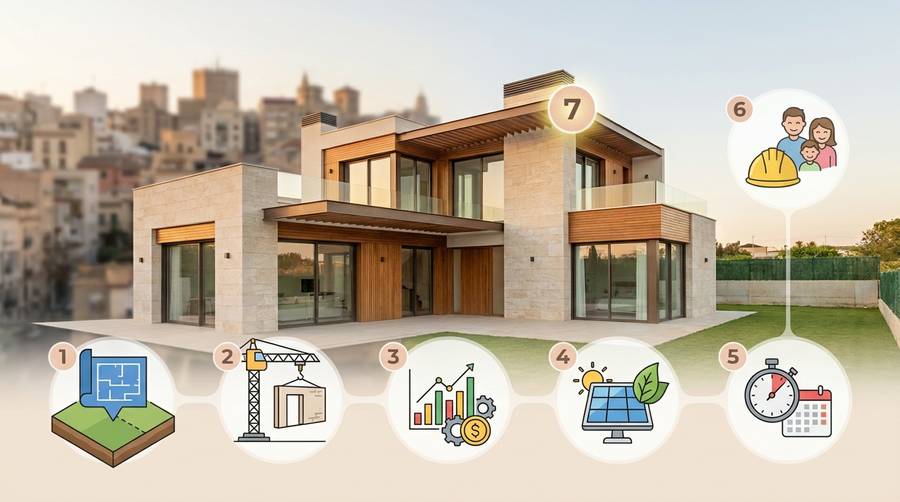
For a detailed decision framework about prefabricated vs traditional builds, see our linked guide Casa prefabricada vs tradicional: guía para decidir (2026) and practical tips for autopromoters in Vivienda industrializada: 7 claves para autopromotores en España.
Final thought: Choosing between a prefabricated house and a traditional build is a trade-off between speed, certainty and the degree of bespoke design. Prefabrication delivers clear advantages on schedule, quality control and the path to high energy performance; traditional builds still offer ultimate flexibility for complex, one-off designs.
If you are ready to compare actual turnkey offers or need a checklist tailored to your plot, request reference projects and tested performance reports before you sign — it will save time and reveal the practical differences that matter most.