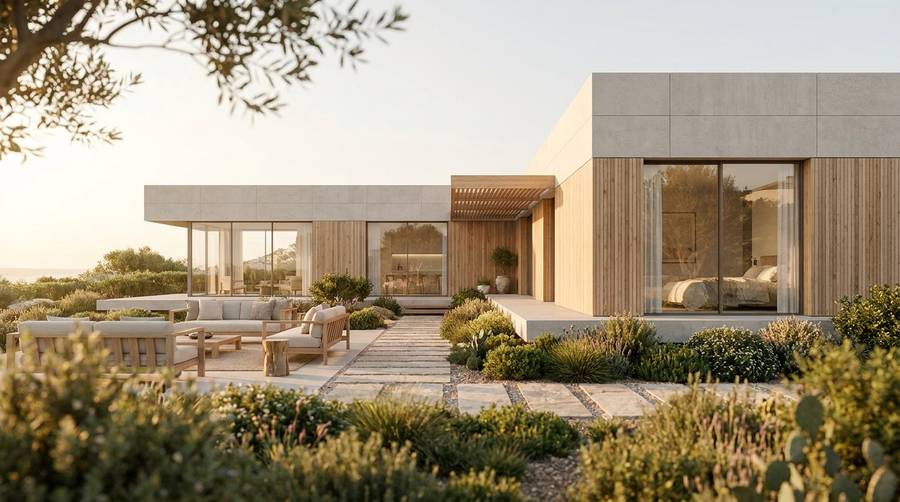
Prefabricated Homes Spain: Vision 2026–2035
Why family industrialized housing will become the Spanish standard: vision 2026–2035
Five years ago, María postponed building her family home because she feared cost overruns and long timelines — in 2026 she moved into a turnkey prefabricated house delivered in under nine months. That shift from hesitation to confident delivery captures a broader transition: industrialized housing is closing the gap between aspiration and reality for Spanish families.
By combining repeatable production, fixed-price contracts and thermal performance standards, prefabricated homes can reduce delivery time by 40–60% and construction-phase CO2 emissions by up to 30% versus traditional builds.
Market signals: recent industry surveys and pilot projects show rising consumer trust, improved financing products and supportive local regulations. The result is a projected adoption curve that accelerates steadily from urban-edge infill to broader suburban and peri-urban family housing between 2026 and 2035.
Market data: projections, adoption rate and key segments
Current adoption in Spain remains concentrated in early adopters: eco-conscious families, self-promoters (autopromotores) and developers targeting mid-sized plots. Key projections for 2026–2035:
- Adoption growth: an estimated compound annual growth rate (CAGR) of 8–12% for industrialized single-family housing units.
- Segments leading adoption: self-build families (autopromoción), affordable mid-market developers, and public-sector social housing pilots.
- Regional hotspots: coastal provinces and growth corridors around Madrid and Barcelona where parcel supply and local planning support modular methods.
Comparative advantages: efficiency, fixed timelines and fixed price with figures
Measured against comparable traditional builds of 120–160 m², representative recent case data reveals:
- Time to delivery: prefabricated turnkey — 6–10 months; conventional — 14–24 months.
- Cost variance: prefabricated — ±3–6% variance from contract price; conventional — ±12–25% on average due to scope and site factors.
- On-site labor reduction: up to 60% fewer on-site worker-days, concentrating work in factory settings where productivity is higher.
Regulatory and financial enablers and barriers
Barriers: inconsistent municipal procedures for approval of modular systems, variable interpretation of technical codes (CTE), and limited standardization in permitting.
Levers: harmonized homologation pathways for panels and modules, targeted incentives for low-carbon construction, and tailored mortgage products for autopromoción. Banks are already piloting mortgages tied to certified turnkey providers — a critical shift that reduces buyer risk and enhances market adoption.
Technological and material trends defining prefabricated homes
Industrialization is not a single technology — it is an assembly of material science, digital design and controlled production. The choices made at the component level determine durability, thermal performance and lifecycle carbon.
Modern materials with data: industrialized concrete, light timber frame and steel frame
Each structural strategy has trade-offs. Recent comparative performance data (normalized per m²) shows:
- Industrialized concrete systems: high thermal mass and acoustic performance, robust airtightness with factory-applied façades; embodied carbon can be mitigated via low clinker cements and optimized element design.
- Light timber frame: lowest embodied carbon among common systems, rapid assembly, excellent thermal performance when airtightness is controlled. Ideal for Passivhaus targets but requires skilled detailing for junctions and moisture control.
- Steel frame (steel frame): high precision, long spans and flexibility for interior layouts; typically higher embodied energy but well-suited for multi-storey modularity and fast erection.
Envelope innovation and efficiency: applying Passivhaus to prefabrication
Prefabrication lends itself to delivering consistent thermal envelopes. Practical results include:
- Airtightness: factory-controlled seals routinely achieve n50 values < 0.6 h-1 in certified projects.
- Thermal bridges: off-site detailing reduces weak points; combined with high-performance glazing and insulation, many prefabricated homes reach or exceed Passivhaus criteria with modest incremental cost.
- Ventilation: balanced MVHR systems integrated at production stage cut operational energy by 30–60% relative to code-minimum homes.
Process digitalization: parametric design, QA and component traceability
Digital tools transform risk into repeatability.
- Parametric design: accelerates design iterations, optimizes material usage and aligns modules to site constraints.
- Quality control: factory-run QA with digital checklists reduces defects and rework.
- Traceability: QR-linked component histories improve maintenance planning and support long-term warranties.
Business models and the turnkey process: evolution and best practices
The turnkey model converts industrial advantages into client certainty. For families and small promoters, a transparent turnkey offering is the single biggest accelerator of adoption.
Optimized phases: from plot search to handover and time metrics
A best-practice turnkey timeline for a 120–150 m² family home:
- Plot assessment & feasibility: 2–4 weeks.
- Design & approvals: 8–16 weeks (with modular design templates and pre-approved details this can be compressed).
- Factory production: 8–12 weeks.
- On-site installation & commissioning: 2–6 weeks.
- Total typical delivery: 6–9 months from contract signing to handover.
Financing and mortgage products for self-builders in Spain
Traditional mortgages often assume completed properties. New products emerge that bridge construction and occupancy:
- Turnkey mortgages: disbursed in milestones tied to factory progress and on-site erection.
- Autopromotion credit lines: tailored for land acquisition + modular build, sometimes with fixed-price escrow arrangements to protect buyers.
- Best practice for buyers: insist on draw schedules linked to independent milestones, and use providers offering extended warranties to support lender confidence.
Guarantees and after-sales strategies that build trust
Key warranty strategies to increase buyer confidence:
- Component certificates: third-party testing for airtightness, structural performance and fire safety.
- Multi-year envelopes: 10–20 year façade and structure guarantees with factory-backed replacements.
- Post-occupancy support: 12–24 month snagging windows and digital maintenance guides linked to component traceability.
Technical comparison: prefabricated vs traditional homes (data and real cases)
Objective comparison requires consistent metrics: cost per m², time to occupy, operational energy and lifecycle emissions. Below summarised findings combine multiple recent Spanish pilots and European benchmarks.
Cost and schedule analysis: case studies with real metrics
Case study A — 140 m² family home (light timber frame, turnkey):
- Contract price: €1,450/m² (fixed-price turnkey)
- Delivery time: 8 months
- Change orders: 2% of contract value
Case study B — traditional build similar spec:
- Final cost: €1,520–1,720/m² (after overruns)
- Delivery time: 16–20 months
- Change orders: 12–22% due to onsite variations
Takeaway: prefabricated, well-managed projects frequently achieve equal or lower costs and considerably shorter delivery windows, especially when the build team controls both factory and site phases.
Energy performance and carbon footprint: quantitative comparisons
Measured over 50-year scenarios with typical occupancy:
- Operational energy: prefabricated Passivhaus-level units reduce heating/cooling energy by 70–90% compared with pre-2020 code homes.
- Embodied carbon: timber-frame prefabs often show 20–35% lower embodied CO2 than concrete counterparts; industrialized low-clinker concrete narrows that gap.
- Net lifecycle: optimized prefabricated homes can achieve 25–40% lower lifecycle emissions versus typical traditional builds when design emphasizes low-energy operation.
Family satisfaction and lessons learned
Post-occupancy surveys indicate higher satisfaction in prefabricated homes for these reasons:
- Predictability: fewer surprises and reliable handover dates.
- Comfort: improved thermal comfort and acoustic performance due to factory-quality envelopes.
- Transparency: clear contracts and documented components reduce disputes.
Designing a family industrialized home in Spain: practical guide and critical steps
Design for industrialization — not the other way around. Early decisions determine cost, sustainability and satisfaction.
Key design decisions: orientation, size, materials and energy certification
- Orientation: optimize living spaces to the south for passive gain; use shading devices for summer control.
- Size & layout: standardizing module widths (e.g., 3–4 m spans) reduces production waste and cost.
- Material selection: choose a primary structural strategy based on site constraints and carbon goals — timber for low carbon, concrete for thermal mass.
- Energy targets: set a performance goal (e.g., nearly zero energy or Passivhaus) at the start to define envelope, glazing and ventilation strategies.
Coordination with plot, climate and local regulations: checklist for autopromoters
- Verify local zoning setbacks and maximum heights.
- Confirm soil bearing capacity and drainage to avoid late surprises.
- Obtain pre-approval for modular dimensions if possible to speed building permits.
- Engage a turnkey provider early to align module connections with site topography.
Cost and time optimization without sacrificing quality: scenarios and examples
Three pragmatic scenarios:
- Budget-first: smaller footprint, compact envelope, timber frame and standardized finishes.
- Balanced: mid-sized home, mixed-material envelope, MVHR, 10-year guarantees.
- Premium low-carbon: Passivhaus target, high-performance glazing, renewable energy integration and extended warranties.
Future scenarios and strategic recommendations for promoters and families
Planning for uncertainty requires distinct strategies depending on market trajectories.
Optimistic / realistic / pessimistic scenarios and investment implications
- Optimistic: regulation aligns, financing scales, adoption accelerates — large developers invest in automated factories; land values stabilize and product commoditization reduces cost.
- Realistic: steady uptake with regional clusters; turnkey providers consolidate; sustained demand for mid-market modular homes.
- Pessimistic: regulatory fragmentation and supply chain shocks slow growth; niche adoption persists but scale economies stall.
Opportunities for sector players: partnerships, industrialization and new services
High-value opportunities:
- Platformization: marketplaces that match landowners, modular providers and finance products.
- Component standardization: certified system families that reduce permitting friction.
- Service bundling: pre-approved design + finance + turnkey delivery to simplify autopromoción.
Practical recommendations for families building between 2026–2035
- Define your energy target early — this steers material and systems choices.
- Choose turnkey providers with documented QA data and post-occupancy references.
- Secure financing that aligns drawdowns with factory milestones.
- Prioritize warranties for envelope and structure to protect long-term value.
How to seize the industrialized housing wave and build your ideal family home
Key findings at a glance: prefabricated homes offer significant time and risk reduction, comparable or better lifecycle performance, and increasing consumer satisfaction when delivered by experienced turnkey teams.
Executive summary of critical takeaways
- Industrialized housing shortens timelines and reduces cost variability.
- Material choice matters: timber for low carbon, concrete and steel for durability and flexibility.
- Digitalized production and component traceability improve quality and after-sales service.
Immediate steps for autopromoters: resources and next contacts
If you are planning a self-build between now and 2035, take these immediate steps:
- Gather three turnkey quotes and compare fixed-price scopes and warranties.
- Request on-paper QA results: airtightness, U-values and component tests.
- Meet with lenders who offer tailored autopromoción mortgages and agree draw schedules before signing.
- Visit at least one completed project to validate comfort and finish quality.
Building your family’s industrialized home is no longer a niche choice — it is a strategic path to predictable quality, lower operational costs and lower lifecycle emissions. If you want practical support exploring plots, budgets and turnkey providers, start by assembling your key constraints (budget, plot, timeframe) and request documented proposals that include QA data and warranty terms. This clarity will separate feasible offers from optimistic marketing.
Ready to move from idea to plan? Compile your plot size, budget range and desired delivery window — then request a transparent turnkey proposal that includes airtightness targets and warranty schedules.