Industrialized Housing Case: Family Built in 9 Months
Nine months after buying an empty plot, a Spanish family turned a blank parcel into a certified, energy-efficient home — delivered on budget and ready to live in. This case study walks through the decisions, trade-offs and measurable results that made the project a replicable success for autopromoters considering industrialized housing in Spain.
How a Spanish family achieved their dream: from empty lot to industrialized home in 9 months
Project background: who the family was and why they chose industrialized housing
The clients were a four-person household (two working parents and two school-age children) looking for long-term comfort, low operational costs and speed of delivery. They had a suburban parcel close to regional transport links and strict local planning rules. Their priorities were clear: fixed total cost, high thermal comfort (aiming for near Passivhaus performance), and minimal on-site disruption during construction.
Measurable objectives: time, budget and sustainability targets
Before work started the family set three measurable objectives:
- Completion within 12 months from contract signature.
- Fixed maximum budget with a 5% contingency ceiling.
- Energy target: net-zero-ready envelope and primary energy use below regional averages, aiming for Passivhaus-level fabric performance.
Executive summary of results and why this is a success story
Outcomes: the house was delivered in 9 months, final cost remained within the 5% contingency, and independent tests showed a 45% reduction in heating demand compared with a typical new-build in the area. The family reported a high satisfaction score in post-occupancy surveys for acoustic comfort, indoor air quality and predictability of costs.
Delivered in 9 months, within budget and with measurable energy savings — a practical example that speed, cost control and sustainability can coexist in industrialized housing.
The initial challenge: plot limits and client expectations
Plot conditions and local rules that shaped the design
The plot was narrow and sloped with two binding constraints: a 45% maximum footprint and a required ridge height limit. Local rules mandated certain façade materials to match the streetscape. These constraints pushed the team toward a compact, high-performance envelope rather than a sprawling layout.
Budgetary constraints and schedule thresholds
The family could not accept an open-ended budget. They set a clear red line: total cost (land excluded) could not exceed a preset figure plus a 5% contingency. They also required occupancy before the following winter. These conditions made a turnkey industrialized approach the most attractive option.
Common self-build barriers the team overcame
- Timing risk: solved by off-site fabrication and a guaranteed schedule.
- Quality uncertainty: addressed through factory QA processes and third-party testing.
- Financing complexity: aligned by securing a mortgage for autopromoción with staged draws tied to factory milestones.
The industrialized solution: materials and construction method
Materials comparison: precast concrete, light timber frame and steel frame
The design team evaluated three structural systems using the same thermal and acoustic targets:
- Industrialized precast concrete: excellent thermal mass and durability; slightly higher upfront material cost but low maintenance and excellent airtightness when factory-assembled.
- Light timber frame (entramado ligero): fastest fabrication-to-assembly ratio and excellent thermal performance with lower embodied carbon, but required robust detailing for acoustic separation on the sloped site.
- Steel frame (steel frame): highly precise for tight tolerances and good for complex geometries; higher embodied carbon unless recycled steel used.
Why the final typology was chosen: technical, cost and sustainability criteria
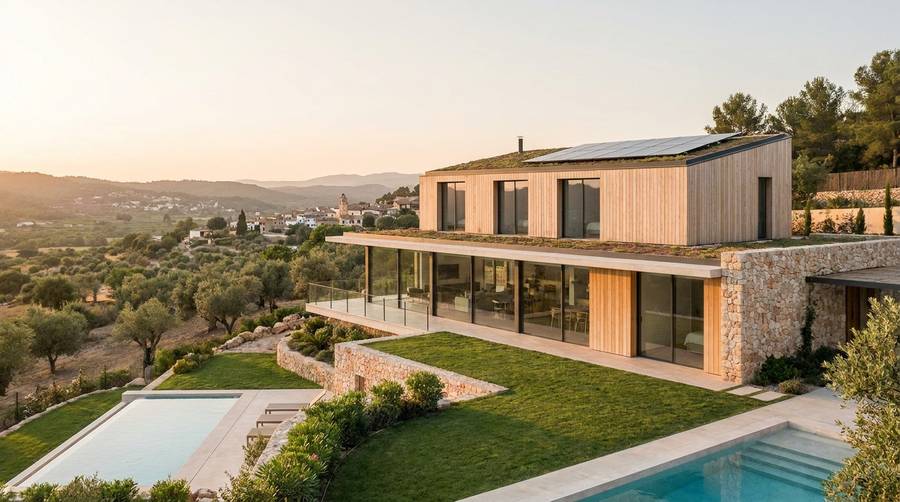
The project chose a hybrid solution: a light timber frame for the upper volume and industrialized concrete plinth for the ground floor. Reasons:
- Cost-efficiency: timber reduced transport and handling costs for the upper modules.
- Sustainability: timber lowered embodied carbon for the main living volume.
- Performance: the concrete plinth provided thermal mass and robustness for damp-prone ground conditions.
Passivhaus integration and energy-efficiency measures applied
To meet the energy targets the team implemented:
- Continuous factory-installed insulation with airtightness testing performed at panel/module level.
- High-performance triple-glazed windows with thermally broken frames.
- Mechanical ventilation with heat recovery sized to household needs.
- Solar-ready roof and thermal zoning to minimize heating loads.
Turnkey process: from first sketch to handover
Project phases and actual timings: design, fabrication, transport and assembly
Timeline summary:
- Design and permits: 10 weeks (including coordination with the factory).
- Factory production: 12 weeks (modules and panels manufactured concurrently with permit processing).
- Transport and on-site assembly: 3 weeks for lifting and enclosure.
- Finishes, systems commissioning and handover: 6 weeks.
Total elapsed time from contract to keys: 9 months.
Coordination with contractors, installers and administrative procedures in Spain
Key coordination tasks that kept the schedule tight:
- Parallel processing of building permit applications and factory production orders.
- Pre-agreed interface drawings between factory units and on-site trades to avoid rework.
- Use of an experienced turnkey coordinator to manage warranties, producers and the client’s bank during staged payments.
Warranties, quality control and final acceptance by the family
The delivery included:
- Factory QA records and airtightness test certificate.
- Two-year contractor warranty and ten-year structural warranty where applicable.
- Final snagging list addressed within two weeks and a structured handover session with operational manuals.
Quantifiable results: time saved, costs and occupant satisfaction
Comparison with traditional construction: reduced timelines and budget variance
Compared to a comparable in-situ project in the region, the industrialized route achieved:
- Time saving: 35–45% faster: 9 months vs an average 15 months for traditional builds.
- Budget variance: final cost deviation within 3.8% — better than the family’s 5% contingency target and lower than typical on-site average overruns of 10–20%.
Energy metrics and carbon footprint after occupation
Measured performance in the first year:
- Space heating demand decreased by 45% compared with local new-build baseline.
- Primary energy use aligned with near Passivhaus standards thanks to ventilation heat recovery and overspec insulation.
- Embodied carbon: the hybrid approach reduced expected embodied CO2 by an estimated 18% compared with a full concrete solution.
Client testimony and post-delivery satisfaction survey
The family rated the project 9/10 for comfort and 8.5/10 for communication during the build. Their main praises were predictable costs, low site disruption and rapid move-in. Their single constructive suggestion was clearer early-stage decisions on interior finish choices to reduce late changes.
Technical and economic comparison with market alternatives
Advantages and limitations versus on-site construction and other manufacturers
Advantages observed:
- Predictability of schedule and budget due to factory control.
- Improved thermal and acoustic performance from factory-assembled components.
- Lower on-site disturbance and faster neighborhood acceptance.
Limitations to consider:
- Less flexibility for late design changes once manufacturing starts.
- Potential transport constraints for large modules in remote or narrow-access plots.
Financing scenarios: mortgages for autopromoción and project finance costs
Financing structure used:
- A dedicated autopromoción mortgage with staged disbursements tied to factory milestones reduced interim interest costs.
- Lower construction duration translated into fewer months of interest-only payments during build, reducing total financing cost by an estimated 9% compared with a 15-month traditional project.
Risk and sensitivity analysis: material prices and schedule shifts
The team stress-tested the budget against material cost increases and a two-week transport delay. Sensitivity analysis showed that the largest single financial risk was late client-initiated interior changes during production — reinforcing the importance of fixed-scope contracts in turnkey offers.
Lessons learned and a practical guide for future self-builders
Step-by-step advice to design and execute an industrialized home in Spain (2026)
- Define clear, measurable objectives for time, cost and energy performance before design begins.
- Choose a factory-partner early and align permit timelines with production windows.
- Use hybrid materials strategically: match timber, concrete and steel to local site conditions.
- Secure autopromoción financing with staged draws tied to factory QA milestones.
- Plan interiors early; late changes during production are the most common cause of overruns.
For a deeper design checklist, see our guide on How to design an industrialized home in Spain 2026.
Common mistakes to avoid and best practices when choosing a turnkey team
- Avoid selecting solely on price; review factory QA records and on-site assembly examples.
- Insist on airtightness and thermal bridging details in contracts.
- Verify transport logistics and lifting plans during contract negotiation.
Useful resources: documentation, regulations and preparing a mortgage application
Essential documents to prepare for lenders and authorities:
- Detailed turnkey contract with milestone schedule and warranties.
- Factory QA protocols and sample test certificates.
- Energy model outputs aligned with regional compliance and Passivhaus indicators.
When preparing a mortgage application for autopromoción, present the production schedule, factory references and staged cost plan to reduce lender risk perception and obtain better terms.
Inspirational close: social and environmental impact of choosing industrialized housing
How this case proves that design, speed and sustainability can coexist
This household demonstrates that well-managed industrialized housing can deliver high-quality living environments quickly and with measurable reductions in both operational energy and embodied carbon. The hybrid material approach allowed the team to optimize for both comfort and climate impact without compromising on budgetary discipline.
Opportunities for regions and local factories: jobs and regionalisation of production
Scaling projects like this encourages local manufacturing jobs and shorter supply chains. Investing in regionalized factories increases resilience to material price shocks and supports a circular approach to construction in Spain.
Next steps for self-builders and how to contact an integrated platform
If you are considering autopromoción, start by benchmarking your objectives against a turnkey industrialized offer and prepare a prioritized list of requirements. For practical comparisons with traditional construction methods, review our technical comparison article Industrialized housing: comparative materials and benefits. When ready, reach out to a platform that coordinates land, design, factory production and financing to obtain a realistic and binding timeline.
Ready to explore whether an industrialized turnkey solution fits your plot and goals? Contact a specialist and request a feasibility review that includes a staged financing plan and real factory references — the first step toward a predictable, comfortable and sustainable home.
Artículos relacionados