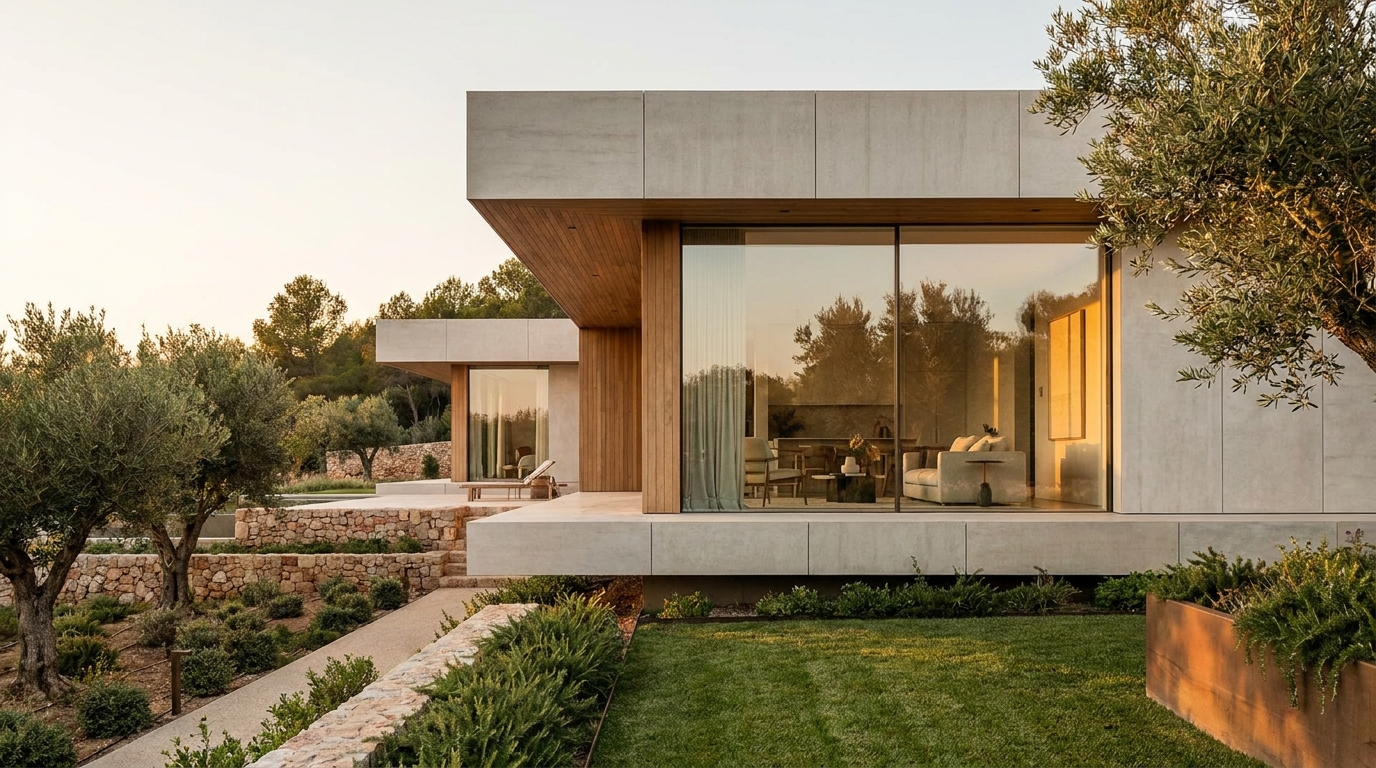
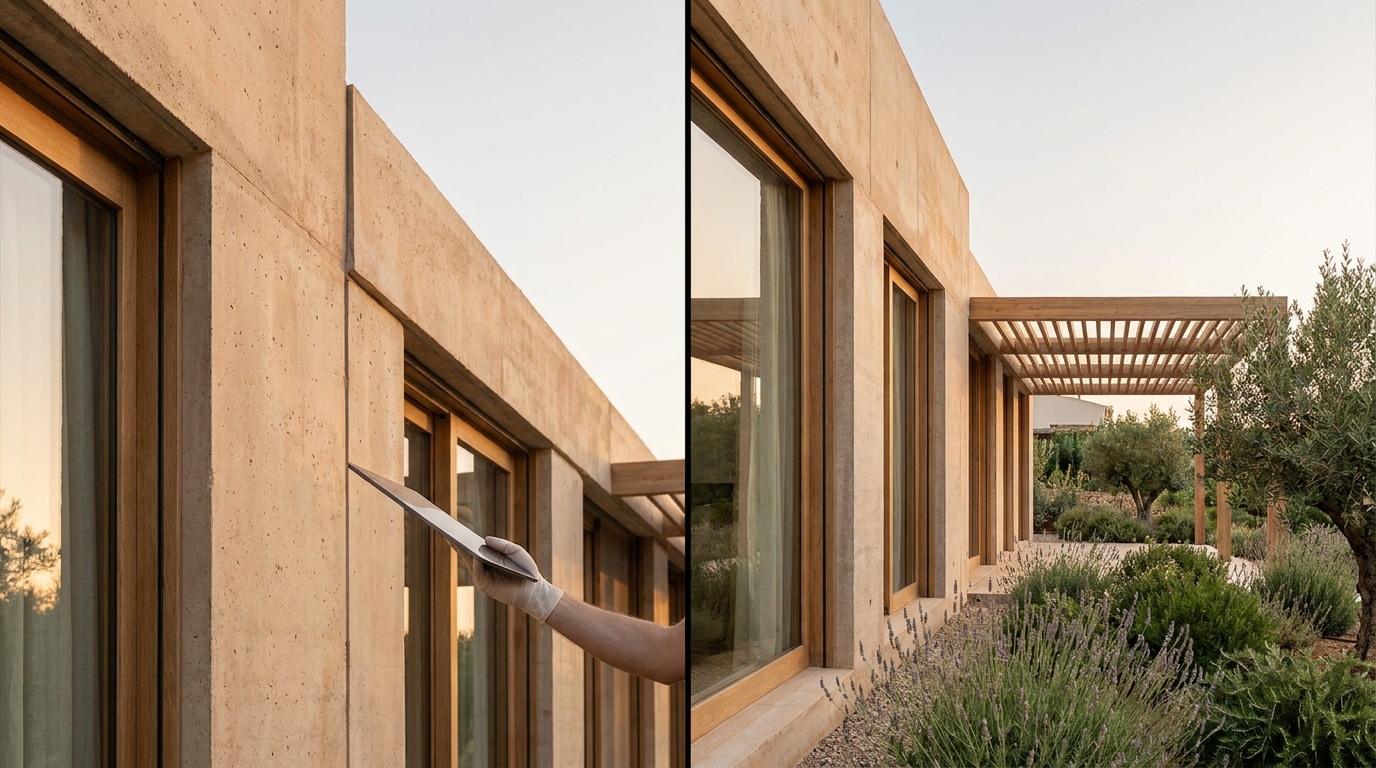
Industrialized Housing: A Spanish Turnkey Success
Una visión que se hizo casa: presentation of the project
They wanted a contemporary, energy-efficient home delivered on schedule—and they got it. The family’s decision to build an industrialized house began as a response to unpredictability in traditional builds and a desire for measurable sustainability.
Profile of the developers: goals and family motivation
The clients were a four-person household: two professionals with remote-capable jobs and two school-age children. Their priorities were clear: comfort, low operating costs, predictable delivery and a modern Mediterranean aesthetic that fit the local landscape.
Key objectives they communicated: fixed budget, 12–14 month total timeline, and high energy performance (Passivhaus target). They also wanted a reliable financing route compatible with self-build mortgage options in Spain.
Plot selection and program requirements
The chosen plot had a gentle slope, south-facing exposure and easy access to utilities—critical factors for optimizing solar gains and installation logistics. The program demanded:
- 140–160 m2 usable living area
- open-plan living with large windows
- two en-suite bedrooms and a flexible workspace
- outdoor terrace and modest garden for family life
These constraints shaped the modular layout and the choice of assembly method.
Initial challenges: time, budget and sustainability
At project start the main threats were common: uncertain on-site durations, cost overruns and meeting Passivhaus-level airtightness in a humid Mediterranean microclimate. The family required transparent milestones and clear factory QA to mitigate those risks.
Why they chose off-site and modular factories
The decision to build off-site reduced on-site unpredictability and compressed the critical path. It also allowed parallel workstreams—permitting design finalization while site preparation began.
Brief comparison: prefabricated vs traditional (time, cost, predictability)
In this case the modular route delivered measurable advantages:
- Time: on-site assembly completed in 4 weeks versus an estimated 6–9 months for full traditional construction.
- Cost predictability: factory contracts fixed major manufacturing costs, reducing budget variance.
- Quality control: standardized factory QA lowered rework and post‑delivery defects.
These benefits do not eliminate the need for careful coordination, but they shift many risks from site to controlled factory processes.
Selection of materials: industrialized concrete, timber frame and steel frame
The project blended systems to match performance and aesthetics:
- Industrialized concrete panels for foundations and select load-bearing walls—improved thermal mass and acoustic performance.
- Light timber framing (entramado ligero) for internal partitions and roof elements—fast, renewable and compatible with high airtightness detailing.
- Steel frame elements where long spans or cantilevers were needed—slim profiles and structural reliability.
Combining systems allowed the team to optimize cost, speed and the Mediterranean look the family wanted.
Sustainability criteria and energy efficiency (Passivhaus target)
The objective was to reach near-Passivhaus performance through three strategies:
- continuous factory-installed insulation and airtightness membranes;
- high-performance glazing with solar control appropriate for Spanish sun exposure;
- mechanical ventilation with heat recovery sized for occupancy.
Meeting these targets in a modular workflow allowed the team to test components in the factory before assembly, reducing thermal bridging and installation errors on site.
Turnkey process: from first plan to handover
Turnkey in this project meant the client received a ready-to-live home, with permits, connections and landscaping coordinated under one delivery schedule. Clear milestones and single-point responsibility were decisive.
Project phases with real timelines: design, manufacture, transport and assembly
Actual durations recorded:
- Design & permits: 4 months (including minor plan revisions)
- Factory manufacturing: 10 weeks (modules and prefabricated components)
- Transport to site: 3 days (staggered deliveries)
- On-site assembly and finishing: 4 weeks
Total calendar time from contract signature to handover: 9.5 months. That met the family’s upper expectation and beat typical local traditional builds by 30–50% on schedule.
Coordination with the plot and permits: how the calendar was optimized
Key scheduling choices reduced idle time:
- initiated foundation and utility trenching while final detailed drawings were produced;
- scheduled factory production to begin once permits for main envelope were approved;
- used pre-approved standard details for connections to speed permit review.
These steps required proactive communication between the client, factory production manager and the local planning office.
Quality control in factory and post-assembly on site
Quality assurance combined factory tests and site checks:
- factory pressure-testing of façade modules for airtightness;
- pre-installation of insulation and wiring to reduce on-site interface errors;
- post-assembly thermographic scan and blower-door test before final handover.
Factory QA prevented common on-site issues and produced a cleaner, faster finishing stage.
Measurable results: time, cost and satisfaction
Numbers matter: results showed notable gains in schedule and energy consumption while respecting the agreed budget.
Key metrics: reduction in construction time and budget deviation
Reported performance vs initial benchmarks:
- Construction time reduced by ~40% compared to regional traditional averages.
- Final cost deviation: +2.5% above the firm estimate—mainly due to personalized interior finishes requested mid-process.
- On-site labor days reduced by ~65%.
These metrics reflect the benefit of fixed factory pricing and compressed on-site labor exposure.
Energy efficiency and estimated carbon footprint after delivery
Measured outcomes in the first winter and summer season:
- Space heating demand estimated at ~12 kWh/m2·year (near-Passivhaus in the local climate).
- Primary energy use was ~35% lower than a comparable traditional new build with conventional systems.
- Embodied carbon was optimized by selecting low-carbon concrete mixes and responsibly sourced timber; lifecycle modelling estimated a 20% reduction versus a fully cast-in-place approach.
“The modular approach delivered a home that performs like a Passivhaus and arrived on time—transforming our anxiety about building into predictable results.”
Client testimony and satisfaction levels (survey and data)
Client survey six months after handover reported:
- Overall satisfaction: 9/10
- Comfort and indoor air quality: 9/10
- Perceived value vs cost: 8.5/10
- Would recommend to a friend: yes
Qualitative feedback highlighted the clarity of milestones and the low disruption during assembly.
Technical comparison and lessons learned vs competitors
Comparisons focused on objective outcomes—timing, energy and constructability—rather than brand claims.
Demonstrated technical advantages vs competing methods (neutral data)
Compared to local competitors using in-situ methods or light on-site panelization, this project showed:
- Better airtightness consistency due to factory-controlled sealing processes.
- Lower on-site dependence for skilled finishes, reducing labor bottlenecks.
- Fewer weather-related delays during critical envelope work.
These advantages are process-driven rather than inherent to any single material choice.
Design and material decisions that made the difference
Decisions that produced measurable gains:
- Hybrid structure: concrete at ground interfaces for durability, timber and steel above for speed and thermal performance.
- Pre-installed services in factory modules to reduce site coordination errors.
- Window sizing and shading calibrated for solar gains in the Mediterranean context.
Common mistakes and how to avoid them: practical advice for self-builders
Lessons distilled from the project:
- Avoid late design changes after factory production starts—these create costly delays.
- Plan logistics early: transport permits and crane access must be booked well in advance.
- Ensure a single technical coordinator to manage interfaces between factory and on-site teams.
Practical guide and inspiring close for those building today
If you’re considering a modular turnkey project in Spain in 2026, follow a clear, action-oriented path.
Quick checklist: essential steps to launch your modular project in Spain 2026
- Secure a plot with favorable solar orientation and good access to services.
- Define a concise program: area, rooms, and must-have performance targets (e.g., Passivhaus).
- Select a manufacturer with factory QA, blower-door testing experience and references.
- Align permits and foundation work so factory production can start without delay.
- Budget for a contingency (5–8%) to accommodate finish-level choices.
Financing options and considerations for self-build mortgages
Financing a turnkey modular home in Spain typically follows two routes:
- Standard mortgage on finished property: lenders may finance after final valuation—simpler but requires bridge funding during construction.
- Self‑build (autopromoción) mortgage: staged disbursements tied to milestones (foundations, assembly, finishing). Modular projects benefit because factory milestones are easily verifiable.
Practical tips:
- Prepare factory contracts and QA reports to satisfy lenders’ milestone checks.
- Negotiate clear payment schedules to align with lender disbursements and reduce borrower cash exposure.
Motivating close: why industrialized housing is a real, accessible alternative
Industrialized housing is no longer an experimental niche. For self-builders seeking predictability, energy performance and modern Mediterranean design, a well-managed turnkey modular approach delivers measurable results: faster delivery, tight cost control and superior comfort.
If you value schedule certainty, reduced on-site disruption and verifiable energy performance, industrialized housing is a practical path to your next home. Consider the checklist and the financing notes above as your starting point—then speak with trusted manufacturers and advisors to assess fit for your plot and objectives.
Ready to explore options and compare realistic timelines and budgets for your plot? Contact experienced teams, ask for factory QA evidence, and request a staged payment schedule that matches lender requirements. Small upfront planning choices drive the large outcomes you’ll live with for decades.
Artículos relacionados