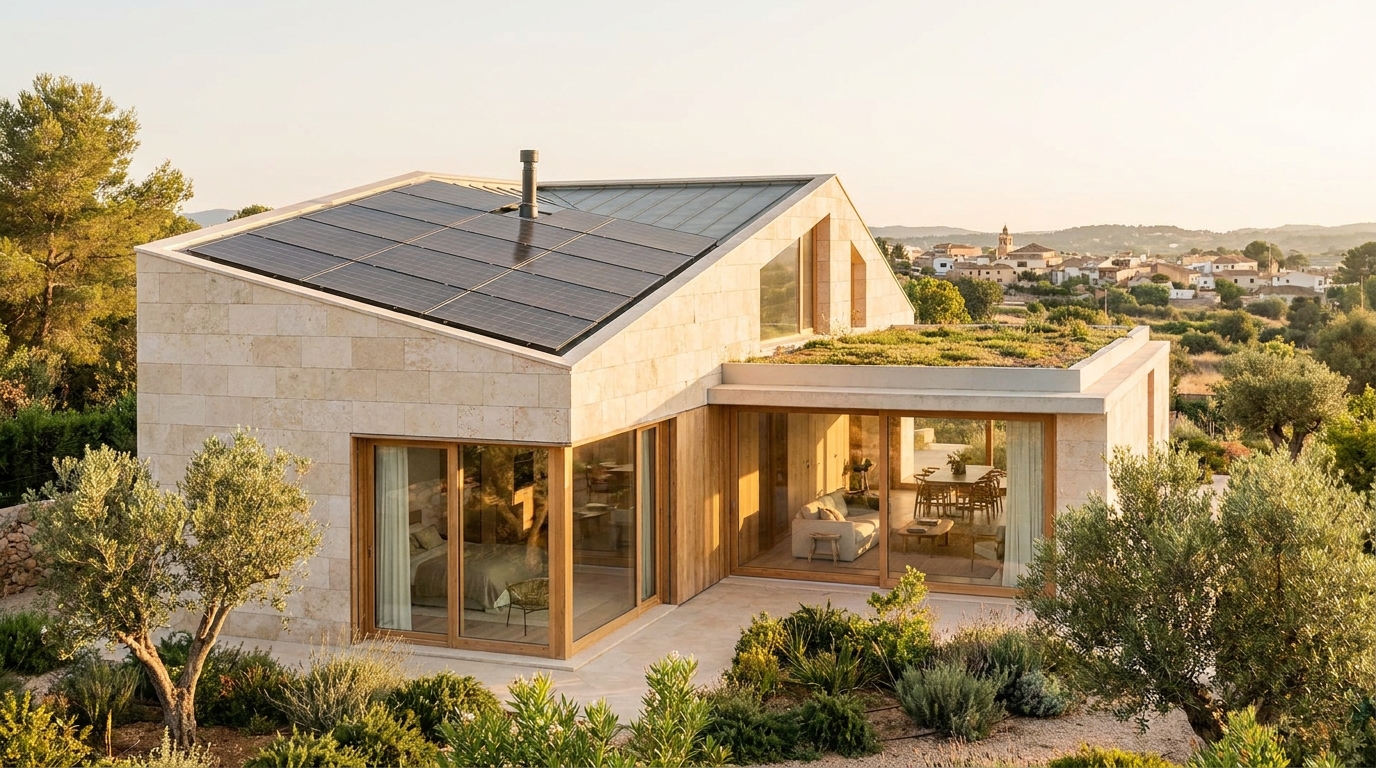
Passivhaus Industrialized Home: A Real Success Story
Un sueño hecho casa: how this Passivhaus industrialized project began
The couple wanted a home that required almost no heating and was built on a tight timeline — and they achieved it. From the first meeting the autopromoter (self-builder) framed three non-negotiables: high thermal comfort, predictable budget, and delivery within 11 months. That simple brief drove every technical decision and made industrialized construction the clear route.
Initial vision and sustainable objectives from the self-builder
The clients valued daylight, Mediterranean materials and a low-carbon future. They asked for a warm home that behaves like a Passivhaus in summer and winter and that ages well. Their priority was long-term running costs and resilience to higher energy prices.
Why industrialized housing was chosen over traditional build
- Predictability: fixed-price contract reduced financial risk.
- Speed: roofed and watertight in weeks once modules arrived.
- Quality control: factory assembly enabled repeatable performance targets.
Context: plot, climate and local regulations
The plot is coastal-inland Spain: Mediterranean climate with hot summers, mild winters and significant diurnal range. Local planning allowed a compact two-storey dwelling and required limits on façade materials that favored neutral light-coloured finishes and natural stone accents.
Delivered in 10.5 months, the house achieved an airtightness of 0.45 h-1 and reduced operational energy by 70% versus a comparable traditional build.
The challenge: combining Passivhaus standards with premium prefabrication
The core challenge was meeting Passivhaus performance without inflating costs beyond the self-builder’s budget. That meant careful choices on structure, envelope and mechanical systems while keeping the fixed-price model intact.
Site constraints and the family's needs
The narrow plot imposed a compact footprint and required vertical zoning to maximise solar gains. The family wanted large glazed areas facing south, a private terrace and durable exterior finishes that fit the Mediterranean aesthetic.
Energy targets and carbon reduction goals
The project targeted a 70–80% reduction in heating demand compared to code, aiming for low primary energy and near-zero overheating risk. Material embodied carbon was considered, and a lifecycle approach influenced material choices.
Time and budget limits shaping the project
With a firm delivery date driven by the family's relocation needs, the schedule left little room for on-site rework. The contract included penalties for delays and clear acceptance tests for thermal performance and airtightness.
Technical solution: materials and systems selected
The design married the control of factory-made components with site-finished craftsmanship. The goal: a premium prefabricated home that doesn't look or feel 'industrial'.
Structure and envelope: concrete, light timber frame, or steel frame?
The team evaluated three systems:
- Industrialized concrete panels: excellent thermal mass for diurnal buffering but heavier and costlier to transport.
- Light timber frame: rapid assembly, low embodied carbon, excellent detailing for insulation continuity.
- Steel frame (steel frame): high precision and long spans but higher embodied carbon and thermal bridging considerations.
Decision: a hybrid approach. Load-bearing insulated concrete plinths were combined with a factory-built light timber frame upper envelope. That delivered structural stability, a lighter superstructure and lower embodied carbon than full steel.
Passivhaus detailing: insulation, airtightness and high-performance glazing
- Continuous insulation: 220–300 mm across the envelope using mineral wool and wood-fibre boards for hygrothermal balance.
- Airtightness strategy: factory-sealed panel joints and on-site tape and liquid membranes at penetrations to meet n50 targets.
- Windows: triple-glazed frames with thermally broken sills and U-values below 0.9 W/m²K.
Efficient systems integration: MVHR and renewables
Ventilation: a central mechanical ventilation with heat recovery (MVHR) sized to Passivhaus standards ensured fresh air with minimal heat loss. Renewable input included a modest photovoltaic array sized to offset household electricity and a solar-thermal preheat loop for domestic hot water.
Turnkey process: from design to on-time delivery
Industrialized housing succeeds when the workflow is tightly choreographed. This project used a clear phase plan and KPI-driven coordination between factory and on-site teams.
Project phases, milestones and timeline
- Design & permits: 10 weeks — schematic design to municipal permit submission.
- Factory prefabrication: 12 weeks — panels and modules assembled and inspected.
- Site preparation: parallel civil works in 8 weeks (foundations, services connection).
- Assembly and enclosure: 2 weeks — modules craned and sealed.
- Finishes and commissioning: 6–8 weeks — interior fit-out, MVHR commissioning, airtightness test.
Total time: 45 weeks from contract signature to handover; on budget and slightly ahead of schedule thanks to overlapping phases.
Coordination across architecture, factory and site supervision
Weekly coordination meetings and a shared BIM model prevented clashes. Factory checklists, photographic records and acceptance gates ensured each deliverable met the agreed tolerances before leaving the factory.
Financing and administrative steps: self-builder mortgage and permits
Financing blended a self-build mortgage (hipoteca de autopromoción) with staged payments tied to milestones. The turnkey provider offered documentation packages that simplified lender draws and municipal inspections.
Real results: metrics on efficiency, cost and client satisfaction
Numbers matter. This section summarizes measured outcomes versus the original brief and conventional benchmarks.
Timeline comparison vs traditional construction
- Industrialized route: 45 weeks delivery (design to handover).
- Traditional build (comparable scope): typically 18–30 months, with higher exposure to weather delays.
Costs and adherence to the fixed price
The contract stipulated a fixed price. Final costs were within 2% of budget, with variations mainly due to client upgrades after contract. The factory process limited on-site scope creep, protecting the client from many common overruns.
Measured energy performance and airtightness
- Airtightness: n50 = 0.45 h-1 (Passivhaus-ish performance).
- Heating demand: ~15 kWh/m²·year — roughly 70% less than a code-compliant new build.
- PV generation covered ~55% of annual household electricity; thermal preheat reduced DHW gas/electric needs by 60%.
Occupant feedback: the family reports stable indoor temperatures, minimal noise transfer and monthly energy bills significantly lower than their previous conventional home.
Objective comparison: industrialized Passivhaus vs conventional solutions
When evaluated across comfort, risk and sustainability, the industrialized Passivhaus approach shows clear advantages.
Comfort and energy: a clear winner
High insulation, airtightness and MVHR produced even temperatures and improved air quality. Overheating was controlled through shading and window specification — a common weak point in naive passive designs.
Lower risk through factory quality control
Factory production reduces variability. Inspectable quality gates and traceable materials mean fewer defects and predictable performance — especially important for airtightness and continuity of insulation.
Sustainability: lower operational impact, competitive embodied carbon
While some systems (full concrete or steel) can carry higher embodied carbon, the chosen hybrid timber upper structure delivered a favorable lifecycle carbon profile. Combined with reduced operational energy, the life-cycle emissions improved markedly.
Key lessons for self-builders: practical recommendations
For autopromotores considering a similar route, these practical tips reduce surprises and increase the chance of success.
How to choose a supplier and what to ask
- Ask for measured airtightness and energy test reports from previous projects.
- Request a detailed fixed-price breakdown with excluded items explicitly listed.
- Inspect a finished house built by the supplier when possible.
Contractual points in turnkey models and guarantees
- Include clear milestones, liquidated damages for delays and acceptance tests (airtightness, MVHR flows).
- Demand material provenance and warranty terms for key components (windows, MVHR, PV).
- Retain a small percentage payment until post-occupancy performance verification.
Adapting Passivhaus design to budget and plot
- Focus on compact geometry and solar orientation before upgrading technical components.
- Prioritise airtightness, insulation continuity and good windows; systems like MVHR can be sized precisely, not oversized.
- Use lifecycle thinking: modest additional upfront cost often recoups in 5–10 years through energy savings.
Final inspiration: the impact of a Passivhaus industrialized home
The family describes the change as dramatic: quiet nights, stable comfort without constant thermostat adjustments, and confidence in predictable bills. Beyond personal comfort, the home is a tangible asset with better resale outlook thanks to energy credentials.
Daily transformation: comfort, savings and wellbeing
Reduced drafts, even temperatures and consistent fresh air changed how the household uses space. They now use the terrace more months of the year due to better internal comfort and shading strategy.
Long-term implications: resale value and sustainability
Lower running costs and verified performance contribute to market appeal. Buyers increasingly value verified energy performance, which translates to premium positioning in resale.
Next steps for those ready to begin
If you are considering a self-build Passivhaus using industrialized methods, start by clarifying your non-negotiables: budget cap, target delivery date and performance goals. Use those to shortlist suppliers and demand evidence.
Ready to explore options? Contact a specialist to review your plot and brief. A short feasibility assessment can reveal whether a hybrid industrialized Passivhaus is the fastest route to a warm, sustainable and predictable home.