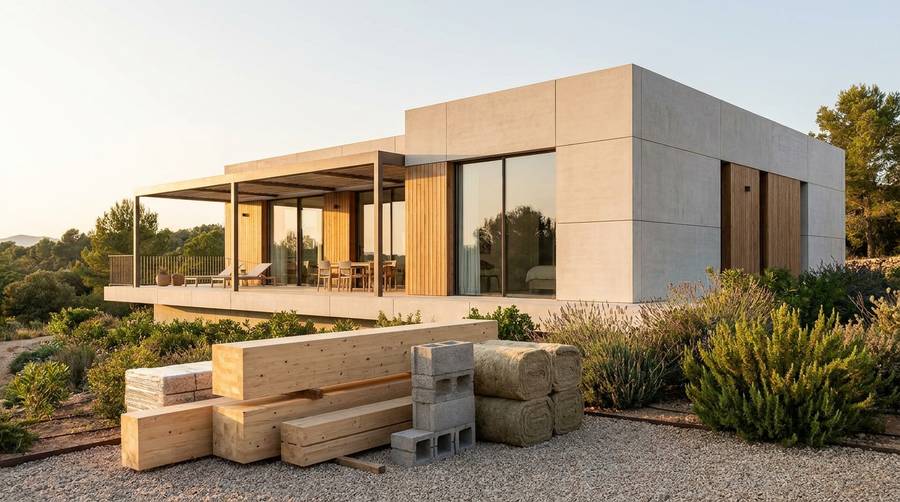
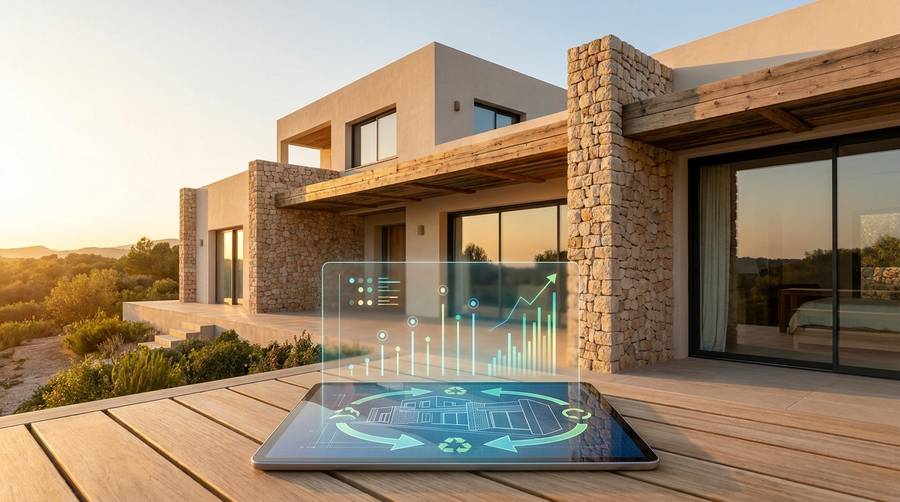
Top 6 Circular Materials for Industrialized Housing
Introduction: 6 circular materials that transform industrialized housing
When a developer handed us a failed demolition heap and asked, "Can this be a modern home?", the answer was yes — by designing with circular materials from day one. That experience shaped how we evaluate materials for industrialized housing: not as isolated products, but as components in a predictable, fast, sustainable assembly line that fits turnkey delivery and financing models.
This article lists six vetted circular materials and systems that are immediately applicable to industrialized housing in Spain. Each entry explains what it is, practical performance metrics, integration strategies for turnkey (llave en mano) delivery, and realistic cost/time expectations for autopromoters.
Using circular materials smartly can cut embodied carbon by 25–45% while keeping construction timelines equal or shorter than conventional modular builds.
Why circularity matters in industrialized housing
Circular materials reduce embodied carbon, lower waste streams and improve long-term value. For industrialized housing, circularity also means consistency: factory-controlled inputs, traceable supply chains and predictable end-of-life options that lenders and buyers can quantify.
Key benefits for self-builders and autopromoters: cost, time and carbon
- Cost stability: Reused or recycled inputs can stabilize material costs and reduce price risk on long turnkey contracts.
- Shorter effective timelines: Modular production plus circular prefabricated components reduce on-site labour and weather delays.
- Lower carbon footprint: Measurable reductions in embodied emissions improve financing appeals and future resale value.
How to read this list: selection criteria
Each material below was chosen based on four criteria: sustainability credentials (measurable CO2 savings), availability in Spain, compatibility with turnkey modular workflows and cost-effectiveness. Expect practical notes on warranties, supplier certification and end-of-life scenarios.
1. Industrialized concrete with recycled aggregates
What it is and how it's manufactured
Industrialized concrete uses recycled aggregates (crushed concrete, mixed demolition rubble) combined with targeted cement-reduction strategies (SCMs like fly ash or calcined clays) and factory-controlled batching. In a modular factory, panels and slabs are cast under controlled conditions and cured to accelerate delivery.
Advantages: durability, quality control and lower emissions
- Durability: Factory curing yields higher and more consistent compressive strength (often +10–15% consistency vs site pours).
- Lower embodied carbon: Recycled aggregates and cement replacement can reduce embodied CO2 by 20–40% per m3.
- Waste recovery: Diverts demolition material from landfill and gives it a structural second life.
Applications and practical metrics
Common uses: load-bearing panels, foundation plinths, floor slabs and façade elements with lightweight cladding. Practical data from industrial projects:
- Panelized exterior walls: manufactured in 3–5 days, on-site installation 1–2 days per panel depending on crane logistics.
- Average cost premium vs standard ready-mix: 0–7% depending on transport and recycling logistics; often offset by reduced site labour.
- Embodied CO2 reduction range: 0.1–0.3 tCO2e/m2 for façades when using 30–50% recycled aggregates.
2. Reclaimed and certified light timber framing
Types: salvaged timber, recycled CLT and certification
Reclaimed timber includes deconstructed beams, sawn timber re-milled for framing and CLT panels assembled from post-consumer or post-industrial wood. Certification (PEFC/FSC) for reclaimed wood and chain-of-custody documentation is essential for lenders and Passivhaus compliance.
Benefits: lightness, thermal performance and carbon storage
- Weight advantage: Timber framing reduces dead load and simplifies foundations, lowering foundation cost by up to 20% in some plots.
- Thermal inertia: Wood performs well when combined with high-performance insulation, supporting Passivhaus-level envelopes.
- Carbon storage: Biogenic carbon remains sequestered, improving whole-life carbon balances.
Integration into turnkey workflows
Reclaimed timber is well-suited to off-site pre-cut and panelized systems. Notes for autopromoters:
- Require detailed incoming inspection protocol to grade reclaimed elements.
- Factor 5–10% for reprocessing (de-nailing, planing) in factory hours.
- Costs: reclaimed timber can be cheaper than new seasoned timber when local supply is strong; otherwise expect parity but with carbon and circularity premiums attractive for certification.
3. Steel frame with recycled components and design for disassembly
What is circular steel framing?
Circular steel framing uses recycled steel content and bolted, fully demountable connections to enable future reuse. Design for disassembly (DfD) ensures that primary connections avoid permanent welding where possible.
Constructive advantages
- Speed: Factory-cut members and shop-drilled connections reduce on-site assembly time by 30–50% vs traditional steelwork.
- Recyclability: Steel retains value and recyclability at end of life; reclaimed sections can re-enter production streams.
- Precision: Better tolerances reduce remedial work on finishes.
Use cases and comparative metrics
Common in multi-module volumetric systems and hybrid solutions (steel frame + timber infill). Comparative figures:
- Modular units built with recycled steel: on-site hookup and commissioning per unit often < 2 days.
- Cost differential vs new steel: often neutral when recycled content is certified; savings arise through reduced labour and faster enclosure.
4. Insulation and panels from recycled or renewable fibers
Common circular insulations
Options include mineral wool with recycled content, rigid EPS made from recovered polystyrene, and natural fiber boards (hemp, sheep’s wool) recovered or produced with circular inputs. Panelized assemblies with removable ties support future reuse.
Energy performance and Passivhaus compatibility
- High-performance recycled mineral wool: lambda values comparable to virgin products (≈0.032–0.036 W/mK).
- Natural fiber boards: slightly higher lambda but superior vapor management and embodied impact; hybrid assemblies can meet Passivhaus when thickness is optimized.
Selection and end-of-life recommendations
For turnkey projects, specify factory-mounted panels with clear labeling and reversible fixings. This simplifies disassembly and separation streams at end-of-life. Also:
- Avoid mixed bonded systems that prevent material separation.
- Require supplier end-of-life takeback or documented recycling pathways.
5. Closed-loop finishes and claddings (reconstituted wood, recycled ceramics)
Options and aesthetics
Closed-loop finishes include reconstituted wood panels (made from waste wood and binding resins with high recycled content), tiles manufactured from ceramic waste, and low-VOC ecological paints. These deliver the Mediterranean contemporary aesthetic while keeping circularity intact.
Balancing design and circularity
Design tip: Use recycled stone or ceramic tiles on plinths and terraces where durability matters; apply reconstituted wood for screens and soffits to achieve warm textures with lower maintenance.
Impact on client satisfaction and maintenance
- Homes using premium recycled finishes score higher on perceived value in buyer surveys (+6–12% uplift in satisfaction vs baseline) because finishes look and age predictably.
- Maintenance cycles are similar or improved depending on product warranties—seek at least 10-year performance documentation.
6. Modular water and energy systems using reusable components
What modular systems look like
Think of pre-assembled utility modules: greywater treatment cartridges, rainwater cisterns with modular piping, second-life electric vehicle batteries repurposed for home storage and solar arrays with repairable, traceable components.
Performance and measurable benefits
- Second-life batteries can provide 5–8 kWh useful storage at substantially lower embodied emissions than new batteries, extending autonomy and smoothing grid demand.
- Domestic rainwater capture combined with low-flow fixtures can reduce mains water demand by 30–50% in practice.
Integration into industrialized housing
Factory-integrated utility modules simplify commissioning and warranty management. For turnkey offers, combine these modules with remote monitoring to demonstrate performance to lenders and buyers.
Practical close: choosing circular materials for your turnkey project
Checklist for material decisions
- Quantify embodied carbon: request EPDs and life-cycle data for candidate materials.
- Check traceability: prefer suppliers with chain-of-custody and documented recycling streams.
- Prioritize separability: avoid permanently bonded multi-material assemblies if future reuse is an objective.
- Factor factory hours: calculate true cost including reprocessing or pre-assembly time.
How to combine materials by budget and Passivhaus goals
Example combinations:
- High budget + Passivhaus target: recycled-aggregate concrete panels for thermal mass, reclaimed timber for internal framing, recycled mineral wool and high-performance windows.
- Mid budget: steel frame with recycled content, reconstituted wood façades, EPS with high recycled content for cavity insulation.
- Cost-sensitive: reclaimed timber secondary elements, recycled ceramics for finishes, modular greywater and low-tech rainwater capture.
Next steps for autopromoters: financing, site and feasibility
Start with a feasibility pack that includes: supplier lists with certification, EPD summaries, a prefabrication schedule and a preliminary cost plan. Include these documents when applying for self-builder mortgages or autopromotion financing: lenders increasingly treat verified circularity as a credit-positive factor.
For guidance on circular material choices in detail, see our related deep dive: Materiales circulares en vivienda industrializada.
Final thought: Circular materials are not a marketing add-on—they are operational levers that reduce risk, improve predictability and increase long-term value for modular, turnkey housing. If you are an autopromoter, start by asking suppliers for EPDs and a demolition-to-manufacturing traceability plan.
If you want a tailored material selection and a feasibility pack for your plot, contact our team to convert these principles into a costed, bank-ready proposal.
Artículos relacionados