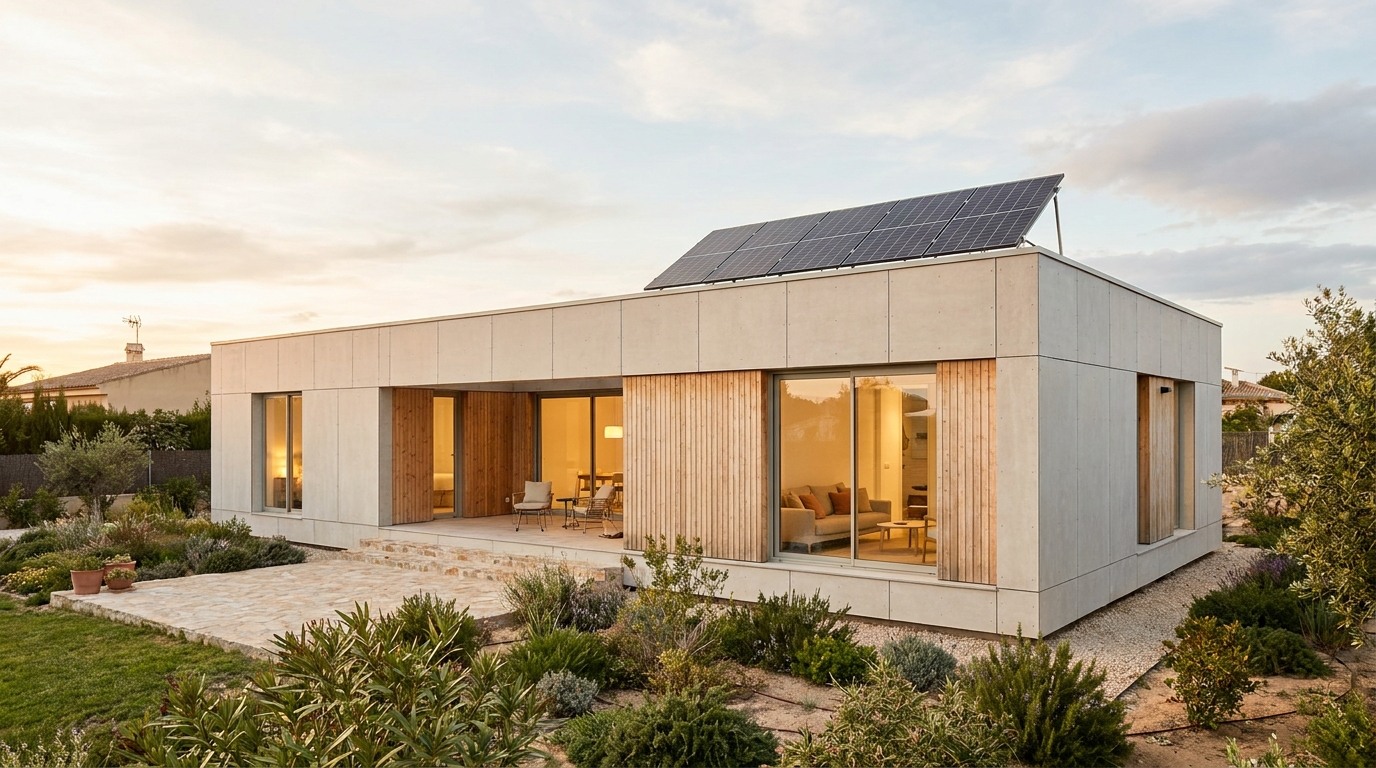
Modular Housing in Spain: 6 Reasons to Choose Industrialized Homes
Start with certainty: why modular housing matters now
Imagine signing a fixed-price contract and moving into a finished home months earlier than a traditional build. That certainty—over cost, schedule and performance—is the core promise of modular housing in Spain. For self-builders, families and developers seeking control and predictability, industrialized construction is no longer an experimental option; it’s a practical strategy.
1. What modular affordability means and why it matters today
Clear definition: industrialized housing in Spain (2026 context)
Modular housing here refers to homes manufactured in a controlled plant environment and assembled on site with high-quality finishes. In Spain, by 2026 this includes systems based on precast concrete panels, light timber framing and steel-frame modules adapted to local climates and regulations.
Cost-time advantages vs traditional construction (concise data)
- Shorter on-site time: plant work runs in parallel with site preparation, cutting total project time by 30–50% in common scenarios.
- Fixed-price potential: clearer scope and factory workflows reduce unknowns that drive change orders.
- Lower finance carrying costs: faster delivery reduces months of interest and interim housing expenses.
Who benefits: profiles of self-builders and families
Primary beneficiaries include:
- First-time self-builders who need cost predictability.
- Families on a tight schedule (e.g., job relocation, school year).
- Investors and small developers prioritising speed to market.
Modular projects convert time savings directly into economic savings: reduced interest, shorter temporary housing and fewer scope disputes.
2. Real savings: total cost and budget predictability
Cost comparison: sample per-m² numbers and recurring items
Below are indicative figures (illustrative, typical mid-market Spain, 2026):
- Turnkey modular: €1,400–€1,900 / m² (includes plant fabrication, transport, on-site assembly, finishes and commissioning).
- Traditional build: €1,600–€2,200 / m² (labour-intensive, variable subcontracts, longer timeline).
- Recurring costs (maintenance, energy): properly specified modular envelopes can reduce energy bills by 20–40% versus older conventional stock.
Fixed price and risk management: how modular avoids overruns
Key mechanisms that enforce predictability:
- Factory-based quality control reduces rework and errors.
- Early definition of scope (BIM or detailed packages) reduces mid-build changes.
- Integrated supply chains and single-point responsibility under a turnkey contract simplify claims and coordination.
Brief case study: measurable savings in a modular project
Example: A 160 m² family home near Valencia delivered as turnkey modular in 2025:
- Contracted price: €240,000 (≈ €1,500 / m²).
- Delivery time: 6 months from contract vs estimated 11 months for traditional build.
- Client-reported final variation: +2.5% (vs common traditional variations of 10–25%).
- Energy performance: estimated 35% lower annual heating/cooling costs after envelope upgrades.
3. Time and logistics: build faster, with fewer surprises
Average project timeline: plot to keys (key milestones)
Typical modular turnkey timeline (indicative):
- Parcel selection & feasibility study: 2–6 weeks.
- Design & permits (detailed design, planning): 8–16 weeks.
- Factory fabrication: 8–12 weeks (runs parallel with permits where feasible).
- Site preparation & foundations: 2–6 weeks.
- Transport & on-site assembly: 1–3 weeks.
- Finishes, commissioning & handover: 2–4 weeks.
Plant fabrication advantage and on-site assembly times
Why the factory matters: weather-independent workflows, repeatable quality checks and bulk procurement yield consistent module delivery windows. On-site assembly becomes a predictable, short phase—minimizing neighbourhood disruption and permit complications.
Impact of shorter schedules on cost and client satisfaction
Shorter schedules reduce financing costs, enable earlier occupancy and improve client satisfaction. In practice, clients report higher perceived value when timelines are respected and communication is consolidated under a single project manager.
4. Modern materials: balancing cost, thermal performance and durability
Main options: precast concrete, light timber frame, steel-frame
- Precast concrete panels: excellent thermal mass, acoustic performance, durability; often chosen in coastal or high-exposure sites.
- Light timber framing (entramado ligero): low embodied carbon, fast fabrication, strong thermal performance with appropriate insulation; highly adaptable to Passivhaus strategies.
- Steel frame (steel frame): high strength-to-weight ratio, long spans and open plans; requires careful detailing to avoid thermal bridges.
Thermal performance and durability vs cost: accessible comparison
When selecting materials, weigh:
- Upfront cost: timber often sits below precast concrete in mid-market builds; steel can be similar to concrete depending on the design.
- Thermal behavior: timber and well-insulated panels deliver excellent U-values with less mass; concrete can stabilize indoor temperatures in Mediterranean climates.
- Maintenance and lifespan: concrete and steel require less routine maintenance; timber needs protective detailing but performs well when specified correctly.
Choosing by climate and budget: practical recommendations
- Hot-summer Mediterranean coastal sites: consider precast concrete or hybrid solutions to exploit thermal mass and night cooling.
- Inland or colder regions: timber frame with high-performance insulation and airtightness simplifies achieving near-Passivhaus standards.
- Constrained budgets: lean timber systems often offer the best cost-performance ratio while enabling high energy efficiency.
5. Sustainability and efficiency: saving now while cutting future carbon
Energy efficiency close to Passivhaus and operational savings
Industrialization enables precise airtightness and consistent insulation details—two pillars of high-performance envelopes. With targeted measures (mechanical ventilation with heat recovery, upgraded glazing, continuous insulation), modular homes can approach Passivhaus-equivalent operational energy even without full certification.
Lower carbon through smarter material choices
Material selection matters:
- Timber systems reduce embodied carbon compared to heavy concrete solutions.
- Local sourcing of finishes and façade materials reduces transport emissions.
- Design for disassembly and repairability increases circularity at end of life.
Medium-to-long term benefits: resale value and maintenance costs
Homes with demonstrable energy performance and lower operating costs command better market prices and sell faster. Additionally, predictable factory-built quality often reduces long-term maintenance budgets.
6. How to finance and execute a turnkey modular project
Financing options: self-build mortgages and alternatives
Financing pathways commonly used in Spain:
- Self-build (autopromoción) mortgages: structured in tranches tied to milestones—verify whether the lender recognises plant-fabrication milestones and final commissioning as triggers.
- Developer-style finance: some modular providers offer integrated financing or partner with lenders to simplify approval.
- Private loans or bridge finance: suitable when speed matters but consider higher rates and short terms.
Turnkey process: concrete steps from parcel search to handover
Follow these practical steps to reduce risk:
- Feasibility and site due diligence: confirm access, utilities, geology and local zoning. A topographical survey and a plot-specific study early on pay off.
- Preliminary design and budget: set a realistic fixed-price target and include site-specific premiums (transport, crane access).
- Permitting: submit a complete set (architectural and structural documents). Ask your modular provider to supply standardised technical documentation to speed approvals.
- Finance approval: secure funds or a committed mortgage before fabrication starts; lenders will ask for a detailed schedule and contract.
- Factory fabrication & site prep: coordinate foundation timings with module delivery windows.
- Assembly, finishes & commissioning: perform final inspections and receive the energy performance certificates and guarantees.
Final checklist for self-builders: permits, timelines, contacts and metrics
Before signing a turnkey contract, confirm:
- Clear fixed price scope with list of excluded items.
- Detailed timeline with penalties or remedies for delays.
- Warranty clauses (structural, envelope, finishes) and who handles claims.
- Energy performance targets (U-values, airtightness, ventilation efficiency) and measurement methods.
- Contact chain: single project manager and escalation path.
Ask for measurable KPIs: final handover date, as-built energy estimates, and acceptable variation limits. These make the contract enforceable and protect your budget.
Practical next steps: how to evaluate providers and make the decision
Five practical evaluation questions
- Can the provider demonstrate recent turnkey deliveries with verifiable timelines?
- Do they deliver assembly and finish standards you can inspect (photos, references, visits)?
- Are energy and airtightness guarantees quantified and third-party testable?
- How do they manage transport and crane logistics for your parcel?
- What is their change-order policy and how are extras priced?
Red flags to watch for
- Vague fixed-price offers without an exhaustive scope.
- No references or inability to share recent client contacts.
- Absence of measurable energy targets or testing protocol.
Checklist for your first meeting with a modular provider
- Bring your plot data, brief, and a realistic budget range.
- Request a sample contract and a draft timeline.
- Clarify what is included: foundations, connections, onsite finishes and landscaping.
- Ask for a breakdown of per-m² pricing, transport allowances and expected variations.
Closing: make predictability the foundation of your build
Modular housing aligns modern materials, factory quality and predictable delivery into a practical path for autopromotores in Spain. If your priorities are cost control, speed and long-term efficiency, industrialized homes offer measurable advantages—provided you choose the right system and contract structure.
Ready to move from uncertainty to a fixed plan? Start by documenting your plot constraints and a simple brief, then request two turnkey quotes that include energy targets and a guaranteed timeline. That comparison will reveal which provider truly delivers the predictability your project needs.
If you want, we can prepare a one-page feasibility checklist for your plot—share its size and location and we’ll draft tailored next steps.
Artículos relacionados