Prefabricated Houses Spain: Affordable Model Guide 2026
Imagine signing a fixed-price contract and moving into a high-performance home in under four months. For many autopromoters in Spain, that scenario is now realistic: affordable prefabricated houses deliver predictable budgets, shorter timelines and strong energy performance—if you choose the right model and manage key risks.
Why consider an affordable prefabricated model in Spain in 2026?
Market momentum and regulation are pushing industrialized housing into the mainstream. Demand for faster delivery, improved energy efficiency (including Passivhaus-compatible builds) and predictable costs has grown since 2020. Developers and small manufacturers now offer affordable prefabricated houses designed specifically for Spanish plots, climates and building codes.
Current market snapshot: trends and demand
- Speed to occupancy: many manufacturers promise 60–120 day assembly windows once the foundations are ready.
- Energy focus: rising interest in low-energy envelopes and systems that allow compliance with nearly zero-energy buildings (nZEB) and Passivhaus principles.
- Price transparency: increased availability of closed-price packages for standard-sized homes reduces negotiation uncertainty.
Who benefits most from affordable prefabricated houses?
- Autopromoters seeking control over design but needing budget certainty.
- Young families prioritizing speed, energy bills and long-term operating costs.
- Investors targeting short delivery cycles and predictable capex for rental supply.
Realistic expectations: timeframes, quality and costs
- Typical total delivery: 6–9 months from project start to handover for turnkey packages (site-dependent).
- Quality tiers: basic economical models to premium modulars; understand which materials and warranties map to each tier.
- Cost examples (indicative): €1,100–€1,500/m² for economical prefabricated turnkey homes; premium modular options rise above €1,800/m².
Data point: A well-managed prefabricated turnkey project reduced on-site workdays by ~60% and delivered final occupancy 3–5 months sooner than a comparable traditional build in a recent Spanish pilot study.
Comparison: affordable prefabricated model vs traditional housing
Total cost and predictability: fixed price and fewer surprises
Prefabricated houses typically offer a clearer baseline price because much of the work is factory-controlled. That reduces risk from weather delays, subcontractor variability and inflation in on-site labor.
Traditional builds often start with lower initial budgets but face higher exposure to change orders, slower procurement and on-site unpredictability—factors that frequently push final costs higher.
- Example numeric comparison (90 m² house):
- Economical prefabricated turnkey package: ~€99,000–€135,000 (including basic finishes).
- Traditional build equivalent: ~€95,000–€160,000, with a higher variance due to on-site issues.
Construction timelines and calendar control
Factory production allows parallel workflows: while site work (foundations, utilities) progresses, modules or panels are produced. This shortens the critical path.
- Prefabricated assembly: on-site fit-out and sealing can be completed in 2–6 weeks after delivery.
- Traditional: structure and weatherproofing alone often take 3–6 months, with longer periods for finishes.
Quality, durability and maintenance: measurable performance
Industrialized production yields consistent quality control. Materials like industrialized concrete panels, timber light-frame with factory-sealed joints, and steel frame systems perform well when detailed properly.
- Thermal performance: factory-installed insulation and airtightness testing deliver stable U-values and lower heating demand.
- Durability: modern prefabricated systems use treated timber, concrete with controlled curing, or galvanized steel to meet long-term standards.
Materials and construction systems for economical models
Industrialized concrete: where it makes sense
Precast concrete panels are ideal for foundations, load-bearing walls and façades. Advantages include robust thermal mass, long lifespan and low maintenance. They can be paired with external insulation to meet energy targets.
Timber light-frame and Passivhaus alignment
Wood frame systems are lightweight, fast to assemble and naturally thermally efficient. When combined with mechanical ventilation with heat recovery (MVHR) and high-performance windows, they reach Passivhaus-level results at lower embodied-energy profiles.
Steel frame (steel frame systems)
Steel framing offers flexibility for open plans and larger spans. It’s fast, dimensionally stable and well-suited to modular panel systems. For economical models, steel is often used in combination with lightweight claddings and factory-installed insulation.
Advantages and disadvantages of choosing an affordable prefabricated model
Key advantages
- Energy efficiency: consistent insulation, airtightness and the option for Passivhaus-level assemblies.
- Short, predictable timelines: factory work reduces on-site exposure to delays.
- Budget control: many suppliers offer closed-price turnkey packages that limit change-order risk.
Limitations and things to watch
- Customization limits: deep customization increases cost; work with standard modules for best value.
- Transport and access: narrow streets or remote plots can add logistics costs and constraints.
- Local permit alignment: some municipal regulations require specific façades or structural approaches—verify compliance early.
How to mitigate common drawbacks
- Negotiate a clear scope with staged approvals so you control variations.
- Choose a supplier with local installation experience to reduce transport surprises.
- Include contractual clauses for airtightness, U-values and delivery timelines with penalties or incentives.
Turnkey process: step-by-step to your prefabricated home
From plot search to permits: essential schedule and documents
- Parcel selection: check urban classification, maximum buildable area and local construction limitations.
- Documentation: land registry extract, urban certificate, topography, connection points for water, sewage and electricity.
- Planning permits: local timelines vary; budget 1–4 months for municipal approvals when documentation is complete.
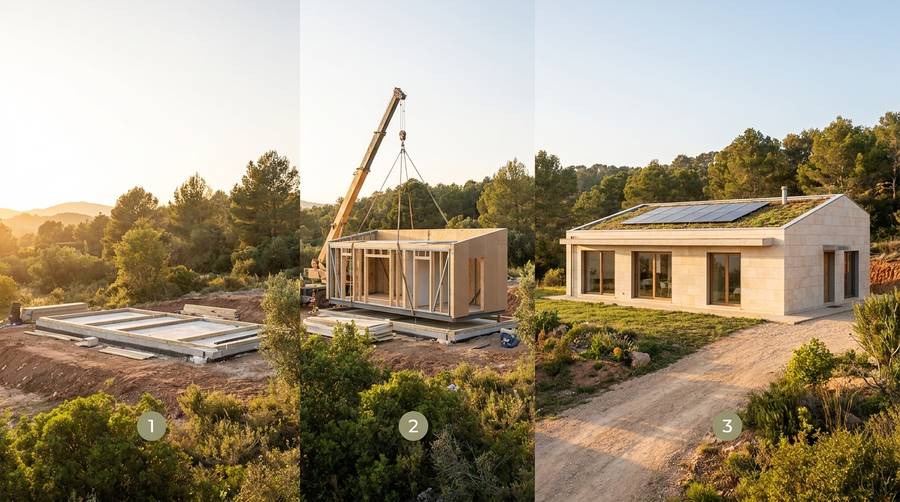
Project, factory production and assembly phases
- Design freeze and technical validation: finalize layout and materials before production begins.
- Factory production: panels, modules or frames produced under controlled conditions (4–12 weeks typical).
- On-site assembly: craning, sealing, connections and systems commissioning (2–8 weeks depending on complexity).
Handover, guarantees and aftercare
- Final checks: airtightness test, thermal imaging, commissioning of HVAC and plumbing.
- Warranties: insist on structural warranty, waterproofing warranty and a minimum one-year general defects period.
- Post-delivery support: agree SLA for responsive maintenance and spare-part availability.
Financing, real costs and a practical autopromoter guide
Mortgage options for autopromotion in Spain
Banks in Spain provide two common routes for self-build: construction mortgages and specific loans for autopromoción. Key criteria banks evaluate:
- Detailed turnkey contract with a licensed manufacturer/contractor.
- Professional plans and certified cost schedule.
- Collateral and borrower equity—lenders often expect a down payment of 20–30%.
Example budgets and case study summary
Study case: 90 m² affordable prefabricated house, Mediterranean climate, turnkey package.
- Total turnkey cost: €115,000 (including standard finishes, kitchen and bathrooms).
- Timeline: 7 months total, with factory production 8 weeks and on-site assembly 3 weeks.
- Client satisfaction: post-occupancy survey showed high scores for thermal comfort and project transparency; annual energy consumption dropped ~45% versus comparable traditional build.
Practical checklist before signing a contract
- Confirm fixed scope and price or clear variation rules.
- Request independent airtightness and energy performance targets in the contract.
- Verify the supplier’s local assembly experience and references.
- Ensure clear warranty terms and after-sales response times.
Real cases and lessons for undecided autopromoters
Case study 1: economical home in 90 days
A family in Valencia delivered a 75 m² turnkey prefabricated house in 90 days after permits were granted. Key metrics:
- Budget adherence: within 2% of contract value due to clear scope.
- Energy: heating demand reduced by 50% against similar masonry home.
- Subjective outcome: homeowners rated communication and predictability as top strengths.
Case study 2: adapting to municipal rules
In a coastal municipality with strict façade rules, a steel-frame modular solution adjusted cladding and eaves to comply without changing structural costs significantly. Lesson: early engagement with planning authorities avoids redesign delays.
Practical conclusions to help you decide
- If you need speed, cost predictability and improved energy performance, an affordable prefabricated house is a strong option.
- If your project demands heavy bespoke elements or has complex site constraints, weigh customization costs carefully.
- Secure financing with a clear turnkey contract and insist on measurable performance obligations.
Bottom line: Prefabricated, affordable models balance speed and efficiency—but success depends on early planning, supplier selection and contractual clarity.
Ready to take the next step? Start by listing your plot constraints, target square meters and a realistic budget range. Share these with two prefabricated suppliers to compare closed-price offers and delivery timelines. That comparison will reveal whether an affordable prefabricated house is the faster, greener and more predictable route to your new home in Spain.
Artículos relacionados