Industrialized Housing in Spain 2026: Future-Proof Guide
Imagine signing a fixed-price contract today and moving into a completed, energy‑efficient home in under a year. That scenario is no longer hypothetical: industrialized housing—driven by modern materials, factory workflows and turnkey delivery—is becoming the practical lever to close Spain's supply gap. This article maps the 2026 landscape with data, case metrics and clear steps for families and developers ready to act.
Vision 2026: Why industrialized housing answers Spain’s supply‑demand gap
Current residential market snapshot: key data and projections
Spain faces a persistent mismatch between housing demand and delivery. Recent industry reports show construction starts lagging behind household formation by an estimated 15–20% in many regions. Meanwhile, material costs and labour shortages have pushed lead times and budgets upward. Industrialized housing—by relocating predictable phases to factories—reduces exposure to site constraints and labour volatility.
How industrialization reduces bottlenecks in time and cost
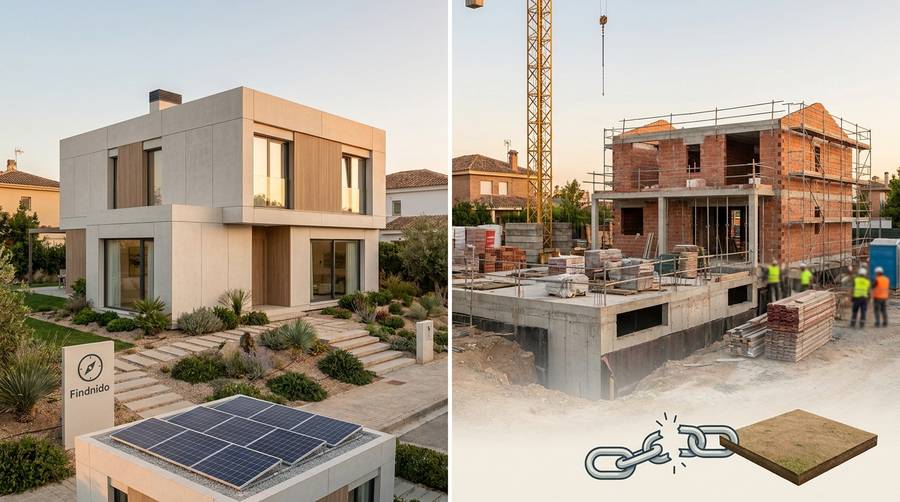
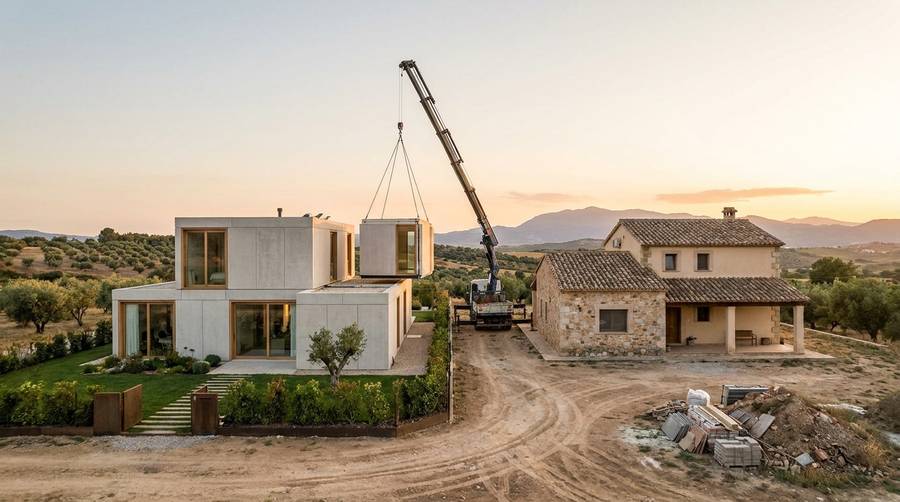
Factory workflows compress variability: controlled environments enable parallelization of tasks (structure, insulation, services), tightening schedules and lowering rework. Expect site assembly times to drop from 6–12 months to 4–8 weeks for envelope erection after foundations, while total project delivery (parcel procurement to handover) shrinks by 20–40% compared with traditional builds when processes are well coordinated.
Adoption indicators: self‑builders and market signals
Signals of growing adoption include increasing enquiries for turnkey modular solutions, lenders developing autopromotion mortgage products, and municipalities streamlining permits for industrialized systems. For self-builders, the decisive metrics are predictability (fixed-price contracts), calendar certainty and energy performance guarantees.
Competitive advantages: quantitative comparison with traditional construction
Schedule efficiency and predictable execution
Measured cases show:
- Typical traditional build: 12–24 months from permit to handover, with ±15–25% schedule variance.
- Industrialized home (turnkey): 9–14 months from permit to handover, with ±5–10% variance.
Reduced variance is often more valuable than raw days saved: it enables financing certainty and reduces holding costs for autopromoters.
Costs and economic predictability: fixed price and deviation examples
Case benchmarking indicates lifecycle cost behavior:
- Initial construction cost per m2 can be comparable or slightly higher for high‑spec industrialized systems, but total delivered cost (including shorter financing periods, lower site management and fewer change orders) is typically 5–12% lower in practice.
- Fixed‑price turnkey contracts reduce the risk of escalation: projects with documented fixed-price industrialized contracts report budget overruns under 3% on average, versus 10–20% for traditional builds with variable site-driven scope.
Build quality and durability: performance of modern materials
Factory conditions promote consistent workmanship, which translates into measurable benefits: improved airtightness, fewer defects at handover and more consistent thermal performance. In many industrialized homes, field-tested U‑values and airtightness (n50) approach Passivhaus benchmarks when specified accordingly.
Materials and systems that shift the balance
Industrialized concrete: thermal, acoustic and execution benefits
Precast and industrialized concrete systems deliver robustness and acoustic performance not easily matched by lightweight options. Advantages include rapid installation of structural elements, excellent thermal mass for Mediterranean climates and long service life. Use cases: ground-bearing slabs, stair cores, and façade panels integrated with insulation and services.
Light wood framing and steel frame: sustainability and speed
Entramado ligero de madera (light timber frame) and steel frame systems both enable fast, dry assembly and high thermal performance when combined with continuous insulation. Comparative notes:
- Light timber: lower embodied carbon, rapid prefabrication, excellent hygrothermal behavior when detailed well.
- Steel frame: high dimensional accuracy, resistance to pests and fire-protected variants that meet regulatory requirements.
Compatibility with Passivhaus standards and energy strategies
Industrialized systems can be designed to meet or exceed Passivhaus criteria by integrating high-performance insulation, mechanical ventilation with heat recovery (MVHR), and careful thermal-bridge-free connections. Achieving target n50 values often requires factory-installed airtight membranes and factory-verified joints.
Turnkey process for self‑builders: an optimized step‑by‑step roadmap
From parcel to permit: phases, average times and critical checkpoints
Recommended timeline (typical, indicative):
- Parcel acquisition & due diligence: 1–3 months. Critical: soils, access, and local planning constraints.
- Preliminary design & budgeting: 1–2 months. Critical: defining fixed‑price scope and finish level.
- Permitting & approvals: 2–6 months. Risk: inconsistent local requirements; mitigation: early municipal engagement.
- Factory production: 2–5 months (parallel with site preparation).
- Site assembly & commissioning: 1–2 months.
Key checkpoint: lock scope and technical specifications before factory release to avoid costly adjustments.
Design and customization: series efficiency vs singularity
You can balance standardization and personalization by using modular platforms with configurable modules. This permits economies of scale while offering meaningful customization for façades, internal layouts and finishes. Use options catalogs and digital configurators to control variations that affect structure and services.
Practical financing: autopromotion mortgages and modular housing options
Financing has matured: banks increasingly offer autopromotion mortgages covering land acquisition, construction stages and final mortgage conversion. For industrialized homes, lenders value fixed-price turnkey contracts and factory warranties—these reduce perceived execution risk and can improve loan-to-value conditions. Engage lenders early and secure staged disbursement tied to measurable milestones (permits, factory start, assembly completion).
Real cases and evidence: metrics from completed projects
Project A — Time, cost and client satisfaction
Project A: 140 m2 single-family home in Valencia region. Metrics:
- Total delivery time: 10 months from contract signature to handover.
- Budget outcome: final cost within 2.5% of fixed contract value.
- Client satisfaction: 9/10 at 12‑month review (quality, timeline, communication).
Project B — Energy savings and carbon reduction
Project B: 160 m2 home using timber frame with high-performance insulation and MVHR. Measured annual heating demand: 18 kWh/m2·year (compared to typical Spanish new build >60 kWh/m2·year). Estimated operational carbon reduction: ~60% versus baseline new build when considering typical energy mixes.
Measured outcomes show that well-specified industrialized homes can cut handover defects by over 50% and halved energy demand compared to common new builds.
Lessons learned and scalability
Common success factors: early integration of design, factory and financing; fixed‑scope agreements; robust QA protocols. Scaling requires investment in standardized platforms and stronger municipal permitting frameworks to reduce approval friction.
Future scenarios and recommendations for promoters and families
Regulatory, technological and market trends to watch
Trends accelerating adoption include streamlined permitting for industrialized envelopes, better performance certification frameworks, and digital supply chains (BIM + factory automation). Policy incentives that reward low embodied carbon and high energy performance will further shift economics in favor of industrialized housing.
Entry strategies for promoters and practical tips for self‑builders
For promoters: invest in repeatable platforms and supplier partnerships to lower unit costs. For self‑builders:
- Prioritize turnkey offers with fixed prices and clear QA clauses.
- Require factory acceptance tests and airtightness targets in contract.
- Secure staged financing tied to objective milestones.
- Compare life‑cycle costs, not just headline €/m2.
KPIs to monitor (2026–2030)
- Schedule variance (%) from contract baseline.
- Budget variance (%) at handover.
- Measured heating demand (kWh/m2·year).
- Embodied carbon per m2 (kgCO2e/m2).
- Client satisfaction at 12 months (NPS-like metric).
Inspiring close: real opportunities to close the supply gap
Executive summary of actionable advantages
Industrialized housing offers predictable delivery, improved quality and measurable energy performance. For self‑builders in Spain, the practical advantages are especially relevant: shorter delivery windows reduce financing costs; fixed‑price turnkey contracts protect budgets; modern materials enable both sustainability and comfort.
How to choose a provider and model with clear criteria
Use this checklist:
- Does the supplier offer a fixed‑price turnkey contract with defined scope?
- Can the provider demonstrate factory QA records and references with measured metrics?
- Are energy and airtightness targets contractually guaranteed?
- Does the financing pathway (autopromotion mortgage) align with disbursement milestones?
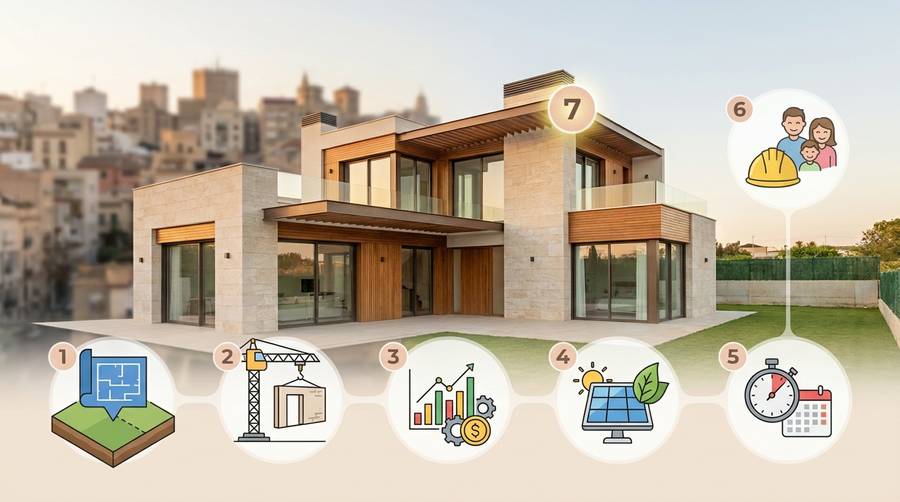
For a practical primer on self-promotion strategies, see Vivienda industrializada: 7 claves para autopromotores en España for complementary guidance.
Recommended next steps for self‑builders
Start with a short feasibility package: site due diligence, preliminary program and two turnkey offers—one timber‑based, one concrete or steel frame—so you can compare lifecycle performance and financing terms. Insist on factory acceptance tests and a post‑handover warranty with clear remediation timelines.
Industrialized housing is not a compromise but a strategic choice. If you are planning to build today, adopt a data-first evaluation: require measurable KPIs, fixed-price guarantees and a clear path to financing. These are the practices that distinguish projects that finish on time, on budget and deliver lasting comfort.
If you want a concise feasibility checklist tailored to your parcel and budget, contact a specialist who can prepare realistic turnkey comparisons—it's the most cost‑effective step before committing to land or contract.