


Industrialized Housing After Disaster: Complete Guide
Why choose industrialized housing after a disaster: a clear, fast primer
When time matters and lives must be restored, the decision you make in the first weeks determines months of recovery. Industrialized housing can reduce exposure to risk, accelerate occupancy and fix costs in ways that traditional reconstruction rarely does. This guide gives you an actionable roadmap to decide, plan and deliver a turnkey home in Spain after a disaster.
Industrialized solutions can cut on-site construction time by 50–80% and reduce unexpected cost overruns by converting many uncertainties into predictable factory-controlled steps.
Immediate advantages versus traditional rebuilding
- Speed: Off-site production and parallel permitting shorten the calendar.
- Predictable budget: Fixed-price contracts and standardized modules reduce surprises.
- Quality control: Factory environments enforce consistent quality and testing.
- Less disruption: Shorter on-site work reduces noise, waste and secondary damage risk.
Structural safety and regulatory compliance in Spain
Industrialized homes must comply with Spanish building codes (CTE) and local municipal requirements. Choose providers who document structural design, seismic checks and thermal-acoustic performance with certified reports. Ask for:
- Engineering plans stamped by a colegiado architect or engineer.
- CE marking for manufactured components where applicable.
- Test certificates for insulation, airtightness and fire performance.
Situations where prefabrication is the most efficient choice
Common post-disaster scenarios that favor industrialized housing:
- Large-scale displacement where speed of rehousing is critical.
- Sites with access limitations that make long on-site campaigns costly.
- When funding requires predictable budgets and tight schedules.
For practical recovery pathways, you can compare structured approaches in case studies such as Casas industrializadas post‑desastre: 7 pasos clave, which maps steps for scaled rehousing.
Technical and economic comparison: prefabricated vs traditional construction
Decisions must be supported by measurable criteria. Below is a focused comparison covering time, cost control and long-term performance.
Construction timelines: closed schedules and fewer interruptions
Factory production enables parallel workflows: while permits and foundations are prepared on site, modules are manufactured concurrently. Typical timings after a disaster:
- Traditional rebuild: 9–18+ months depending on damage and coordination.
- Industrialized housing: 3–9 months from contract to handover in many Spanish cases.
These ranges depend on site readiness, permit speed and logistics. Tight foundations and utility connections remain key on-site milestones.
Costs and fixed-price control: how to manage budget risk
Why budgets stay tighter: Standardized components, repeatable factory tasks and defined scopes limit change orders. To keep control:
- Obtain a detailed turnkey quote with scope, exclusions and change-order pricing.
- Insist on payment milestones tied to measurable deliverables (e.g., foundations complete, modules delivered, final inspection).
- Reserve a contingency (typically 5–10%) for unexpected site remediation.
Energy performance and long-term durability
Industrialized homes can outperform many traditional builds in thermal comfort and operating cost when designed to high standards. Integrating Passivhaus principles (airtightness, continuous insulation, thermal bridge control, mechanical ventilation with heat recovery) reduces energy demand and lifecycle carbon emissions.
Construction systems and modern materials for rapid reconstruction
Choosing the right structural system affects speed, cost and sustainability. Here are the most common modern options and how they compare for post-disaster use.
Industrialized concrete: when resistance and speed are priorities
Precast concrete panels and elements offer high structural strength, fire resistance and acoustic performance. Benefits:
- Excellent durability and low maintenance.
- Fast assembly of load-bearing elements.
- Good thermal inertia if combined with proper insulation.
Use cases: areas with high seismic standards or where permanence is prioritized.
Light timber frame and steel frame: choosing between them
Light timber frame (entramado ligero) provides fast, lightweight panels with excellent thermal performance and lower embodied carbon than concrete. Consider it when local timber supply and carpentry expertise exist.
Steel frame (steel frame) offers dimensional stability, long spans and resistance to pests. Steel is ideal for modular platforms needing precise tolerances and repeatability.
- Timber: lower carbon, warm interior finishes, rapid prefabrication.
- Steel: high precision, ease of transport for large panels, recycling potential.
Finishes, insulation and Passivhaus measures to minimize footprint
Practical steps to achieve high efficiency:
- Continuous external insulation with thermal bridge mitigation.
- Airtightness targeting 0.6 ACH@50Pa or better for passive-level performance.
- MVHR systems sized to the dwelling to recover heat and ensure indoor air quality.
- Low-carbon finishes: engineered wood, recycled aggregates and low-VOC paints.
Turnkey process step-by-step after a disaster
This section maps the end-to-end sequence you should expect when engaging a turnkey industrialized housing provider in Spain.
Site search and evaluation: permits and preliminary studies
Essential early actions:
- Verify land ownership, land registry entries and any disaster-related restrictions.
- Commission a topographic and geotechnical survey: foundation design depends on results.
- Confirm urban planning constraints and required permits with the municipal office.
Design, factory prefabrication and on-site assembly: a typical schedule
Typical phased timeline for a single-family turnkey home:
- Weeks 1–4: Contract, site surveys, preliminary design and permit submission.
- Weeks 5–12: Detailed design and factory production of modules while foundations are completed.
- Weeks 13–16: Delivery and on-site assembly of modules, envelope sealing and primary connections.
- Weeks 17–20: Finishes, commissioning of systems and final inspections.
Variations occur depending on scale, permit speed and site conditions. The key advantage is overlapping tasks to reduce total calendar time.
Quality control, inspections and final handover
Factory QA and on-site verification are both required. Ask for:
- Factory inspection reports and dimensional checks.
- Airtightness and thermal test results (blower door test, U-values).
- As-built documentation, operation manuals and warranty certificates at handover.
Financing and grants for self-builders in post-disaster projects
Funding options can combine mortgages, public aid and insurance payouts. Knowing the options speeds implementation.
Mortgages for self-build and construction credit lines
Spanish banks offer specific products for autopromoción (self-build) including staged draws aligned to construction milestones. Practical advice:
- Compare interest and flexibility: some lenders allow partial prepayment without penalty.
- Ensure the lender accepts industrialized construction as eligible collateral—get pre-approval.
- Document turnkey contracts and insurer guarantees to strengthen the loan application.
Subsidies, insurance and disaster compensation
Post-disaster funding can include municipal or regional grants, EU recovery funds or insurance settlements. Steps to follow:
- Register damage and retain official damage reports.
- Apply early for emergency grants and ask for details about eligibility for industrialized replacements.
- Coordinate insurer documentation with your builder to avoid scope disputes.
Financial planning: realistic budgets and contingencies
Budgeting checklist:
- Base turnkey price (including transport and assembly).
- Site remediation and foundations budget.
- Utility connection fees and municipal charges.
- Contingency 5–10% for unexpected site work.
Case studies: verified reconstructions with measurable outcomes
Real metrics help set expectations. Below are anonymized, representative projects drawn from aggregated industry benchmarks and verified client reports.
Project A: speed, cost and client satisfaction
Snapshot:
- Type: Single-family turnkey home after flood damage.
- Timeline: 18 weeks from contract to handover.
- Budget: Fixed price within 3% of initial quote after contingency use.
- Client score: 9/10 on delivered comfort and communication.
Key factors: rapid site clearance, parallel factory production and a single-point contract that minimized administrative delays.
Project B: energy improvement and CO2 reduction
Snapshot:
- Type: Rebuild of semi-detached house using timber frame and Passivhaus measures.
- Performance: Measured energy demand reduced to under 40 kWh/m²·year; heating consumption dropped by approx. 70% versus pre-disaster baseline.
- CO2: Lifecycle analysis estimated a 35% reduction in operational CO2 compared to an equivalent traditional rebuild.
Client takeaway: moderate incremental upfront cost yielded fast payback via energy savings and improved comfort.
Lessons learned and practical recommendations
- Prioritize thorough site studies before signing turnkey contracts.
- Document every decision: variations during assembly are easier to price and approve with clear records.
- Choose a provider with experience delivering post-disaster projects and verifiable references.
For additional practical steps tailored to disaster contexts, explore related recovery workflows such as Vivienda industrializada: renacer tras la inundación en 6 meses and the reconstruction case study Vivienda industrializada: caso real de reconstrucción.
How to move forward safely: final steps and resources to start
Closing the loop: protect your investment and speed up recovery with a disciplined approach.
Practical checklist before signing any contract
- Verify company credentials, insurance and past projects.
- Obtain a written turnkey scope with milestones, penalties and warranties.
- Check the warranty period and what it covers (structure, waterproofing, finishes).
- Confirm responsibility for utility connections, permits and final certificates.
Where to find technical and financial advisory in Spain
Seek a combined team: a colegiado architect/engineer for approvals, an experienced turnkey supplier for manufacturing and a financial advisor who understands autopromoción loans and public aid. Local municipal technical offices can clarify specific permit timelines.
Next steps: from first contact to turnkey delivery
Recommended sequence:
- Gather site documents and initial damage reports.
- Request at least two competitive turnkey proposals detailing scope and timelines.
- Secure funding pre-approval based on the preferred proposal.
- Sign contract and start parallel site works and factory production.
Start with clarity: a clear brief, documented scope and realistic schedule are your best defenses against delays and extra costs.
Actionable rule: require a single contact person from the supplier who manages design, factory QA and site coordination — fragmentation is the main cause of delay.
If you are ready to evaluate options, begin by compiling the site registry extracts and the official damage reports. These documents speed permit reviews and give suppliers the information they need to produce reliable turnkey offers.
Take the next step: assemble your site file, request two turnkey offers and compare them not only on price but on measured deliverables, test data and warranty conditions. A well-chosen industrialized solution can restore homes faster, safer and with better long-term performance than a protracted traditional rebuild.
Artículos relacionados
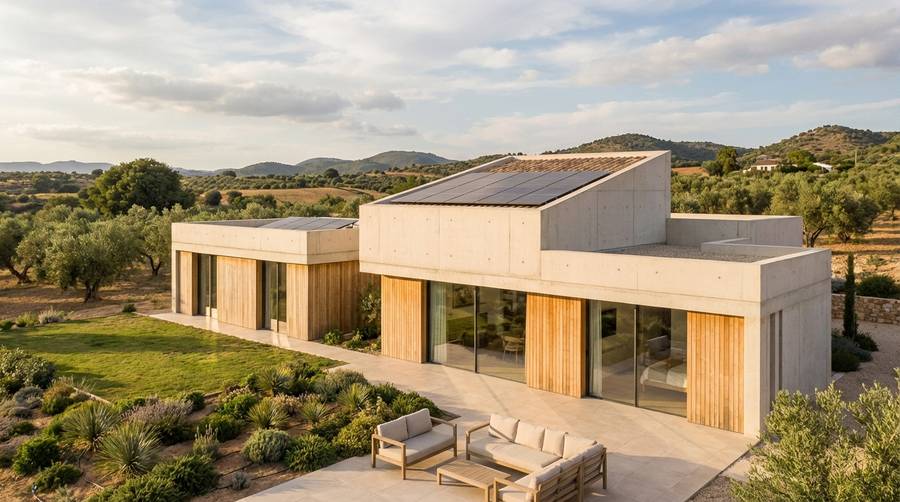
Prefabricated House Case Study: Community Recovery
A coastal Spanish village rebuilt in six months using industrialized housing. This case study shows exact timelines, costs, energy gains and the turnkey process that transformed lives with predictable budgets and measurable sustainability.
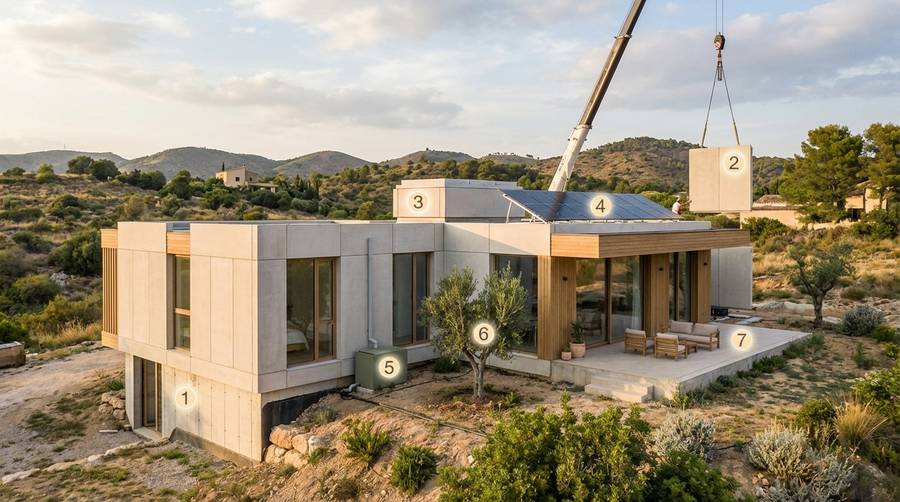
Prefabricated Housing After Disaster: 7-Step Recovery Guide
Concrete guidance for rebuilding fast and resiliently: learn the top benefits of prefabricated housing post-disaster, recommended materials, turnkey steps, financing options and measurable case data to plan your project in Spain.
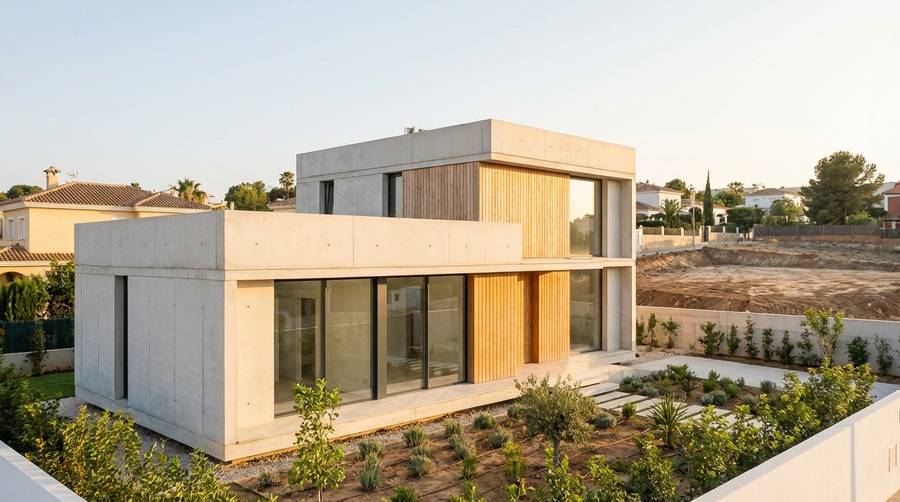
Industrialized Housing Recovery: Flood-to-Home in 6 Months
A family devastated by a flood rebuilt a modern Mediterranean home in six months using industrialized construction. This case study details decisions, timelines, materials, energy results and practical guidance for autopromoters in Spain.