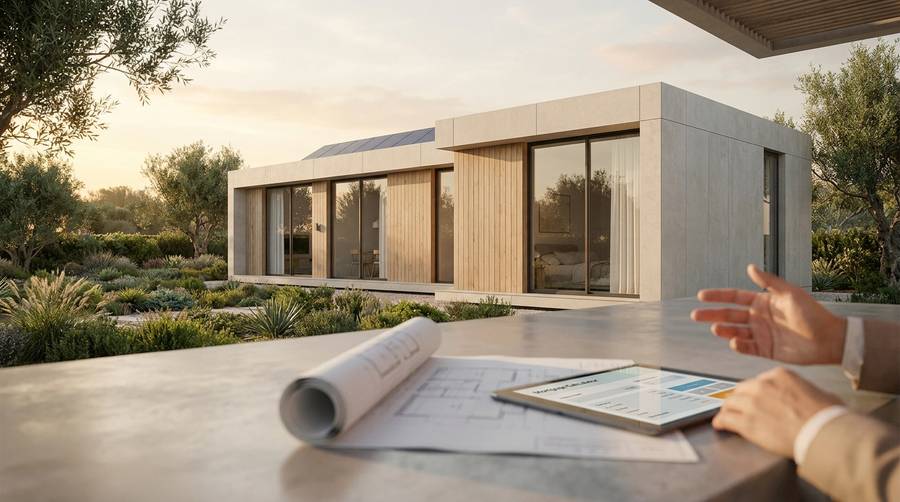
Modular Home Mortgage: Common Errors and Fixes
Why financing a modular home is different (and what usually fails)
When María signed the preliminary contract, she believed the bank understood 'modular' meant faster delivery and a fixed price. A month later, her mortgage was stalled because the submission lacked the right technical details. This scenario repeats with alarming frequency among self-builders in Spain.
Financing an industrialized or modular home combines elements of construction lending, mortgage underwriting and energy performance valuation. If you treat the application like a standard home mortgage, you risk delays, higher costs or outright rejection. Below I list the common pitfalls and the fixes that actually work in practice.
Key modular advantages that affect mortgage underwriting
- Fixed-price contracts and shorter delivery windows: banks can view these as lower risk if documented properly.
- Factory-controlled quality: improves build predictability, reducing cost-overrun risk in theory.
- Better energy performance: Passivhaus-level designs increase valuation upside when evidenced by certificates.
Typical failures from not knowing the 'turnkey' process
- Submitting incomplete milestone schedules that don’t match the lender’s drawdown triggers.
- Confusing project phases: banks need clarity on factory production, site assembly and final commissioning.
- Missing guarantees on delivery or penalties for delays in the contract.
Practical consequences of misaligned mortgage requests
- Lowered loan-to-value (LTV) or higher margin to cover perceived risk.
- Requests for additional collateral or personal guarantees.
- Longer approval times and repeated document requests that raise costs and stress.
Incomplete or poorly presented documentation: the single most common failure
Missing paperwork is the fastest way to a stalled mortgage. Lenders evaluate construction risk and borrower capability from documents. Presenting a clear, consistent dossier is non-negotiable.
Essential papers for self-build mortgages in Spain (2026)
- Certified preliminary project (proyecto básico) and execution project (proyecto de ejecución) when required.
- Builder/factory contract with fixed price, delivery schedule and penalties.
- Technical report listing industrialized materials (e.g., precast concrete, light timber frame, steel frame).
- Energy performance documents or passivhaus/efficiency certifications, if available.
- Land deed or purchase promise and evidence of planning permission or communications with the local town hall.
- Detailed phased budget (itemised), including site works and utility connections.
How to prove project, budgets and phases (factory phase vs on-site delivery)
- Use separate documents for factory production and on-site assembly. Label them clearly: Factory manufacturing schedule and Site installation & commissioning plan.
- Provide production certificates or factory QA records showing components manufactured and acceptance tests passed.
- Map payment milestones to physical deliverables (e.g., 30% on contract signature, 40% on factory completion, 30% on final commissioning).
Practical solutions: downloadable checklist and real examples
- Create a one-page executive summary that aggregates the key facts: price, timelines, milestones, guarantees and energy rating.
- Attach an annex with signed samples of factory QA, technical datasheets for exterior envelope and a photographic timeline of previous projects.
- Offer the bank contact details for the factory project manager and a written escalation path for delays.
Submitting a concise, phase-mapped dossier reduces lender queries by up to 60% in our case reviews—turning weeks of delays into days.
Underestimating the true budget: contingencies and hidden costs
Most buyers focus on the factory price and forget the rest. The cost of land preparation, utility connections, local taxes and finishes can add 15–30% to the headline figure.
Frequent estimation errors: land, connections and premium finishes
- Assuming land is ready: many plots require retaining walls, drainage, or soil stabilization.
- Utility hookups (water, sewage, electricity, gas) often have municipal fees and distance-based trenching costs.
- Upgrading to high-end finishes or bespoke façades can escalate costs quickly—budget separately for 'upgrades'.
How to calculate contingency margins and adjust the mortgage
- Include a minimum contingency of 10% for standard projects; use 15–20% for complex sites or high-end finishes.
- Prepare an itemised risk register: list each risk, probability, and estimated impact. Use that to justify a higher loan amount or flexible drawdowns.
- Where possible, secure a separate small line of credit for contingencies rather than inflating the mortgage—which may carry different terms.
Case study: closed-price contract versus real deviations
Example: A 150,000€ factory package with 60,000€ site works and 20,000€ finishes. Unexpected drainage and neighbor-required boundary works added 22,000€ (12% of total). With a 10% contingency the owner still needed a short-term top-up. Solutions include negotiating a staged contingency release with the bank or using a short-term construction bridge loan.
Choosing the wrong financing route: construction loans, bridge loans and final mortgages
The right product mix matters. Not all lenders have experience with modular delivery models. Mixing products without alignment on triggers and amortisation can create legal and cashflow hassles.
Differences between construction loan, bridge credit and final mortgage
- Construction loan (préstamo para obra): disbursed in tranches against milestones; usually higher interest during construction.
- Bridge loan (crédito puente): short-term cover between land purchase and long-term financing—useful if timing is tight.
- Final mortgage: long-term amortising loan after completion and final certification.
Common mistakes when combining products and how to avoid them
- Failing to synchronise the end date of the bridge with the start of the construction loan—this leaves a coverage gap.
- Using a mortgage lender that refuses to accept factory certificates for the conversion from construction loan to mortgage.
- Not checking whether the lender demands a new valuation after assembly or accepts an agreed completion certificate.
Resolutive recommendation: optimal route for self-builders
Preferred path for many autopromoters: secure a construction loan tied to detailed milestones, with an agreed automatic conversion to the final mortgage upon delivery and final habitability certificate. This reduces refinancing risk. Where conversion is not automatic, negotiate a commitment letter for the final mortgage conditional on documentary completion.
Failing to negotiate modular-specific terms
Generic mortgage contracts overlook modular specifics. You should proactively request clauses that reflect the product strengths of industrialized housing.
Clauses to adapt (guarantee, valuation, disbursement by milestones)
- Allow factory QA reports as acceptable evidence for disbursement.
- Agree on a valuation methodology that recognises energy efficiency and fixed-price contracts.
- Define acceptable substitute guarantees—performance bonds or insurance-backed warranties can replace personal avales in some agreements.
How to sell the bank on your advantage: time and price certainty
- Present comparative metrics: average construction time, documented delivery penalties and factory QA pass rates.
- Use energy certifications (or simulation reports) to justify a higher valuation or more favourable terms.
- Request fee reductions or lower margins tied to documented delivery performance—offer to share the project risk transparently.
Practical tips for negotiating fees and interest
- Bring two equivalent financing offers to the table—banks often match competitive terms.
- Request phased interest calculation aligned to the drawdowns, not a blanket construction rate.
- Negotiate an early repayment clause without heavy penalties for switching to a better long-term rate.
Technical project issues that block approval
Banks reject dossiers on technical grounds more often than on borrower credit. Avoid common documentation gaps that invalidate valuations.
Project errors that kill valuations (technical memos, material specs)
- Lack of a materials schedule that clarifies durability, U-values and acoustic performance.
- Missing structural reports for site-specific loads (foundations, wind, seismic where relevant).
- Inconsistent drawings between the factory and site plans.
How to document energy compliance to add value
- Include energy simulation outputs or third-party Passivhaus consultation notes when applicable.
- Provide evidence of expected energy costs and reduced maintenance—banks appreciate quantifiable savings.
- Attach certification plans (and timelines) for the final energy label or passive house certificate.
Solutions: coordinate engineers, certifications and success stories
- Use a single coordination lead (project manager or technical director) who compiles a consistent dossier for the bank.
- Obtain a brief third-party technical review with a signed technical opinion summarising compliance—this short document carries weight with underwriters.
- Attach a one-page case study of a similar completed project with metrics: delivery time, final costs, and client satisfaction.
Decision and handover: closing without surprises
The last mile determines client satisfaction. Delivering on time is only useful if the final paperwork satisfies both the bank and the client.
Final checklist before receiving a turnkey home
- Final habitability certificate (cédula de habitabilidad or equivalent) in place.
- Completion certificate signed by the project manager and factory QA sign-off.
- Updated valuations for the bank, with photographic evidence of finished work.
- Insurance and guarantees active (decennial or equivalent depending on the contract).
Managing warranties, insurances and final certifications for the bank
- Provide copies of builder warranties, manufacturer warranties for systems (HVAC, windows) and a clear claims process.
- Confirm that the bank accepts the warranties and the habitability certificate for mortgage conversion.
- Maintain an accessible folder (digital and printed) with all final paperwork for the lender and the homeowner.
Steps to avoid claims and secure client satisfaction
- Run a formal snagging process with the client present and sign-off on a punch list before final payment.
- Holdback a small retention linked to the completion of the punch list, agreed upfront with the bank if possible.
- Offer a short onboarding session to explain maintenance, warranties and energy systems to the homeowner.
Practical conclusion: a quick action plan to avoid these errors
Before you apply, follow these seven decisive steps.
Seven must-do steps before requesting the mortgage
- Assemble a one-page executive summary of the project with clear milestones.
- Prepare a detailed, itemised budget including 15% contingency and a risk register.
- Obtain factory QA documents and a production schedule labelled separately from site works.
- Secure a technical coordinator to provide a single-point dossier for the lender.
- Negotiate milestone-based disbursements and an automatic conversion commitment where possible.
- Document energy performance or Passivhaus steps to increase valuation weight.
- Plan the handover with a signed snagging list, warranties and insurance documents ready for the bank.
Resources that save time
- Downloadable checklist templates: executive summary, phased budgets and snag lists (adapt to your project).
- Use comparative case studies showing time-to-delivery and final cost variance—these help persuade underwriters.
- When in doubt, consult specialised advisers who have closed modular mortgages; they fast-track approvals.
How to prepare your file with professional support
If you want a fast review of your dossier, prepare the executive summary and contact a technical coordinator who will validate the bank-ready packet. If mortgage specifics worry you, read our detailed guide on Hipoteca vivienda modular: errores y soluciones for legal pitfalls and remedies.
Take action: start by compiling the one-page executive summary and the phased budget. These two documents alone will reduce bank queries and speed approvals. If you prefer, engage a project coordinator to compile the full dossier and negotiate the bank terms on your behalf—saving weeks and avoiding common legal traps.