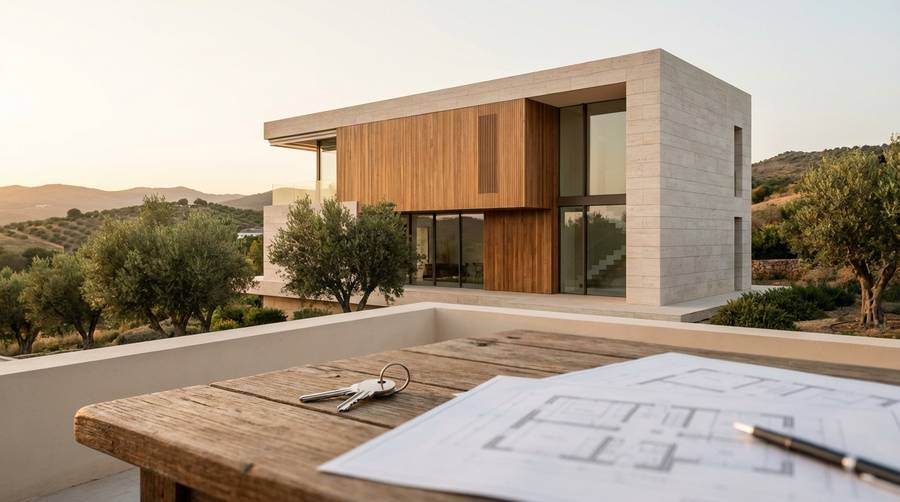
Industrialized Housing in Spain 2026: Top 6 Insights
Imagine signing a fixed-price contract and moving into a finished, energy-efficient home in under nine months — with monthly surprises replaced by predictable milestones. That reality is what industrialized housing now offers in Spain, and this guide explains exactly how to assess, plan and finance one.
1. Quick guide to industrialized housing in Spain 2026
What makes industrialized housing different from traditional construction?
Industrialized housing shifts major production stages from the building site to a controlled factory environment. Instead of workers assembling bricks and blocks on-site for months, components or entire modules are manufactured under quality-controlled conditions, then transported and assembled on your plot.
Core distinctions
- Factory production: predictable timelines, repeatable quality checks.
- On-site assembly: shorter, safer site work window.
- Integrated systems: mechanical, electrical and finishes coordinated in production.
Key advantages: time, fixed price and quality control
Three strengths stand out for self-developers:
- Reliable lead times: production schedules in factories reduce weather and subcontractor variability.
- Cost transparency: fixed-price proposals are common because factory processes reduce unknowns.
- Repeatable quality: factory QA, calibrated tooling and standardized details reduce rework.
Initial decisions: plot, local rules and energy requirements
- Plot suitability: check access for transport and crane operations, slope, soil bearing and local services.
- Regulation: confirm municipal parameters (occupancy, height, envelope ratios) early to avoid redesigns.
- Energy targets: define target (e.g., near-Passivhaus) at concept stage — it affects wall build-ups, glazing and ventilation strategy.
2. Five reasons a prefabricated house can outperform traditional builds
1) Faster, more predictable schedules
Typical result: foundation and site works completed while the home is built in the factory; on-site assembly often takes weeks, not months. In practice, many 120–150 m² homes reach enclosure in 2–6 weeks of on-site assembly.
2) Cost control and fewer surprises
Fixed-price contracting and preconfigured product ranges reduce scope creep. Expect lower incidence of change orders that commonly inflate traditional builds by 10–25%.
3) Higher quality through industrial processes
Controlled environments ensure consistent material conditions and inspections. Modern systems—industrialized concrete panels, light timber frame and steel frame—offer precise tolerances and repeatable thermal performance.
4) Healthier, safer sites
Shorter on-site time minimizes dust, noise and risk exposure. This is especially relevant for residential neighbourhoods where disruption matters.
5) Better integration for energy efficiency
Factory assembly enables tighter joints, optimized insulation layers and preinstalled ventilation systems, easing the path to high-performance certifications.
3. How to evaluate sustainability and energy efficiency (Passivhaus and beyond)
Ask for measurable indicators — not promises. A credible industrialized home proposal includes estimated annual heating demand (kWh/m²·year), airtightness targets (n50), and primary energy consumption.
Key indicators to request
- Estimated seasonal energy demand: heating and cooling kWh/m²·year.
- Airtightness (n50): target test result (e.g., <1.0 h‑1 for high-performance homes).
- Primary energy and carbon footprint: operational and embodied estimates.
- Certifications: whether the design aims for Passivhaus, EnerPHit, NZEB or other compliance.
Materials and passive design strategies
Choose materials and details that align with your sustainability goals:
- Industrialized concrete: high thermal mass, robust finishes; specify low‑carbon mixes where possible.
- Light timber frame: low embodied carbon, rapid assembly, effective when combined with mechanical ventilation with heat recovery (MVHR).
- Steel frame: precise geometry and long spans; manage thermal bridges with thermal breaks and insulation strategy.
Practical metrics from case studies
Examples from recent Spanish projects illustrate performance ranges:
- A 140 m² timber-framed home delivered as turnkey: measured heating demand 22 kWh/m²·year, airtightness n50=0.6, annual energy bill reduced ~65% vs conventional build.
- Steel-frame 180 m² home with high-efficiency glazing: delivered in 8 months total; operational energy cost savings ~50% and embodied carbon 20% lower than comparable cast-in-place concrete alternative.
Design choices that prioritize airtightness, balanced ventilation and continuous insulation typically deliver the largest operational savings — far beyond cosmetic upgrades.
4. The 'turnkey' process: step-by-step for self-developers
Step 1 — Plot search and feasibility
- Verify access for module transport and crane lift.
- Order a topographic survey and geotechnical report; these define foundation type and cost.
- Check local urban rules and utility connections.
Step 2 — Permits and approvals
Work with a promoter or architect familiar with modular approvals. Early engagement reduces comments and resubmissions. Expect 2–6 months for municipal planning procedures, depending on the location.
Step 3 — Design and factory engineering
- Finalize layouts, façades and specifications.
- Factory engineering translates those decisions into buildable modules and production sequences.
Step 4 — Site preparation and parallel fabrication
Foundations and services are executed while the factory builds the modules. This parallelism is the main time-saver.
Step 5 — Transport, assembly and finishes
Modules arrive and are craned into position; weatherproofing, connections and finishes are completed on-site. Typical on-site assembly spans weeks, not months.
Step 6 — Handover and aftercare
- Comprehensive commissioning: HVAC balancing, airtightness testing and electrical verification.
- Warranty and post-sale support: ask for response SLAs and a clear list of covered items.
5. Financing and mortgages for self-build and modular homes
Financing an industrialized home in Spain follows similar rules to traditional self-build, but lenders expect clearer schedules and production contracts.
Types of financing to consider
- Self-build mortgage: staged amortisation tied to progress certificates.
- Construction loan: short-term credit converted to a mortgage after completion.
- Developer-backed financing: some modular providers partner with lenders to ease approval.
What banks want to see
- Fixed-price turnkey contract with delivery timeline.
- Factory production plan and guarantees for defects and completion.
- Detailed budget: foundation, transport, assembly, IVA and contingency.
- Evidence of plot ownership or reservation and necessary permits.
If you already started a mortgage application, consult practical tips in Errores en hipotecas y elección de vivienda industrializada to avoid common pitfalls.
Alternatives and public support
Investigate regional grants for energy-efficient homes and national subsidies targeting low-carbon construction. Combining program incentives with a factory-built approach can improve affordability.
6. Real cases and a final checklist to decide with confidence
Short case studies with concrete metrics
-
Case A — Mediterranean timber-frame home (140 m²)
- Total delivery time: 9 months (incl. permits)
- On-site assembly: 3 weeks
- Final cost: within 2% of initial turnkey quote
- Performance: 22 kWh/m²·year heating need; occupant satisfaction 9/10 after 12 months
-
Case B — Steel-frame suburban home (180 m²)
- Total delivery time: 10 months
- On-site assembly: 4 weeks
- Cost: 8% lower than comparable traditional estimate when factoring avoided overruns
- Performance: Estimated 45% lower annual energy cost vs conventional build
Practical checklist before committing
- Transport feasibility: confirm route and crane access.
- Fixed-price clarity: verify what’s included (landscaping, connections, taxes).
- Performance guarantees: require airtightness and thermal estimates in the contract.
- Warranty and SLAs: ask for response times and coverage details for the first 2–10 years.
- Finance alignment: ensure your lender accepts factory contracts and staged payments.
Next steps to start with confidence
Begin with a feasibility pack: site survey, quick cost estimate and a timeline from a modular provider. Compare at least two systems (concrete panel, timber frame and steel frame) using the same brief to isolate differences in performance and price.
Deciding on industrialized housing is less about choosing a trend and more about matching process reliability, measurable energy performance and clear finance to your project priorities. If you want, we can help you assemble a feasibility pack and compare turnkey proposals side by side — practical, metric-driven and focused on what matters.
Ready to evaluate your plot and get a realistic turnkey proposal? Contact an expert to convert your goals into a delivery plan that fits your budget and timeline.