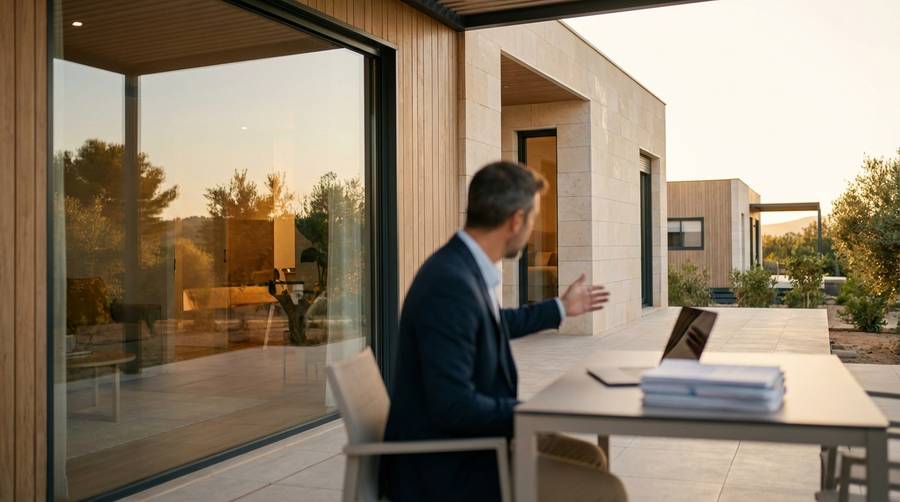
Industrialized Housing in Spain: 6 Reasons to Build Now
1) Why building industrialized housing in Spain pays off today
They told María her plot would take three years to build. Instead she moved in after 10 months. That speed is not luck — it is the predictable outcome of industrialized processes, off-site production and a fixed-cost approach that many traditional builds cannot match. If you want control over time, budget and environmental performance, industrialized housing is a strategic choice.
Advantages vs traditional construction: efficiency, timelines and fixed price
- Faster delivery: Factory production and parallel site preparation commonly reduce total calendar time by 30–60% compared with on-site builds.
- Predictable budgets: Fixed-price contracts for modular packages minimize cost escalation from weather delays or subcontractor shortages.
- Less on-site disruption: Shorter assembly windows reduce logistics, waste and neighborhood impact.
- Higher quality control: Components manufactured in controlled environments have fewer defects and tighter tolerances.
Impact on sustainability and energy efficiency (e.g., Passivhaus standards)
Industrialized housing enables consistent insulation, airtightness and thermal bridge control — the three pillars of high-performance envelopes. Achieving a Passivhaus-level result is easier when panels and modules are produced to spec in factory settings. This translates into lower operational energy, reduced carbon over the building’s life, and measurable comfort gains for occupants.
Buildings constructed with industrialized methods can reduce embodied CO₂ by up to 20% and operational energy by 60–90% when paired with Passivhaus strategies.
Profile of the ideal self-builder
The typical autopromotor who benefits most: a family or investor seeking time certainty, fixed budgets, high energy performance and a modern architectural result without the hassle of repeated site decisions. If you value transparency, schedule control and a strong warranty, industrialized housing is likely a better fit than a conventional build.
2) Modern materials and systems that make the difference
Choosing the right structural system determines long-term performance, cost and maintenance. Below are the materials most used in Spanish industrialized homes, with clear trade-offs.
Precast and industrialized concrete: durability and quality control
Benefits: excellent thermal mass, fire resistance and low maintenance. Factory-cast concrete elements arrive with high dimensional accuracy, reducing on-site rework.
Typical uses: load-bearing panels, basement walls, stair cores and façades where a premium, durable finish is desired.
Light timber framing and steel frame: insulation and speed
Timber frame: high thermal performance, light weight and good carbon profile when sourced sustainably. Ideal for Mediterranean climates when paired with proper moisture control.
Steel frame (steel frame): extremely fast to assemble, precise, and compatible with large spans. Requires attention to thermal bridging and protection against corrosion.
Short technical comparison: thermal performance, cost and maintenance
- Thermal performance: Timber and insulated steel panels typically outperform basic concrete in initial U-values, but concrete’s thermal mass can benefit comfort in mixed climates.
- Cost: Timber and steel modular systems often reduce labor costs and schedule risk; precast concrete can be more expensive upfront but lower maintenance long-term.
- Maintenance: Concrete and properly treated timber have predictable maintenance cycles; steel needs finishes and detail work to avoid long-term corrosion risks.
3) Five financing and mortgage options for modular self-builders
Financing a modular build is feasible and increasingly familiar to Spanish lenders. The right product depends on whether you already own the land and on the delivery model (turnkey, shell only, or phased completion).
Traditional mortgage vs self-build mortgage: core differences
Traditional mortgage: granted on completed properties; not suitable for financing construction phases.
Self-build (autopromoción) mortgage: disburses in stages tied to construction milestones, often requires technical oversight and additional guarantees but funds works in progress.
Specific products and mechanisms for modular housing
- Stage-disbursement self-build loans: Funds are released after verification of factory production and on-site assembly milestones.
- Bridge loans for plot purchase: Short-term finance to secure land while the construction loan is arranged.
- Green mortgages or eco-premium products: Some lenders offer better rates if the home meets energy performance standards such as Passivhaus.
- Developer or manufacturer-backed financing: Manufacturers sometimes partner with lenders to offer combined packages that simplify paperwork.
- Public aid and subsidies: Regional programs in Spain occasionally provide grants or favorable loans for energy-efficient new builds.
Tips to negotiate terms and prepare documentation
- Prepare a clear cashflow plan with milestone dates and expected invoices from the manufacturer.
- Secure detailed specs and warranties from the producer to present to the bank.
- Work with a broker experienced in autopromoción mortgages to compare staged disbursement terms.
- Ask about rate discounts for energy targets and include projected energy savings in your affordability model.
4) The turnkey process: clear steps from plot to handover
Turnkey (llave en mano) modular projects succeed when each phase is defined, timed and assigned ownership. Below is a realistic timetable and the decision points you must control.
Plot search and validation: urban rules and feasibility
Start with a technical viability check: land use classification, buildability ratio, road access, utilities and potential restrictions. A quick survey and a certified urban planning report save costly surprises.
Design, permits and factory production: estimated phase times
- Concept & schematic design: 4–8 weeks.
- Construction documents & permits: 8–16 weeks (can vary by municipality).
- Factory production: 8–20 weeks depending on system and customization.
These phases can run in parallel: while permits are processed, foundations and site works can be prepared so modules fit immediately upon arrival.
Assembly, finishes and handover: quality control and guarantee
On-site assembly commonly requires 2–6 weeks for modular envelope installation, followed by finishes and inspections. A robust quality-control checklist should include airtightness testing, thermal imaging and a documented commissioning procedure. Insist on a clear warranty and post-delivery support for systems and finishes.
5) Real case studies: measured metrics on time, cost and satisfaction
Below are concise, anonymized accounts based on real project archetypes to show the differences in outcomes and decisions that matter.
Case 1 — Coastal family home: timeline, final cost and lessons
Project: 140 m² single-family home on a coastal plot. System: mixed timber frame with precast concrete base.
- Timeline: 3 months site prep + 4 months factory & assembly = 7 months total.
- Final cost: Within 4% of the original fixed-price contract (including permits and connections).
- User feedback: High satisfaction with thermal comfort and quick delivery; minor finish adjustments resolved under warranty.
- Lesson: Early site preparation parallel to design reduced calendar time significantly.
Case 2 — Passivhaus-certified house: energy performance and annual savings
Project: 120 m² two-storey Passivhaus using timber frame panels and high-performance glazing.
- Construction time: 10 months from contract to handover.
- Energy performance: Average heating demand <10 kWh/m²·year; measured annual electricity reduction ~75% vs regional average homes.
- Savings: Estimated annual energy bills reduced by €900–1,200.
- Lesson: Investment in envelope and mechanical ventilation reduced long-term operating costs and increased occupant comfort.
Comparative lessons: what reduces risk and overruns
- Clear scope and fixed-price contracts reduce financial surprises.
- Parallel work streams (site and factory) shorten the schedule.
- Choose manufacturers with documented QA processes and field references.
6) How to start today: a practical checklist for self-builders
Take action with a focused plan that preserves optionality while progressing decisions.
Immediate steps
- Obtain a plot viability report and confirm utilities and access.
- Request preliminary budgets from two modular manufacturers based on a simple brief.
- Secure financing pre-approval or speak with a broker about staged self-build mortgages.
Recommended team
- Architect familiar with industrialized systems who can translate your brief into modular layouts.
- Experienced manufacturer with proven deliveries and warranty terms.
- Broker or bank contact who understands autopromoción financing.
Common mistakes to avoid and useful resources
- Avoid vague contracts; demand clear milestones and acceptance criteria.
- Don’t skip airtightness and commissioning checks — they determine real comfort and energy use.
- Use templates for milestone-driven payments and retention clauses.
For a list of early risk signals and practical mitigation techniques, see Vivienda industrializada: errores comunes y soluciones.
Final thoughts and next steps
Industrialized housing in Spain is no longer an experimental niche; it is a mature alternative that delivers speed, budget certainty and measurable sustainability when approached with discipline. If you are planning a self-build, prioritize a clear scope, verified manufacturer quality and staged financing that aligns with factory production and on-site milestones.
Next step: compile your plot data and request two preliminary turnkey quotes. That comparative process alone will clarify timelines, costs and the design compromises that matter.
If you want a checklist or help evaluating two manufacturer proposals, contact a broker or technical advisor experienced in modular autopromoción — it’s the fastest way to move from idea to keys in hand.