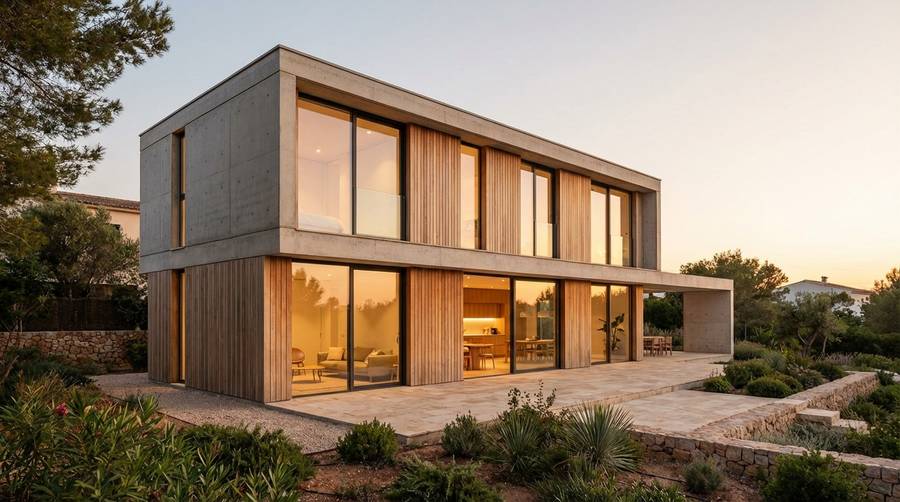
Prefabricated House: Two-Storey Family Success Story
From dream to reality: a family chooses a prefabricated house
The day they walked the plot, María and Javier knew the decision would shape their next decade: schools, commuting, and a home that would age with the family. They also wanted predictability—no endless surprises or stretching budgets. Within 18 months they moved into a finished, two-storey prefabricated house built under a turnkey model. This is how they did it, what worked, and the measurable outcomes other self-builders can replicate.
"We wanted a house that felt permanent, efficient and beautiful — but with a fixed budget and timelines we could trust." — María, homeowner
Initial situation: needs, plot and family goals
The family had a suburban plot near Valencia, 450 m², gentle slope, good solar exposure to the south and access to utilities. Their brief was clear: two floors, three bedrooms, an open-plan ground floor that connects to the garden, and low operational costs consistent with Passivhaus principles. They were prepared to be involved but not to manage dozens of contractors.
Why they rejected traditional construction
Traditional builds offered flexibility but introduced two main risks: variable costs and uncontrollable schedules. María and Javier had heard of neighbours with extended sites and hidden cost increases. They prioritized a model that offered:
- Cost certainty — a fixed price contract aligned with a clear scope.
- Predictable timeline — short on-site installation to minimize weather delays.
- High energy performance — modern envelope and mechanical systems to lower lifetime costs.
The challenge: designing a bespoke two-storey prefabricated home
Plot constraints, local regulations and municipal coordination
The plot’s gentle slope required a retaining wall and small adjustments to the foundation interface. Local zoning limited buildable footprint and maximum height, which fitted a two-storey solution but required early coordination with the town hall to confirm setbacks and stormwater rules. Having the design team handle permits accelerated approvals by converting municipal conditions into actionable constraints within the technical project.
Client priorities: space, energy efficiency and Mediterranean style
The family wanted a house that felt both modern and rooted in the Mediterranean: light façades, natural wood accents, stone details and large windows that open to terraces. They also demanded low energy use: high-performance insulation, airtightness target, and mechanical ventilation with heat recovery.
Choosing a structural system: concrete, timber frame or steel frame?
The technical evaluation compared three industrialized systems:
- Industrialized concrete: high thermal mass, robustness, and excellent acoustic performance. Prefabricated elements reduced site time but increased transport and crane coordination complexity.
- Light timber frame (entramado ligero): excellent thermal performance, rapid assembly, lighter foundations and a warm aesthetic aligned with Mediterranean wood accents.
- Steel frame: precision, long clear spans and industrial repeatability, but potentially less thermal inertia and higher detailing cost for thermal bridges.
For this project, the design team prioritized energy performance, speed, and a warm interior feel; they recommended a hybrid approach: a timber frame primary structure with prefabricated concrete plinth elements for ground-level acoustic and moisture control. That choice balanced indoor comfort, speed of assembly and a Mediterranean look.
Findnido solution: turnkey process and technical choices
Design phase and bioclimatic strategies
The project started with a concise bioclimatic brief: orient main living spaces to the south, minimize large west-facing glazing, use shading devices for summer, and design thermal mass into ground-level floors. Key actions:
- High-performance windows with low-e glass and thermal breaks.
- Continuous external insulation (ETICS or prefabricated insulated panels) to avoid thermal bridges.
- Compact plan to reduce envelope surface-to-volume ratio.
These measures were modelled early with a simple energy simulation to project heating and cooling loads and ensure the project could reach near-Passivhaus performance without extreme measures.
Materials and systems: why timber frame plus concrete plinth
The hybrid system was chosen for these advantages:
- Speed: prefabricated timber panels and floor cassettes reduced on-site assembly to less than three weeks for the superstructure.
- Comfort: timber provides a warm internal environment; concrete plinth smooths acoustic performance for street noise.
- Sustainability: responsibly sourced timber and reduced on-site waste improved embodied carbon metrics versus a fully traditional build.
Mechanical systems were sized conservatively: a balanced ventilation with heat recovery (MVHR), a compact heat pump for domestic hot water and heating support, and photovoltaic panels sized to cover a significant portion of annual electricity demand.
Coordination of schedule and logistics to minimize site time
Key schedule decisions:
- Design-for-manufacture: detailed design finalized before manufacturing to reduce changes during fabrication.
- Just-in-time deliveries: panels and modules arrived in two commercial truck loads timed to the crane and foundation completion.
- Two-week assembly window: structural assembly and weatherproofing completed quickly to allow interior trades to follow indoors.
These choices minimized on-site exposure to weather and reduced nuisance for neighbours. The turnkey model meant the client had a single contractual partner responsible for the sequence from permit to handover.
Real results: time, costs and satisfaction metrics
Total time from project start to handover
Measured from contract signature to keys in hand, the timeline was:
- Design and permits: 4 months
- Manufacturing of panels and prefabricated elements: 6 weeks
- On-site assembly and finishes: 4 months
Total: 9–10 months. By contrast, similar projects built conventionally in the region averaged 14–20 months with higher variability.
Fixed cost and key breakdown
The contract provided a closed price. Principal cost components were:
- Design, permits and project management: 12%
- Manufacturing and materials (timber panels, concrete plinth): 45%
- On-site assembly and finishes: 28%
- MEP systems, PV and commissioning: 15%
Compared to a conventional build, the prefabricated route delivered predictability rather than large nominal savings. For María and Javier, the main financial benefit was lower contingency risk and known cashflow needs.
Satisfaction, energy use and lived experience
Six months after occupancy, monitoring showed:
- Heating demand consistent with sub-50 kWh/m²·year in mild Mediterranean climate with efficient ventilation and good airtightness.
- Electricity generation from rooftop PV covered roughly 35–45% of annual household electricity, depending on usage patterns.
- High occupant satisfaction: easy maintenance, thermal comfort year-round and acoustic benefits noticed by the family.
The family reported that faster delivery reduced life disruption and allowed financial planning with the certainty of a fixed final cost.
Practical guide: design and finance a two-storey prefabricated home in Spain (2026)
Essential steps in a turnkey process
Follow a concise roadmap to reduce delays and maximize outcomes:
- Site assessment: check orientation, access, and utilities. Confirm local planning rules.
- Program and budget: define spaces, performance targets and absolute budget ceilings.
- Design for manufacture: finalize designs to allow prefabrication without late changes.
- Permits and approvals: submit a coordinated technical package; engage the manufacturer early for technical details they must certify.
- Manufacture and logistics: reserve production slot and coordinate transport with site readiness.
- Site assembly and commissioning: sequence interior trades after the building is weathertight to speed finishes.
- Handover and documentation: request operation manuals, warranties and energy certificates.
Financing options and mortgages for self-builders in Spain
Financing a prefabricated house combines elements of a mortgage and a construction loan. Practical advice:
- Seek a lender experienced with prefabricated or modular housing; some banks offer specific products for self-builders.
- Use a staged drawdown linked to milestones: land purchase, manufacturing start, on-site assembly, and handover.
- Document the turnkey contract and fixed price to reduce lender risk and potentially improve mortgage conditions.
- Consider government or regional grants for energy-efficiency upgrades (check local 2026 programmes for retrofits and new builds).
Tips to optimize energy performance from the outset
- Prioritize orientation and shading before selecting window sizes.
- Invest in airtightness detailing and continuous insulation; small investments here yield large operational savings.
- Size PV and heat-pump systems based on realistic simulated loads, not optimistic assumptions.
- Choose materials with lower embodied carbon when feasible (FSC-certified timber, recycled insulation, low-carbon concrete mixes).
Lessons learned and final advice for future self-builders
Common mistakes and how to avoid them
Frequent pitfalls include:
- Late design changes after production starts — avoid by locking a design-freeze milestone tied to procurement.
- Vague contracts that don’t define tolerances and finishes — insist on clear specifications and samples.
- Underestimating site preparation (access, crane pads, temporary works) — plan logistics early with the manufacturer.
Choosing a supplier: warranties and certifications
Select a partner who can provide:
- Traceable material certificates and supply-chain documentation.
- Performance guarantees for airtightness, waterproofing and structural elements.
- Clear warranty periods for structural and finishing components.
Long-term view: maintenance, resale value and carbon reduction
Prefabricated houses constructed with quality materials and good detailing age well and can outperform conventional builds in resale because of known performance, warranties and lower operational costs. Plan routine maintenance (sealants, roof checks, ventilation filters) and document all handover materials to preserve value.
Measured outcomes — faster delivery, cost predictability and lower energy use — are the reasons many Spanish self-builders now choose industrialized housing.
If you are considering a two-storey prefabricated house: start with a realistic budget, confirm your plot constraints, and choose a turnkey partner who can translate design ambitions into a fixed-price, time-bound delivery. The right process delivers not only a house, but certainty and peace of mind.
Ready to explore options for your plot and budget? Contact an industrialized housing specialist to request an early feasibility review and a comparative schedule and cost estimate tailored to your site.