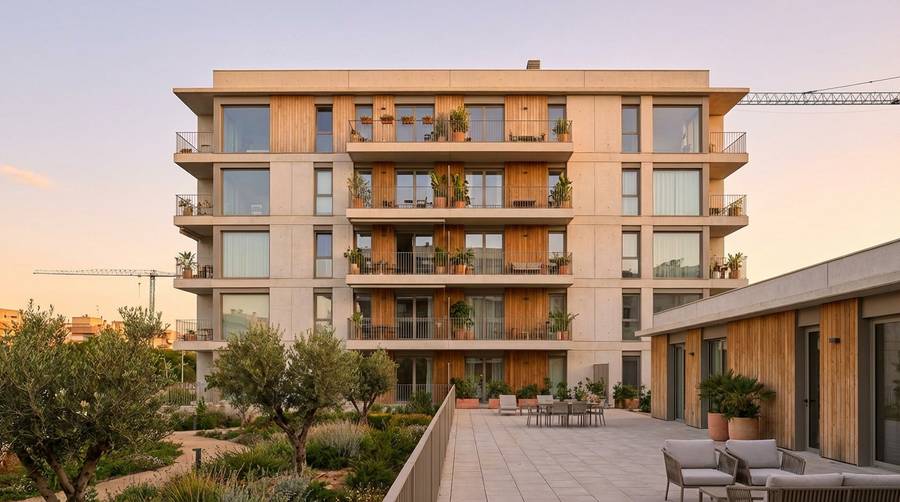
Modular High-Rise Buildings in Spain: Complete 2026 Guide
Modular high-rise buildings in Spain: what to expect in 2026
Imagine cutting construction time in half while delivering homes that meet Passivhaus goals and a fixed final cost. That is the practical promise of modular high-rise construction when planned and executed with industrial discipline. This guide walks autopromoters, developers and project teams through the entire journey—from plot appraisal to handing keys—offering actionable checklists, real metrics and design rules that work in Spain's regulatory and climate context.
Modular projects can reduce on-site time by 40–60% and lower construction-related carbon by up to 30% when combined with optimized materials and energy design.
Who should read this
This guide is written for three audiences:
- Autopromoters looking to build multi-family homes or small apartment blocks using industrialized methods.
- Developers evaluating modular as a strategy to compress schedules and improve cost certainty.
- Technical teams (architects, structural engineers, energy consultants) needing a practical roadmap for design-for-manufacture and assembly.
Why choose modular high-rise: benefits and key decision criteria
Time efficiency and off-site manufacturing
Manufacturing modules in plant environments removes major weather risk and enables parallel workflows. While foundations proceed on site, modules are produced in controlled conditions—this typically reduces total project duration by 40–60% compared with conventional builds. For multi-storey residential projects this time saving translates into faster cashflow and lower financing costs.
Industrial quality and fixed-price certainty
Controlled production lines enable repeatable quality. Standardized modules facilitate tighter cost control and transparent pricing models—often delivered as a fixed-price package that reduces the typical variance seen in stick-built projects.
Selection criteria: when modular makes sense
- Project scale: medium-rise apartment buildings (4–12 storeys) maximize factory economies.
- Site access and logistics: suitable for crane access, stageable deliveries and urban conditions.
- Regulatory alignment: local planning norms for façade, height, setbacks and seismic design must match modular dimensions.
Modern materials and systems for modular high-rise
Industrialized concrete: structure and durability
Precast concrete and hybrid concrete modules provide high structural capacity and fire performance for taller modular buildings. Use precast cores and floor slabs where vertical stiffness and robustness are priorities. Advantages include reduced on-site concrete curing time and well-known long-term durability.
Light timber framing and mixed systems
Entramado ligero de madera (light timber framing) is ideal for internal partitions, infill modules and mid-rise apartments where thermal performance and embodied carbon reduction are objectives. Combining timber infill with concrete cores balances sustainability with structural needs.
Steel frame and hybrid assemblies
Steel frame modules deliver speed of assembly and long-span options. Hybrid solutions—steel frames with timber or concrete panels—allow optimization for weight, thermal performance and buildability.
Design and project steps for a modular high-rise
Phase 0: plot analysis, regulations and program definition
- Site constraints: orientation, topography, access for lorries and tower cranes, noise limits and shadowing.
- Normative review: verify local land-use rules, fire egress and structural codes; obtain pre-application feedback from the municipality.
- Program basics: unit mix, gross floor area, parking and shared amenities—define module typologies early.
Technical project and industrial coordination
Design-for-manufacture is not an afterthought. Coordinate architecture, structure and MEP to match factory capabilities:
- Standardize module grid and connections.
- Define service risers and junction boxes for fast on-site hooking.
- Agree transport and lifting coordinates with logistics partners.
Modular optimization and accessibility
Design units to be efficient in production and comfortable in use. Prioritize natural light, cross-ventilation and acoustic separation. Ensure universal accessibility through integrated lift cores and ramp strategies compatible with modular stacking.
Turnkey process: from feasibility to occupied building
Operational stages and expected durations
Typical phased timetable for a 6–8 storey residential modular building (indicative):
- Feasibility & approvals: 3–6 months
- Technical design & factory coordination: 3–5 months (overlaps with final approvals)
- Foundation and base works: 1–2 months
- Module manufacturing: 2–4 months
- Transport and assembly: 2–6 weeks
- On-site finishes & commissioning: 1–2 months
With parallel workflows the total calendar time is commonly 40–60% shorter than traditional sequences.
Quality control, tests and energy certifications
Factory QA/QC processes should include dimensional checks, pre-assembly testing of mechanical systems and airtightness pre-tests. For energy targets like Passivhaus:
- Set a target airtightness and verify in-factory where possible.
- Use thermal bridge-free detailing at module joints.
- Plan on-site commissioning for renewables, ventilation and heating systems.
Supply chain and reliable schedules
Secure long-lead items early (windows, lifts, MEP skids). Build contractual milestones that align factory output with transport slots and crane availability. Include weather-contingent clauses for site groundwork only.
Financing and economic considerations for autopromoters
Financing options
Autopromotion financing in Spain can combine:
- Self-equity plus a construction loan structured for phased disbursements.
- Specialized industrialized housing loans—lenders increasingly acknowledge fixed-price modular contracts as lower risk.
- Bridge financing or investor equity for land acquisition.
Cost models and savings
Evaluate costs at module level. Modular benefits include reduced site overheads and shorter interest periods. Examples from recent projects show on-site labor costs falling by up to 50% and overall construction cost volatility reduced thanks to closed-shop factory pricing.
Guarantees and insurance
Key protections to require in contracts:
- Factory production warranty covering materials and assemblies.
- Transport insurance and lifting risk coverage.
- Defects liability and post-delivery warranty for systems and finishes.
Case studies and technical comparisons
Real project: 48-unit modular residential building — measured results
Summary metrics from a recent Spanish mid-rise modular project (representative figures):
- Total timeline: 12 months from permit to occupancy (traditional estimate: 20–26 months)
- Factory production: 10 weeks for full module run
- On-site assembly: 4 weeks
- Cost variance vs traditional: ±5% lower overall, with lower exposure to material price swings
- Occupant satisfaction (post-occupancy survey): 88% satisfied with acoustic comfort and thermal performance
Technical comparison: modular vs conventional
- Energy performance: Modular buildings with airtight detailing and mechanical ventilation show equal or better energy use intensity compared to traditional builds when combined with good insulation and heat recovery.
- Carbon footprint: Hybrid timber-concrete approaches reduce embodied carbon; selecting low-carbon concrete and timber elements optimizes the balance.
- Maintenance: Factory-applied finishes increase initial durability and reduce early maintenance cycles.
Practical checklist to decide
Use this decision checklist before committing:
- Is the project scale suitable for standardized modules?
- Are logistics and crane access feasible on your site?
- Does local regulation allow modular assemblies and prefabricated façade systems?
- Have you sourced a factory partner with experience in multi-storey projects?
- Is your financing structured to reward shorter delivery and fixed price certainty?
How to start your modular high-rise project with confidence
First practical steps
- Commission a fast feasibility study that covers zoning, massing and a high-level cost/time estimate.
- Engage a modular-experienced technical team—architects and engineers familiar with factory interfaces.
- Request factory visits and sample modules to validate finishes and build quality.
Questions to ask your suppliers
- What are your standard module dimensions and lifting points?
- How do you guarantee airtightness and thermal continuity at joints?
- Can you provide references for multi-storey projects and measured performance data?
Resources and next milestones
Set three immediate milestones: feasibility completion (4–6 weeks), partner selection (6–8 weeks) and permit submission (as soon as technical packages are ready). These milestones keep momentum and reduce the risk of scope drift.
Taking the first step matters. Modular high-rise buildings are a practical route to faster delivery, better quality and improved sustainability when you pair clear program definition with a reliable factory partner. If you are planning a project, start with a focused feasibility study that quantifies time, cost and carbon implications specific to your site. A short study will show whether modular is the strategic choice for your project and identify the critical path to delivery.
If you’d like, we can help you define that feasibility study tailored to your plot and program—reach out to set a review and get a practical next-step plan.