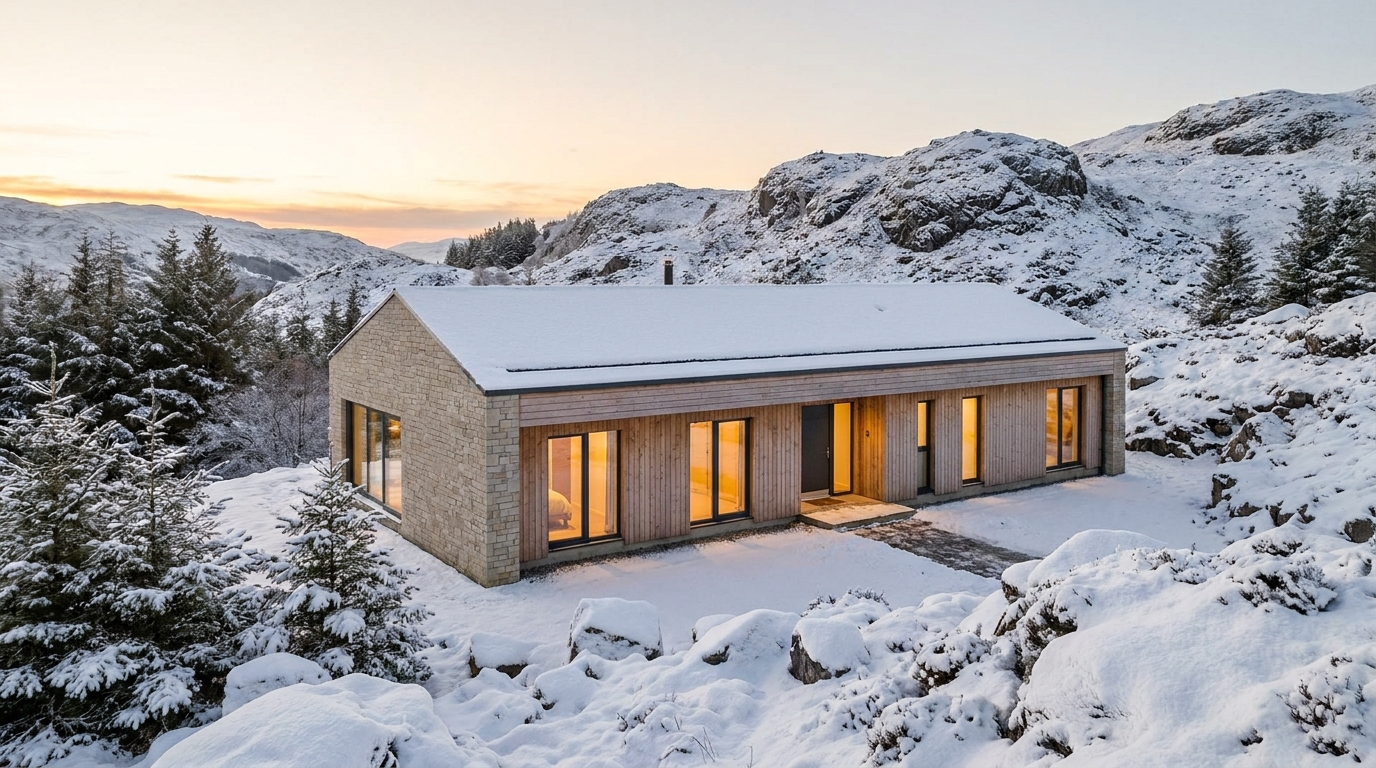
Industrialized Passivhaus in Spain
How a Passivhaus Conquered an Extreme Site: Project Beginnings
They chose a windswept cliff plot and completed a certified Passivhaus in under 10 months from permit to handover — on a fixed price. That opening fact framed every decision: speed, certainty and performance.
Owner motivation and energy targets
The owners were a young family returning from abroad with three clear priorities: near-zero energy use, healthy indoor air for their children, and predictability in budget and schedule. Instead of a piecemeal renovation or a traditional build, they wanted a modern, durable home they could maintain easily for decades.
Target: Passive-house certification (≤15 kWh/m²·year heating demand) and total primary energy below 60 kWh/m²·year.
Plot selection and local climate analysis
The selected parcel faced strong seasonal winds and high solar radiation in summer, with moderate winter temperatures but significant night-time cooling. A simple microclimate study showed:
- Prevailing NW winds up to 45 km/h in winter storms.
- High summer irradiance requiring shading strategies.
- Low soil bearing variability — suitable for a shallow foundation solution.
These constraints pushed the project toward a compact form, robust envelope and controlled mechanical ventilation.
Why industrialized housing over traditional construction
Three decisive advantages made industrialized construction the logical choice for this site:
- Time certainty: off-site fabrication reduced on-site exposure to storms and allowed a guaranteed completion window.
- Price control: fixed-price packages reduced contingency and change-order risk.
- Quality and airtightness: factory-controlled assembly achieved repeatable seals and higher insulation continuity than many on-site trades.
Design and Materials Selected to Withstand Extreme Conditions
Choosing the structural system: concrete, timber frame or steel?
We evaluated three systems for resilience and carbon impact:
- Industrialized concrete panels — excellent thermal mass and durability against winds and moisture, but higher embodied carbon unless using mixed cements or supplementary cementitious materials.
- Light timber frame — low embodied carbon, rapid fabrication and excellent insulation continuity; best when protected from direct moisture during assembly.
- Steel frame (steel frame) — very precise and robust for large openings, but requires careful thermal bridging detailing and corrosion protection.
The final hybrid decision combined a precast concrete ground floor plate and plinth with an industrial timber-framed upper enclosure. This balanced durability, embodied emissions and airtight detailing.
Passivhaus solutions: envelope, airtightness and thermal bridges
To meet Passivhaus limits the team implemented:
- Continuous insulation: 220–300 mm of high-performance insulation in walls and roof, layered to avoid compression and thermal bridging.
- Airtight membrane and taped junctions: all penetrations were detailed in the factory and inspected with a test protocol before transport.
- Thermal-bridge strategy: prefabricated insulated connections and thermal breaks at steel-to-concrete interfaces.
These measures delivered an as-built airtightness of n50 = 0.28 h-1 — comfortably within Passivhaus targets.
Sustainable materials to reduce carbon and ensure longevity
Material choices focused on embodied carbon and lifecycle durability:
- Cross-laminated timber (CLT) in roof panels and certain wall elements, sourced from well-managed EU forests.
- Low-clinker concrete for the plinth and foundation, reducing embodied CO2 by ~25% vs standard mixes.
- Recycled metal flashings and locally quarried stone accents for façades to minimize transport emissions.
Factory Production and Speed On Site: Closed Timelines and Quality Control
Workshop prefabrication, finishes and documentation
Production followed a strict factory workflow:
- Digital BIM models drove panel cutting and service coordination.
- Quality control checkpoints at insulation, membrane application and joinery installation.
- Photographic and test documentation compiled into a build dossier handed to the client.
Benefit: defects detected in the workshop avoided costly rework on site and improved predictability.
Assembly on site and logistics under adverse weather
Because panels arrived partially finished and protected, on-site assembly was accomplished in 12 days for the superstructure. Key logistics steps that made this possible:
- Pre-scheduled crane parks and temporary wind barriers.
- Just-in-time delivery windows coordinated to avoid storm days.
- Local subcontractors trained in modular connections to minimize on-site mistakes.
Real comparative times and costs versus traditional build
Actual project metrics compared to a matched traditional project of similar size and specification:
- Design-to-permit: 4 months (same as traditional, thanks to early-engagement of the architect and structural engineer).
- Factory production: 8 weeks (traditional on-site framing 8–12 weeks).
- On-site assembly and finish: 10 weeks total for the industrialized home vs 30–40 weeks median for traditional.
- Cost: final fixed price was within 5% of a conservative traditional estimate when factoring fewer contingencies, lower labour overruns and shorter financing periods.
Turnkey Service and the Client Experience: End-to-End Support
Stages of our turnkey offering
The project followed a clearly defined turnkey map, which reduced friction for the owners:
- Parcel search assistance and feasibility review.
- Technical design, Passivhaus certification paperwork and permit submission.
- Factory manufacture, site assembly, commissioning and snagging.
- Finishing services and final handover with maintenance briefing.
Transparent communication and expectation management
Weekly progress updates, an online client portal with photos and documents, and scheduled decision checkpoints limited surprises. When wind delayed a crane lift by three days, the team presented a revised timeline and cost-neutral mitigation plan within 24 hours.
Client satisfaction: metrics and testimonies
Measured outcomes after 12 months in occupation:
- Net promoter score (NPS): +72.
- On-budget delivery: 98% of the quoted turnkey price was final (small variations due to personalized finishes).
- Client testimony: “We have a predictable monthly cost, superior indoor comfort and no surprises. The fixed price and fast delivery were vital for our young family.”
"The factory-made envelope saved us weeks of bad-weather delays, and the airtightness meant our heating use dropped to levels we hadn’t expected."
Measurable Results: Energy Efficiency and Comfort in Numbers
Consumption before and after: kWh/m²·year and Passivhaus compliance
While there is no 'before' for a new build, the expected baseline was a conventional new-build consumption of ≈60–90 kWh/m²·year heating demand. The industrialized Passivhaus achieved:
- Heating demand: 12 kWh/m²·year (measured, certified under PHPP and verified on site).
- Total primary energy: 52 kWh/m²·year including domestic hot water and electricity.
These figures placed the home well within Passivhaus thresholds.
Carbon reduction and a simplified life-cycle analysis
Preliminary life-cycle comparisons showed a 25–30% reduction in embodied carbon when combining low-clinker concrete and high timber content versus an all-concrete solution. Operational carbon is dramatically lower due to low heating and efficient ventilation.
Comfort and indoor air quality indicators reported by occupants
Post-occupancy monitoring recorded:
- Indoor temperatures maintained within 20–24°C during winter without active heating for most daytime periods.
- Relative humidity between 35–55% year-round, thanks to balanced ventilation with heat recovery.
- PM2.5 levels consistently below outdoor averages, improving perceived air quality for the family.
Lessons Learned and Recommendations for Self-Builders in Extreme Environments
How to choose the right system and suppliers
Key selection criteria we recommend:
- Pick a supplier with verified Passivhaus experience and demonstrable airtightness results.
- Prefer modular systems with factory QA documentation and a clear warranty on airtightness and thermal performance.
- Insist on a fixed-price turnkey contract with defined milestone payments tied to deliverables.
Financing tips: self-builder mortgages and project funding
Financing autopromotion typically blends a plot mortgage with staged construction draws. Practical tips:
- Prepare a detailed turnkey quote and cashflow plan for lenders.
- Ask lenders for product flexibility to shorten the construction phase — shorter builds lower interest on interim loans.
- Use the fixed-price nature of industrialized housing as evidence of lower financial risk.
Replicating success: a checklist to design an industrialized Passivhaus in Spain
- Site analysis: wind, sun path, soil and access constraints.
- Choose hybrid systems suited to the microclimate (concrete plinth + timber envelope recommended for coastal, windy sites).
- Define airtightness and insulation targets early; detail junctions in the design phase.
- Engage a turnkey supplier with Passivhaus certification experience.
- Secure financing that recognises shorter construction timelines.
- Plan for post-occupancy monitoring to validate performance and catch issues early.
Final thought: Industrialized Passivhaus construction turns climate and weather from adversaries into constraints that strengthen design. The result for this family was not only lower energy bills but measurable health and comfort gains.
If you're planning a self-built home in Spain and want reliable timelines, predictable budgets and certified energy performance, consider treating factory-made construction as a strategic tool — not a compromise.
Ready to explore a tailored solution for your plot? Contact an experienced industrialized housing team to start with a microclimate check and a fixed-price feasibility study.