Prefabricated House vs Traditional Build: Clear Advantages
Why industrialized housing is gaining ground in Spain
When a family sold their flat and found a plot near town, they expected a two-year nightmare of noise and uncertainty—what they got was a finished home in nine months. That shift from open-ended construction to predictable delivery explains why many Spanish self-builders now consider a prefabricated house first.
The reasons go beyond speed. Industrialized housing centralizes quality control, shortens on-site work, and fixes many variables that traditionally derail projects. This section summarizes the practical advantages, the ideal autopromoter profiles, and where the market is heading in 2026.
Advantages versus traditional construction: efficiency, cost control and predictable schedules
- Predictable timelines: Factory workflows and parallel tasks reduce on-site exposure to weather and subcontractor gaps.
- Cost transparency: Standardized modules and fixed-scope turnkey contracts lower the risk of surprise costs.
- Higher quality control: Repeated factory processes improve workmanship consistency and testing before delivery.
- Less disruption: Shorter on-site periods reduce neighbour impact and urban logistics complexity.
Who are the ideal self-builders (autopromotores)?
- Families seeking predictable schedules and fixed budgets.
- Owners of small urban plots with limited onsite staging room.
- Buyers prioritizing energy performance and low lifecycle costs.
- Clients willing to work within a defined module and specification set to gain speed and price certainty.
Market snapshot 2026: key figures and trends
By 2026, adoption of industrialized housing in Spain has grown across peri-urban and suburban projects. Typical indicators: shorter average construction times (-30% to -60%), rising demand for certified energy performance homes (Passivhaus-inspired designs), and improved access to autopromoter financing. Urban logistics and in-situ assembly techniques have evolved to reduce street-level disruption during installation.
Industrialized deliveries in Spain now routinely reduce on-site assembly time to under 6 weeks for the envelope—transforming planning risk into a bankable schedule.
Technical comparison: prefabricated vs traditional
This section provides concrete metrics and a balanced assessment so you can decide on the best approach for your project.
Construction timelines and realistic schedules
Typical comparative examples (for a single-family 150 m² house in a suburban Spanish plot):
- Traditional build: Permits to handover: 18–30 months. On-site structural and finishes work: 10–18 months. Weather and subcontractor coordination account for most delays.
- Prefabricated house: Permits to handover: 10–16 months. Factory production: 8–12 weeks. On-site assembly and finishes: 6–12 weeks. Critical path often moves to site preparation and connections rather than structure.
Actionable tip: build your project schedule around permit lead times and utility connections—these are frequently the gating items for both approaches.
Build quality and durability: materials and factory controls
Factory environments allow standardized QA checks that are harder to enforce on-site.
- Quality advantages: controlled curing (for concrete), repeatable thermal insulation installation, integrated air-tightness testing before delivery.
- Durability risks: proper detailing at component junctions (foundations, balconies) still depends on on-site execution; choose suppliers with robust installation protocols and warranties.
Total cost and variability: fixed prices, contingencies and maintenance
Prefabricated models typically offer a firm contract price for the defined scope. Traditional builds tend to have more contingency exposure.
- Prefabricated: Lower budget variance; easier to secure financing once price and schedule are fixed. Watch for extras (site adaptation, bespoke finishes).
- Traditional: More flexibility for bespoke changes, but higher risk of cost overruns and longer financing drawdown periods.
- Maintenance: Lifecycle costs often favor modern prefabricated solutions due to better insulation and reduced thermal bridging.
Modern materials and their impact on urban assembly
Choice of structural system affects logistics, on-site time and urban compatibility. Below are the main contemporary options and how they perform in tight city contexts.
Industrialized concrete: structural performance and urban assembly
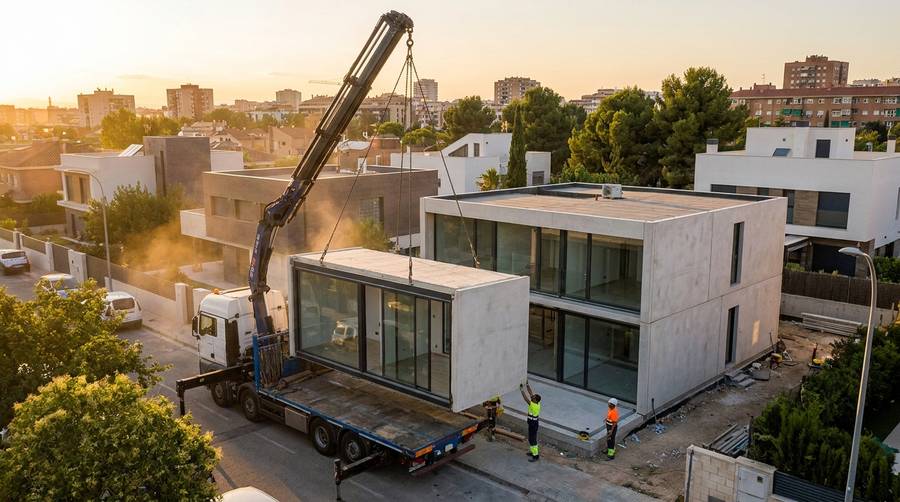
Precast concrete panels and elements offer high structural robustness and acoustic performance. In cities, their weight and crane requirements matter.
- Pros: fire resistance, durability, excellent acoustic insulation.
- Cons: requires heavy lifting equipment and careful street logistics; best when assembly windows and permits for crane use are secured early.
Light timber frame: speed, insulation and planning considerations
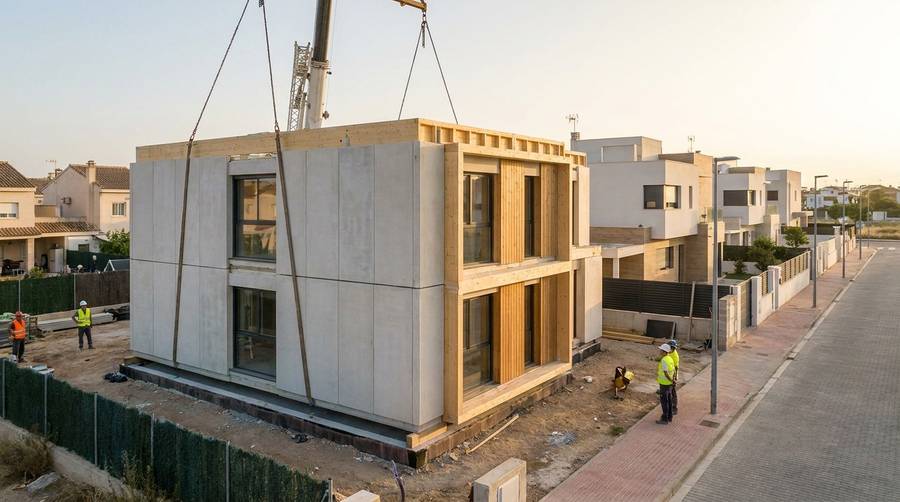
Entramado ligero de madera (light timber frame) is growing as a preferred option for energy-efficient houses. It excels in thermal performance and speed.
- Pros: rapid assembly, excellent thermal and hygrothermal behavior, lower embodied carbon than concrete.
- Cons: requires careful detailing for fire regulations and local urban codes; may face restrictions in some historic or strict urban zones.
Steel frame: logistical compatibility and on-site efficiency
Steel framing balances lightness and strength, enabling larger spans and reduced on-site times.
- Pros: compact elements, efficient for narrow access sites, predictable tolerances for finishes.
- Cons: thermal bridging must be addressed with thermal breaks and continuous insulation systems.
Sustainability and energy efficiency: what industrialization brings
Industrialized housing is well suited to meet ambitious energy goals with repeatable performance. Below are practical ways it contributes.
Designing for Passive House and lowering carbon footprint
Prefabrication facilitates consistent implementation of airtightness, continuous insulation and thermal bridge-free details—key for Passivhaus-level performance.
- Factory assembly allows pre-testing of airtightness and component-level insulation.
- Combining high-performance windows and simple mechanical ventilation with heat recovery yields measurable energy reductions.
Energy savings and certifications: measuring long-term benefits
Certifications (nZEB, Passivhaus components) make savings tangible. Expect operational energy savings of 50%–80% compared to poorly insulated traditional stock depending on systems chosen.
Recyclable materials and waste management
Factories optimize material use and collect offcuts for recycling—reducing on-site waste volumes significantly. Ask suppliers about their end-of-life strategies and recycled content percentages.
Turnkey delivery: from plot selection to handover
A true turnkey approach reduces the buyer's coordination burden. Here are the practical phases and what to verify at each stage.
Plot search and preparation in urban settings
- Assess servitudes, building envelope constraints and access for delivery vehicles.
- Confirm connections (water, sewer, power) and stormwater requirements; unresolved utilities commonly delay projects.
- Obtain early technical reports (soil study, topography) to prevent unexpected foundation works.
Logistics and on-site assembly in cities: cranes, transport and closed durations
Effective coordination includes booking crane windows, street occupation permits and neighbour communication. Short, intense assembly windows are an advantage—less time with heavy traffic and fewer noise complaints.
Handover and commissioning: guarantees and checklists
At delivery, require a documented checklist: warranties, as-built drawings, test certificates (airtightness, HVAC), and an agreed snagging protocol with timelines. Client satisfaction correlates strongly with transparent documentation and a clear defects resolution path.
Financing and mortgages for self-builders and modular housing
Financing modular or industrialized housing is increasingly mainstream in Spain, but banks require clear documentation and staged disbursement plans.
Financing options in Spain: self-build mortgages and current conditions
- Self-build (autopromoción) mortgages: banks disburse in tranches tied to milestones (site prep, foundation, envelope, completion).
- Some lenders treat turnkey prefabricated projects like conventional mortgages once final valuation and certificates are provided—this simplifies the client experience.
How to present a modular project to a bank
Prepare a consolidated dossier that includes:
- Fixed-price contract and detailed payment schedule from the supplier.
- Production and delivery timeline with procurement and crane windows.
- Technical documentation and warranties for structural elements and energy systems.
Strategies to optimize finance costs and drawdowns
- Negotiate a fixed-price turnkey contract to reduce contingency margins requested by banks.
- Align tranche releases with factory production milestones to minimize interest on capital not yet used on-site.
- Consider bridging products only if the bank requires staged security; minimize overlap between mortgage and interim financing.
Practical conclusion: how to decide between prefabricated and traditional
Choosing the right method depends on priorities. Below is a decision checklist and recommended use-cases.
Decision checklist for self-builders
- Priorities: speed and schedule certainty vs maximum design freedom?
- Budget: do you need a fixed price to secure financing?
- Site constraints: limited access or tight urban plots favor prefabrication.
- Energy goals: pursuit of Passivhaus or nZEB favors industrialized methods for predictable performance.
- Customization: simple to moderate bespoke finishes are feasible; highly bespoke forms may fit better with traditional construction.
Recommended use-cases
- Choose prefabricated if you want a predictable schedule, certified energy performance and controlled costs.
- Choose traditional if your project demands highly irregular forms, extensive on-site adaptation or incremental construction phasing.
Next steps: planning a technical consultation and getting a real quote
Start with a short technical meeting that includes a site review, a preliminary soil report and an outline of your budget and timing. Many clients find it useful to request two comparable proposals—one turnkey prefabricated and one traditional—to quantify differences.
For a practical example of a finished industrialized project and metrics on time and client satisfaction, see this detailed case study: Vivienda industrializada: caso real de éxito.
Decide based on measurable priorities—time, budget, energy—and not on myths. When correctly specified, a prefabricated house often delivers superior value and lower lifecycle cost for Spanish self-builders.
Ready to evaluate your plot? Request a feasibility review that compares both approaches side-by-side with a realistic timeline and financing outline. That first comparative quote will clarify trade-offs and let you choose with confidence.